Wednesday, November 2, 2011

Ag Bill Passes Without Prohibition Against Federal Horse Meat Inspectors

Straight from the Horse's Heart

Story by Steven Long ~ Publisher of Horse Back Magazine

Horse-Eaters Sink to New Lows

HOUSTON, (Horseback) – Horse slaughter enthusiasts got a rare victory, of sorts, when the United States Senate passed an agriculture appropriations bill that did not contain a provision banning horsemeat inspections at U.S. slaughter plants. HR 3233, will now move to conference committee where conferees will hammer out the final legislation that will be passed by both houses of Congress.
A provision banning the use of federal meat inspectors at horse slaughter facilities has been included in every ag money bill since 2007. That, along with laws outlawing slaughterhouses in Texas and Illinois, and a U.S. Supreme Court ruling upholding those laws, spelled  doom for the American horse slaughter industry.
A house version of the bill still contains the provision banning use of federal tax dollars to pay meat inspectors in the facilities. No horse slaughter plants currently operate in the United States where horses are not raised for food and. The overwhelming majority of American horses are treated with phenylbutazone (Bute), banned by the FDA in all food animals.
"Slaughterhouse" Sue Wallis Hits a New Low
In a release issued late Tuesday, United Horseman, a small organization made up mostly of stockmen and horse breeders who sell their culls to abattoirs across the U.S. border, stated, “Our dedicated networks of horsemen and horsewomen are making a difference, KEEP IT UP!”
“Now is the time for the horse people of America to take back the reins of our industry,” it said.
he release, issued over the Internet, showed the head of a dead horse with the caption, “Animal rights activists saved me from slaughter.” There was no explanation from the group of what that meant, but in the paragraph below they wrote, “Radical animal rights anti-slaughter proponents have nothing to do with animal agriculture or animal husbandry…they should not be speaking for horses, or what is in the best interests of animals or people who make their living with them.”
The group is headed by Rep. Sue Wallis, (R) Wyoming, of rural Recluse. It is reported that although she claims to speak for the entire horse industry, Wallis does not own a horse.
The resumption of horse slaughter has strong support from powerful breed associations such as the American Quarter Horse Association, the Arabian Horse Association, and veterinary organizations. The influential American Horse Council, while claiming neutrality on the issue, has quietly supported resumption of slaughter.
Opponents of the practice offer graphic sill photos and videos literally by the thousands of unspeakable cruelty to horses in the slaughterhouses and on transport trucks. Two years ago an expose of practices in Mexican facilities showed horses being maimed by being stabbed in the neck with a sharp knife.
The horses, still living, are hoisted up by the hind legs and bled to death.  In a recent scandal in Presidio County, Texas, the carcasses of dead horses from a slaughter holding facility was dumped into a flash flood prone creek during hurricane season. The creek feeds into the heavily used Rio Grande River that separates the U.S. from Mexico where a slaughter house is located just across the border.
Many equine humanitarians also oppose use of the unwieldy captive bolt gun on prey animals such as the horse where misses are as frequent as hits. The captive bolt must strike the horse on the pole precisely on the top of the head.


Federal Court grants wild horse groups' request to intervene aiming to destroy nearly half of Wyoming's wild horse herdshe

The Cloud Foundation


Cross-posted from AWHPC:
For immediate release

Federal Court grants wild horse groups' request to intervene aiming to destroy nearly half of Wyoming's wild horse herds

Cheyenne, Wyoming (November 2, 2011) . . . Today, the U.S. District Court for the District of Wyoming, granted intervenor status to the American Wild Horse Preservation Campaign, a national coalition, and two of its coalition partners, the International Society for the Protection of Mustangs and Burros (ISPMB) and The Cloud Foundation, in the case of the Rock Springs Grazing Association (RSGA) vs. the U.S. Department of the Interior. The lawsuit seeks removal of all wild horses on public and private lands in the southern Wyoming. The motion was filed by the highly regarded, public interest law firm Meyer, Glitzenstein and Crystal.

At stake is the future of nearly half of Wyoming’s remaining wild horses living on a two-million-acre swath of private and public land known as the “Wyoming checkerboard.” The area includes four wild horse Herd Management Areas – Salt Wells Creek, Great Divide Basin, White Mountain and Little Colorado – administered by the Interior Department’s Bureau of Land Management (BLM).

In granting the organizations’ request to intevene, the court stated, “Certainly the relief requested by Plaintiff would impact the number of wild horses roaming the Wyoming Checkerboard on both private and public lands. Further, it appears that agreements negotiated between RSGA and wild horse advocacy groups played a significant role in the earlier litigation and BLM’s stated management objectives regarding wild horses in the Wyoming Checkerboard areas….” (See court order here.)

“We are pleased that this court decision will allow us to be a voice for the future of Wyoming’s mustangs,” said Karen Sussman, president of the ISPMB, the oldest and largest wild horse advocacy group in the nation. “As a party to the original agreement establishing population levels in this area, we will vigorously defend the Wyoming’s wild horses and work toward an agreement that keeps them free where they belong on our public lands.”

“We are intervening to ensure that the Department of Justice, representing the BLM, will fight just as hard to protect the wild horses as they have fought challenges by wild horse advocates seeking their protection,” states Ginger Kathrens, Executive Director of the Cloud Foundation. “It comes as no surprise that the largest ‘welfare ranching’ organization in the nation threatens the future of thousands of federally protected mustangs in southern Wyoming.”

“Since we cannot count on the federal government to stand up for Wyoming’s wild horses, we must intervene in this case to ensure that the federal law protecting mustangs is upheld,” said Suzanne Roy, AWHPC Campaign Director. Roy noted that the RSGA complaint indicates that the Department of Interior invited the lawsuit as a mechanism for getting Congress to appropriate more funds for wild horse roundups.

The RSGA lawsuit was filed shortly after the AWHPC, joined by the Western Watersheds Project, filed a lawsuit against the BLM over the plan to castrate free-roaming stallions living in the White Mountain and Little Colorado HMAs. The BLM withdrew the plan in the face of the AWHPC legal action, which was also brought by Meyer, Glitzenstein & Crystal.

The RSGA controls about 2 million acres of rangeland in southern Wyoming, in an area 40 miles wide by 70 miles long that runs along the historic transcontinental railway corridor. RSGA members graze approximately 50,000 to 70,000 sheep and about 5,000 cattle on deeded private lands and leased public lands. By contrast, just 1,100- 1,600 wild horses are thought to roam the area.

Thanks to taxpayer subsidies, RSGA members graze livestock on public lands for approximately one-twelfth (1/12) market rate. The RSGA complaint, filed on July 27, 2011, seeks a court order that will (a) result in removing all wild horses from private lands in the Wyoming Checkerboard area, and (b) declare that the BLM “must remove all of the wild horses that have strayed onto the RSGA lands and the adjacent public lands within the Wyoming Checkerboard.”

# # #

The American Wild Horse Preservation Campaign (AWHPC) is a coalition of more than 45 horse advocacy, public interest, and conservation organizations dedicated to preserving the American wild horse in viable, free-roaming herds for generations to come, as part of our national heritage.

International Society for the Protection of Mustangs and Burros, founded over 50 years ago, was instrumental in securing the enactment of the 1971 Wild Free-Roaming Horses and Burros Act, the landmark federal legislation that established protections for wild free-roaming horses and burros on public lands in the West.

The Cloud Foundation is a non-profit dedicated to the preservation and protection of wild horses and burros on our Western public lands with a focus on protecting Cloud’s herd in the Pryor Mountains of Montana.


Tuesday, November 1, 2011

Animal Abuser – Therapy or Jail?

Straight from the Horse's Heart

Guest OpEd by Jerry Finch ~ President of Habitat for Horses

Animal Abusers are one step away from Serial Killers

“One of the most dangerous things that can happen to a child is to kill or torture an animal and get away with it.” -Anthropologist Margaret Mead
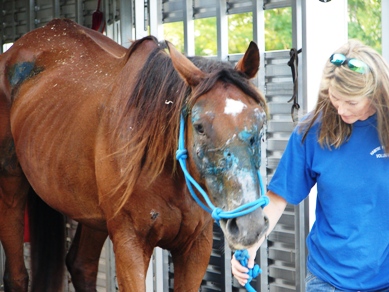
Naysa Rescued June 9, 2007 ~ photo courtesy of Habitat for Horses
As part of my less formal education I attended a course from HSUS called “First Strike – The Violence Connection.” While the material presented was shocking, the conclusion fits like a glove onto every scenario of animal abuse and neglect that I’ve witnessed. The bottom line is that when you see a person who is guilty of animal abuse, you are also looking at a person who has no problem beating the hell out of another human. Animal abuse is a proven predictor of violent behavior.
The FBI considers past animal abuse not only as a predictor of human violence, but uses it when profiling serial killers.  In one study alone 70 percent of women seeking shelter from physical abuse report that their partners had threatened, injured or killed one or more family pets.
There is no doubt about the connection. Anyone who is even vaguely and remotely interested in the subject can Google “animal abuse and human violence” and have instant access to over 2.7 million articles. Those articles are not hidden from law enforcement or the judicial system. No one is telling the prosecutors, “Oh, don’t look at that stuff. Doesn’t mean anything.”
So the question of the day is – why do those who beat, starve and kill animals receive little more than a slap on the wrist? What part of the statement, “…a predictor of human violence….,” does our judicial system not understand?
Case in point – Naysa was a bone thin mare, sold at an auction in Louisiana and, when she was reluctant to load in a trailer, the owner made a halter of barbed wire, tied her to the trailer, pulled her half a mile down the road, shot her in the head and left her in a ditch. (She survived, came to HfH for rehabilitation and now is living happily in Florida) After two and a half years and a zillion letters from all over the world to the District Attorney, the owner, father of several children and a “horse trainer,” admitted he was guilty and received a probated sentence, which was nothing more than, “Ya’ll don’t be doin’ that no more, ya’ hear?”
Jason Meduna, former owner of the Three Strikes Ranch in Nebraska, killed countless horses, starved hundreds more, claimed his neighbors were poisoning them (I’m still searching for the type of poison that causes starvation, massive worm infestations and snow-shoe hooves), spent 20 months in jail and is now free to wander around Wyoming. Think he has an ounce of remorse for his deeds? Do you really think he learned anything?
Montana Large Animal Sanctuary and Rescue – we pulled 1,200 animals out of there in the middle of winter, starved, too weak to walk, complete lack of even the basic level of care, and to this day, no one has had to answer to a single person about the indescribable horror those animals went through or the endless death we witnessed. Oh, the DA is very proud of his case file. It’s right up there on his bookcase. The bad guys can be found down at the coffee shop.
Habitat for Horses is one humane organization out of thousands that deal with the victims of abuse on a daily basis. There isn’t a single active animal rescue organization that doesn’t have a horror story they could share, nor one that doesn’t look back in revolting disgust at the weak-kneed, “couldn’t care less” attitude of the judicial system.
I well remember talking with the Assistant DA in the Naysa case as he explained the delay in taking the case to trial, “We have a murder case, two rapes, I don’t know how many assaults. These animal cases just get pushed back.” As much as I tried to explain it to him, he wasn’t interested.
“Have you checked on his kids?” I asked. The blank look was all the response I needed.

Click (HERE) to read the rest of the story at the HfH Blog