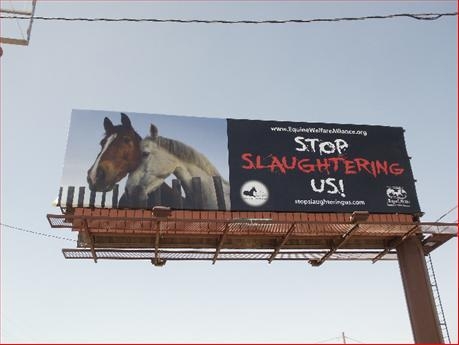
Thursday, March 8, 2012

Community Speaks Out Against Horse Slaughter in Missouri

Wayne Pacelle, HSUS blog

Sue Wallis, a Wyoming state representative and the most visible booster for horse slaughter in the United States, took it on the chin the other day in Missouri, as local residents strongly opposed her proposal for a horse slaughter plant near the Mountain Grove community of nearly 5,000. There were about 300 angry residents who packed the town council meeting at the Mountain Grove Senior Center and wanted nothing to do with such an enterprise in their town. They knew that profits would be slim, and that they’d also be getting too large a share of pollution problems, reduced property values, and animal cruelty bound up with this industry.
The community's resounding rejection of the proposal put the lie to Wallis’s prior claim that “the folks in Missouri are 100 percent on board with what we’re trying to do and how we’re trying to do it.”
Horse transport to slaughter
Kathy Milani/The HSUS
Some people want to become firefighters, to help people in the developing world, to open up a legitimate business, or to serve their country, in one form or another. As for Sue Wallis, she just seems to want to help kill horses. It’s hard to know at any given time whether she is operating as an elected official, a rancher, an investor, or a prospective manager of a slaughter plant. For her, it seems that all roads lead to an equine abattoir.
The message Sue Wallis got the other night came from local people who were being asked to live with a horse slaughtering plant in their midst, and it was consistent with what we know of public opinion on the issue. In poll after poll, the majority of Americans―urban, suburban, and rural―have signaled their disapproval of horse slaughter, especially for sale of the meat in the global marketplace.
Representatives of the horse slaughter industry need to stop their excuse-making for horse owners who abandon their animals, or who only want to profit from them by selling them to a kill buyer. The horse slaughter business is predatory, cruel, and marginal. Even communities trying to attract business want nothing to do with it, despite the efforts by a handful of politicians who see just a bundle of tissue, sinew, bone, and hair rather than living, feeling animals who have played no small role in the history of our nation.

Wednesday, March 7, 2012

Updates: Two States Where Slaughter Goes DOWN!

Equine Welfare Alliance:

Illinois:
 "Good news everyone! The bill to repeal the ban on horse slaughter in IL has been referred to legislative Siberia...aka "subcommittee"! This effectively kills the bill for the spring session!

Thanks to all for your help in beating this back!!"

Missouri: Horseback Magazine

Missouri Plant Goes Down in Defeat as Slaughter Spokesman Booed at Mountain Grove Council Meeting

March 6, 2012
Mountain Grove Rejects Horse Slaughter Plant
Sue Wallis Photo Courtesy Wyoming State Internet Site


MOUNTAIN GROVE, MO  (EWA) – A much publicized proposal to locate a horse slaughter plant in Mountain Grove, Missouri was soundly rejected by the Mountain Grove town council tonight. The meeting was attended by a capacity crowd of about 300, with many people being turned away and others sitting in areas where they could not see or hear.
The plan, proposed by Sue Wallis of Unified Equine, was to use land just east of the town of Mountain Grove to build a facility to slaughter horses. Wallis had claimed that she chose the location because people in the area were “100% behind what we are doing and 100% behind how we are going to do it.”
The first cracks in her plan happened just days earlier when Dr. Temple Grandin, who Wallis said was to design the plant, publicly stated that she knew nothing about it.
According to Wallis, Chevideco NV, a Belgium corporation with slaughter houses in several countries, was to be her backer and partner. Chevideco was the company that owned the Dallas Crown slaughter house in Kaufman Texas. In 2007, Dallas Crown was closed under an old state law.
Cynthia MacPherson of MacPherson Law Center in Mountain Grove made a blistering and lethal case against the plant. Unfortunately for Wallis, the decades long record of their many sewer and environmental violations was brought out at the meeting along with many other disturbing facts. In just 19 months of operation the plant had 481 sewer violations. At one point the town of Kaufman had ordered Dallas Crown closed, but the plant had managed to delay the order through a protracted legal battle.
At the end of her presentation, MacPherson showed a power point presentation detailing the devastation of communities caused by Dallas Crown and two other horse slaughter facilities.
In a document supplied to the town, Wallis had addressed some of the issues she knew would surface. On crime, she said it was not likely that crime would increase as a result of the slaughter plant, but MacPherson showed that the closure of Dallas Crown resulted in a huge reduction of crime, discrediting Wallis’ prediction.
• Murders dropped from an average of .5/100,000 a year to 0.
• Rapes dropped from an average of 6/100,000 a year to 0.
• Robberies dropped 65%
• Assaults dropped 61.2%
• Thefts dropped 71.2%
• Auto thefts dropped 83.3%
Wallis held a place on the agenda which she delegated to Roger Lindsey of IDC (Intercity Development Council), the owner of the land in question. The IDC is consortium of which Mountain Grove owns a one-sixth share.
The community opposition was nearly unanimous and when Roger Lindsey rose to speak in favor of the plant he was booed and heckled. The Mayor gaveled the crowd down three times and threatened to clear the room if order was not restored.
The plant is the third announced publicly by Sue Wallis. In recent years she had announced that she was going to use the Cheyenne Stockyards as a mustering point for horses, and when that did not materialize she announced a plan to build a mobile slaughtering facility that would travel around Wyoming slaughtering horses. Reports indicate she is going to try other towns in Missouri.
In a quote to Equine Welfare Alliance, Cynthia MacPherson said “if they move their plans to another town, we will be right behind them!”
#
The Equine Welfare Alliance is a dues-free 501c4, umbrella organization with over 220 member organizations and hundreds of individual members worldwide in 18 countries. The organization focuses its efforts on the welfare of all equines and the preservation of wild equids.


Monday, March 5, 2012

Bureau tarts up the same tired horse program - Pickens

Horsetalk

March 6, 2012

Wild horse advocate Madeleine Pickens has accused the Bureau of Land Management (BLM) of tarting up its same tired program for mustangs and offering it up as something new.
Pickens, the wife of Texas oil tycoon T. Boone Pickens, was responding to news a week ago that a private ranch in southeastern Wyoming may soon become the first wild-horse eco-sanctuary in the United States to be run in a deal with the Bureau of Land Management. The foundation Pickens founded, Saving America's Mustangs, has been pushing for more than two years to establish an eco-sanctuary for wild horses in northern Nevada.
Pickens said the foundation wanted to express its appreciation for the bureau's selection of the 4000-acre ranch in Wyoming to house some wild horses, but said the proposal raised more questions than it answered.
"It continues along the outdated and inhumane path the BLM has pursued for years; continuing to give wild horses to private ranch operations that profit from them without assurances of a real public benefit," Pickens said.
She noted that the bureau had suggested it could carry out the necessary National Environmental Policy Act (NEPA) compliance work in three to six months.
"I have been waiting for over two years and have been told all along that the NEPA compliance work on the proposal that I submitted for an eco-sanctuary in northern Nevada would take as long as two years, if they ever start on it.
"I can only presume that there is a special, unique 'fast track' for a rancher where NEPA is concerned.
"When I met with representatives of the Elko County Commission to discuss my proposal for a ranch in northern Nevada, I was told by the ranchers that taking only a thousand head wouldn't really save the government and taxpayers that much money and, therefore, wasn't worth much.
"Why then is a rancher taking 250 head cause for celebration, or is this just more double-talk?
"And, why is it a 'milestone' to continue the same tired, flawed model by which horses are gathered in the wild and turned over to ranchers who are paid a stipend by the BLM, instead of coming up with a humane plan which has a return to the public?
"The bottom line is this: the BLM tarts up the same tired program and marches it out as if they are offering the public and the wild horses a new experience and direction - when the reality is that it is just more of the same.
"I wait futilely for years while the BLM fiddles, instead of deciding to participate in a truly revolutionary project that would be ground-breaking and change the paradigm; different from business as usual, and they continue to putter on."
Pickens said her foundation did not want to criticize every small rancher who stepped forward with a plan to take some horses.
"Unfortunately, the BLM has, since its inception, run the Wild Horse and Burro Program for and at the direction of the ranchers.
"We think the American public is entitled to better, is entitled to see that those with the right intentions and solid proposals are included in the process."

Sunday, March 4, 2012

Some Hang On Tight to Cowboy Life

MyFoxPhoenix


SCOTTSDALE, Ariz. - Part of the appeal of Arizona for many is the western culture. Question -- when is the last time you've gone horseback riding, been to a ranch, enjoyed a campfire or for that matter, seen a cowboy? The real West is fading, but how far gone is it?

It was a typical weekend night at a Scottsdale watering hole, with a country band, cowboys and cowgirls in full swing -- part of the cowboy culture that some say is all hat and no cattle -- so-called Urban Cowboys.

You can also find many Western cowboy experiences aimed mostly at tourists.
“It’s really nice to be in nature on horses, because you don’t get to see them every day, and you don’t get to see Arizona mountains,” said one person.
But where's the real deal? Does it still exist in the valley?
“A southwestern culture, maybe, but the cowboys are getting pushed out more and more these days -- making it hard for them to make a living,” said Rusty Bates, of the D Spur Ranch.
At 27, Bates makes a living working for Shelley Donnelly on her D Spur Ranch, just East of Gold Canyon, in the east Valley.
Bates is the only ranch hand on the ranch.
“You know, we’re not in it for the money. It’s the lifestyle,” said Shelly Donnelly.
Donnelly is a true western woman who loves the cowboy way so much that after her husband died, she continued to operate a 6,000-acre ranch.
It's not an easy life.
“No heat, no electricity -- for AC, I run on generators, and of course, the price of fuel makes it pretty expensive. So I don’t run my generator a lot, yet when I step out on my front porch and look at this, it’s worth it -- absolutely worth it,” she said.
The Superstition Mountains are her front yard. She raises about 50 head of Texas Longhorns because she likes them, and the tourists like them too.

It helps that the breed can practically survive on nothing, Donnelly said.

“They’re survivors. They’ve been around for many, many years. They’re really, really good beef animals – healthy,” she said.
Bates takes care of the cattle, the horses, the visitors -- and does just about every thing else. He doesn't complain, and as for relaxing, Fox 10 ask him where he hangs out.
“I work seven days a week, so I don’t have time for hanging out,” he said.

Out at the ranch, there are no computers, no smart phones, no TV. He doesn't go "into town" often – the town, Scottsdale.

Bates said some people he meets are a little perplexed by his lifestyle.

“Their first question is, ‘What do you do at night?’ I say, ‘I go to bed at night.’ It seems like a foreign concept. We've been out all day. It’s time for dinner, time to clean up and time to go to bed. That’s the simple life cowboys are known to live,” Bates said.
Donnelly and Bates make the most of the simple life. They fear that with the houses from nearby subdivisions getting closer, it may not be around for much longer.

They hope some pure form of the cowboy culture survives.
“I do believe it may not be as popular as in past years, but yes, I think there will always be a certain element that wants their horses and wants to be able to ride out and enjoy the countryside and chase some cows and throw a few ropes and live the cowboy lifestyle,” Donnelly said.

The Spur D Ranch is a working ranch that welcomes visitors every day of the week.
Arizona Cowboy: www.dondonnelly.com

Saturday, March 3, 2012

Wild Burro Gather: Cibola-Trigo HMA (Arizona)


Big Ag’s Own Secretary Gets a Dose of Horse Lover’s Contempt

Horseback Magazine

March 1, 2012
Wild Horse and Burro Advisory Board appointment draws a storm of protes
By R.T. Fitch, Straight From the Horse’s Heart
WASHINGTON (March 1, 2012) – The Department of the Interior has received thousands of calls today in protest to the appointment of Callie Hendrickson, an openly anti-wild horse, pro horse slaughter woman from Colorado to the National Bureau of Land Management (BLM) Wild Horse and Burro Advisory Board. Hendrickson was appointed to serve on the Board, representing the General Public. Callers contend that Hendrickson does not represent the vast majority of citizens who oppose the slaughter of horses and support the presence of wild horses on rangeland in the West.
“We’re proud that so many Americans are riding to the rescue of our wild horses,” states Ginger Kathrens, Executive Director of the Cloud Foundation and producer of the popular Cloud programs on PBS. “The appointment of Ms. Hendrickson is the latest in an alarming trend, considering that this Board recommends wild horse and burro management strategies to the BLM.”
“It appears that Sec. Salazar and his cattle baron friends are trying to stack the deck and turn back the clock to 2008 when they planned to slaughter the wild horses in holding”, said R.T. Fitch, volunteer President of the Wild Horse Freedom Federation, “But the public is not going to sit back and allow that to happen, this is a new world with an engaged American society and we are simply not going to stand for such bullying.”
Last June, Secretary Salazar appointed James Stephenson of Washington state to the Board. Stephenson spoke about the need for slaughter as a management option at the last National Advisory Board meeting in Washington D.C.
  • Currently, over 45,000 once-wild horses live in government holding facilities, double the number that wild horse advocates estimate are still living free on their designated ranges in the West.
  • 339 wild herds were identified for protection by the 1971 Wild Horse and Burro Act. Today 179 herds remain.
  • Wild horses and burros exist on roughly 31.6 million acres (11% of our public lands)—down from 53 million acres originally designated for their use.
  • 2-3 million head of privately owned livestock are permitted on 157 million acres of BLM lands.
  • Wild horses and burros compete for forage with livestock on 86% of their designated ranges where private livestock are allocated 83% of the forage.
  • Only 3 to 4% of all beef consumed in the United States comes from public lands grazing.
  • Public land grazing revenues total $23 million. Administration costs total $144 million, resulting in a yearly shortfall of $121 million.
Links of Interest:
Unified Equine Welfare Group’s Protest Press Release: http://wp.me/pyapj-3GZ
ASPCA Poll from Lake Research Partners shows 80% of Americans do not believe in horse slaughter: http://bit.ly/ySl7oG
R.T. Fitch OpEd on Hendrickson’s appointment: http://wp.me/pyapj-3GZ
10 Steps to Restore America’s Wild Horses & Burros: http://bit.ly/nWcJRh


Thursday, March 1, 2012