Thursday, August 2, 2012

Update: Pryor Mountain Wild Horse Range

BLM Website 


News and Information


Daily Gather Update  - August 2, 2012

At day's end yesterday, the BLM removed 1 male, 4 females and 1 foal from the Krueger Pond bait trap site. Horses removed from the range are being transported on the same day to Britton Springs, where BLM staff is monitoring the site. 
The BLM has also set an adoption date for the horses gathered and removed from this year's bait trap gather.  The date will be September 8, 2012, at the Britton Springs Corrals near Lovell, Wyo.  More details on the adoption will be posted within the next several days.  For general information on how to adopt a wild horse, please click here.
The BLM will continue to monitor horse patterns and work the trap site at the high elevations (Krueger Pond) today.  The National Park Service staff will also continue to monitor the trap sites in the lower elevations (Bad Pass and Layout Creek). Trap sites the horses are not heavily utilizing will remain open for the horses to pass in and out.
The BLM is aiming to gather and remove 30-40 excess wild horses from the range as identified in the Environmental Assessment.

As the bait gather progresses, the list of gathered and removed horses (with their given names as identified in the Environmental Assessment) will be made available every Friday on a weekly basis.  List of Names  More info at the site HERE.

Wednesday, August 1, 2012

Three Angels Farms owner involved in new company

ThreeNBC News Nashville


WSMV-TV
updated 1 hour 22 minutes ago

A Channel 4 News investigation has found that the owner of a Lebanon company shut down for trucking violations is actively involved in a company that opened a few weeks later.
That new company, Terri's Farms, is driving the same equipment and hauling the same cargo - horses bound for slaughter in Mexico.
Three Angels Farms was shut down by the federal government on June 29 after two interstate mishaps involving trailers loaded with horses.
In January a driver, who said he'd fallen asleep, rolled a trailer full of horses in Williamson County. Six months later, another trucker from the same company was driving on Interstate 440 when his horse trailer collapsed in the middle.
The federal government closed Three Angels Farms, deeming the company an imminent threat to public safety.
Documents obtained by the Channel 4 I-Team show Three Angels owner, Dorian Ayache, was in the driver's seat of a livestock truck that was stopped for violations in Knoxville three weeks after Three Angels was closed. In that stop, Ayache was cited for equipment violations and given a warning for log book violations.
He was driving a truck under the company name Terri's Farms, a business in Murfreesboro, but Ayache was driving the same tractor and trailer that had been registered to Three Angels Farms
Paperwork from one of the stops further links Ayache to the new company. In one Arkansas stop, Ayache is listed as the shipper.
Officials with the Tennessee Department of Safety declined to comment specifically on its investigation into Ayache, but they spoke in general terms about "chameleon carriers" - the name for companies that are shut down for bad acts and then reopen under a new name.
Trooper Allen England said that state and federal officials work together to identify "chameleon carriers" and shut them down. Investigators track vehicle VIN numbers, owner and employee names and equipment, as they try to determine if an owner is merely trying to disguise his bad history by closing and reopening under a new name.
England said there are valid cases where a new owner buys out an old company, upgrades the equipment and implements a good safety program. In that case, the company is not a chameleon.
But public safety is jeopardized, he said, when an owner shuts down one bad company then starts another bad company.
Channel 4 News attempted to contact Ayache, but he has not returned our messages.

U2 for the documentary film Wild Horses & Renegades

BLM Oregon to Remove Most of Jackies Butte Herd After Wildfire

American Wild Horse Preservation Camapign


August 1, 2012 by  · Leave a Comment 
On July 26, 2012, the Bureau of Land Management in Oregon announced the emergency removal via helicopter roundup of an estimated 85 wild horses from the Jackies Butte Herd Management Area (HMA) after a lightning-induced wildfire burned three-quarters of their 65,000+-acre habitat area.
Cows graze in the aftermath of Longdraw fire, but wild horses are being removed. Oregon Live photo.
The action will leave just 5-15 horses in the HMA. Most of the captured horses (50-75) will be sex-segregated and held at the Burns Wild Horse Corrals for up to two years, while the range regenerates, before being returned to the HMA. The captured horses that are not held will be placed into the agency’s adoption program, where they will be adopted, sold or sent to long-term holding.
The BLM has set an allowable management level (AML) of just 75 – 150 wild horses in this public land area where the government allows three times as many privately-owned livestock as federally-protected horses to graze. In August 2011, the BLM conducted a helicopter roundup in Jackies Butte, removing 193 wild horses from the range and reducing the population down to approximately 75 horses (the low AML). Three wild horses were killed during the roundup.
Jackies Butte wild horses captured in BLM August 2011 helicopter roundup
Although a wildfire caused by lightning would appear to be unavoidable, the Western Watersheds Project informs us that the reason why this fire burned so much land so quickly is that the BLM has seeded the area extensively with crested wheat grass, a highly flammable, non-native species that is commonly planted to make forage available for livestock. Once again, the BLM’s policy of prioritizing special interests — in this case the powerful cattlemen’s lobby — over the public interest has harmed our treasured wild horses and the public lands they inhabit.
Cows graze on crested wheat grass.
Read the BLM’s decision record for the emergency Jackies Butte roundup here.

Drivers Beware of Burros on Highway 95

KSWT News 13 Desert News Now


YUMA, Ariz. (AP) - Federal authorities in Yuma say at least five wild burros have been killed in recent traffic accidents along Highway 95. 
The Bureau of Land Management's Yuma Field Office continues to ask the public to use caution when traveling on that highway, especially between Mile Posts 45 and 65. 
Officials say the wild burros normally live along the Colorado River during the summer months because of the water source. 
Because of the recent rains, the roaming burros are crossing Highway 95 to get to their food and water. 
The BLM Yuma Field Office completed a wild burro gather in June, gathering 350 wild burros from the Cibola-Trigo Herd Management Area north of Yuma. 
Officials estimate there's about 350 burros left in that area, but the herd management level is only 165.

Your Support Is Needed, Updates on Roundups and More News

American Wild Horse Preservation Campaign


Please Support Our Critical Work to Save America's Remaining Wild Horses and Burros
The American Wild Horse Preservation Campaign (AWHPC) is a national coalition of more than 50 organizations dedicated to ending the brutal and inhumane practices the federal government uses to erase wild horses from our public lands to make way for commercial interests. Each and every wild horse that falls victim to this program is a lost icon of the freedom and untamed beauty that makes this country great.
Each week we bring you action alerts and news items to empower citizens to speak up for America's last remaining mustangs and burros and against the helicopter roundups that are terrorizing and traumatizing these beloved animals and stampeding them into oblivion. Our ability to continue this work depends on you, our dedicated and generous supporters. Your donation -- whatever the size --  is critically important to continue our fight to save and protect America's wild horses and burros. Please donate by clicking here or below. 

Read more and TAKE ACTION HERE.

Sue Says She is Not Giving Up ~ Healthy Mature Horses will be “Processed”.

The Persian Horse's Blog


Dedicated to the Horses who Shed their Blood, Gave up their Freedom and Lost their Lives for BLM.
ROCKVILLE, Mo. - The primary backer of a proposed horse slaughtering operation in western Missouri said she isn’t giving up, even though plans have stalled because of legal problems surrounding the plant that was to be used for the business.
In June, Wyoming legislator Sue Wallis announced that a former beef processing plant in Rockville was being retrofitted to be a horse slaughtering plant, raising hopes of bringing much-needed jobs to the town 100 miles south of Kansas City.
But Wallis’ company, Unified Equine, has not acquired the plant and no work has been done at the site.
Wallis’ critics said that is typical of how she has operated since she began pushing to reopen horse slaughtering plants in the U.S. after Congress voted in 2011 to restore funding for horse plant inspections by the U.S. Department of Agriculture.
“She goes around to all these places with the promise of jobs and people get all excited and nothing ever comes of it,” said Pat Fazio, who works to protect wild horses in Wyoming and has clashed with Wallis many times.
Wallis insisted she plans to continue working to acquire the Rockville plant, noting that organizations such as the Missouri Equine Council support her effort.
Wallis said her company wanted to open a plant in Missouri because it would be close to major transportation hubs and within a few hundred miles of 30 percent of the country’s horses. The plant would be able to process up to 200 animals a day.
The company said its plant would mainly buy healthy, mature horses, process their meat as steaks and hamburger and ship it to markets in China, Mexico, Europe and some ethnic niche markets in the U.S.
But the Rockville plant she wants to use is mired in ownership and legal troubles. Last September, owner Vincent Paletta was sued for breach of contract by a company owned by his wife. Since then, the couple has been sued by a Grandview electrician who sought a lien on the property, saying he is owed $60,000 of refrigeration work.
And Vincent Paletta was charged in February with two counts of stealing involving to plant’s operation. He has pleaded not guilty and has said the other issues are being resolved.
Even if the plan moves forward, Wallis will be opposed again by Cynthia McPherson, an attorney who successfully led a fight earlier this year when Wallis announced she planned to open the horse slaughtering operation in Mountain Grove, in southwest Missouri. McPherson represents the electrician who sued Paletta.
Unlike in Mountain Grove, Rockville residents generally supported Wallis’ plans. Mayor Dave Moore said the town was behind it because the beef processing plant had been the town’s biggest employer before it shut down.
Moore said recently that the town continues to hope the project will happen but he acknowledged that nothing has been done since Wallis visited the town to promote the idea.
On top of all the other issues, Congress could again take away funding for USDA inspections of horse slaughter operations. Last month, an amendment to remove funding was added to an appropriations bill by Rep. Jim Moran of Kansas. It has cleared the House Appropriations Committee.


Horse Slaughter Dealt Death Blow by EU Regulations

Straight from the Horse's Heart


Posted: August 1, 2012 by R.T. Fitch


Story by Steven Long ~ Publisher/Editor of Horseback Magazine
“Slaughterhouse” Sue Wallis Will Be Eating Crow
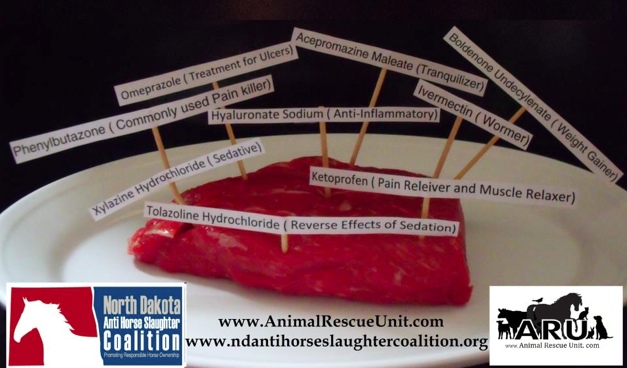
Phenylbutazone, a human carcinogen, is prevalent in U.S. horse meat, along with numerous other drugs banned by the FDA in food animals. (photo: Animal Rescue Unit)
HOUSTON, (Horseback) – Despite claims by pro-horse slaughter activists who would seemingly put a slaughterhouse on every rural main street, the market for American horse meat just dwindled to almost nothing. The European Union released its 2013 regulations for meat imported into the 27 countries.
Under the new regulations, all horses and burros destined for slaughter and export to Europe must have a passport that shows they are free from substances such as phenalbutazone (bute), and clenbuterol. Such substances never leave an animal’s body and are carcinogens. The U.S. Food and Drug Administration bans their use in all food animals.
Almost all U.S. horses have been administered a dose of bute during their lifetime.
The EU is putting teeth into strict enforcement of regulations that began in 2010 when the European nations warned horses coming to those countries from abroad must be in full compliance within three years. That time span has nearly lapsed.
Horse slaughter activists such as Wyoming State Rep. Sue Wallis have been ignoring the European recommendations. That will now be impossible.
In an additional blow to the budding U.S. horse meat industry, it was learned today, July 31st, that the Europeans have also have found Bute and Clinbuterol in Canadian horse product exported to Europe.
Click (HERE) to visit Horseback and to Comment

Mother Nature Gives West Douglas Herd a 30 Day Reprieve

Straight from the Horse's Heart


Posted: August 1, 2012 by R.T. Fitch


Rain Rides in to Rescue Wild Horses
A West Douglas Family Band ~ photo by Toni Moore
On July 30th the Colorado division of the Bureau of Land Management (BLMcalled off the alleged “Emergency” roundup of Colorado’s West Douglas Wild Horse Herd.  Earlier in the month wild horse and burro advocacy groups; Colorado Wild Horse and Burro CoalitionCloud FoundationFront Range Equine RescueHabitat for HorsesDr. Don and Toni Moore along with the Wild Horse Freedom Federation attempted to block the proposed gather as it appeared to be an attempt to circumvent the current litigation blocking the BLM from zeroing out the unique wild horse herd for almost two decades.
Late in June the groups sent into the HMA qualified investigators that returned with photographic evidence that natural water supplies were prevalent throughout the HMA but on July 3rd U.S. District Judge Rosmary Collyer barred the BLM from removing all horses yet allowed the limited roundup of 50 horses due to the alleged short water supplies.
Wild horse advocates shared deep concerns that removing 50 individuals from the herd would seriously put the genetic viability of the ravaged herd at risk but it appears that mother nature has come to the rescue with ample precipitation and the horse removal operation has been suspended.    Read MORE...