Wednesday, August 29, 2012

Central Park Carriage Horse “Oreo” Leaving NYC

Horseback Magazine


August 29, 2012

Being Groomed for Career Change at Mass. Sanctuary

Teamsters, Carriage Drivers Call on Vance to Prosecute Activist who Assaulted Driver to Fullest
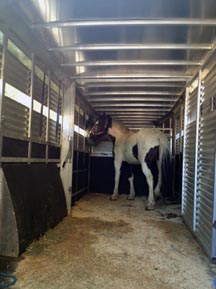
New York, NY (Horse and Carriage Association of New York) – Horse and Carriage Association President Steve Malone and Teamsters Local 553 President Demos Demodoulos announced a fond  farewell to Oreo, the   the NYC carriage horse who was corralled on Manhattan’s Ninth Avenue after a widely-reported accident near Central Park on August 16. The horse will be traveling to his new home at Blue Star Equiculture of Palmer, Massachusetts.
In addition, Malone and Demopoulos called on District Attorney Cy Vance to prosecute Roxanne Delgado to the fullest extent of the law for her arrest on August 18, for assaulting carriage Driver Jesus Rojas at the corner of Sixth Avenue and Fifty-Ninth Street. Delgado is a member of NYCLASS, a rabidly anti carriage horse group closely associated with the ASPCA and  NYC real estate interests. Over the past several months the group  has conducted, and condoned the harassment, of drivers that has now escalated into assault. She was arrested for third-degree assault after kicking Rojas, who was simply trying to do his job and provide for his family.
“It’s time for DA Vance to send a clear message to NYCLASS that the harassment and attacks on hard-working, law abiding carriage drivers must come to an end,” Malone said. “By prosecuting Delgado to the fullest extent of the law, even if only for a misdemeanor charge, he can help put an end to the verbal and now physical assaults that NYCLASS has unleashed on drivers for months.”

High Profile Incident, But Only Minor Injuries to Passengers, Leg Injury for Driver, No Injuries to Horse
On Thursday August 16, Oreo, a six-year-old black and white spotted draft-cross gelding, was working his regular shift at Central Park, when a bundle of scaffolding at a nearby construction site crashed to the pavement.  Startled by the unusual loud noise, Oreo reportedly bolted, still hitched to his carriage. Despite the driver’s best efforts, Oreo got away from him, and headed west on Fifty-Ninth Street in the direction of his stable.  The carriage struck several other vehicles before breaking apart, with the two Australian tourists in the carriage left behind.  The horse, still in harness but with no carriage attached, continued taking his regular route back to the stable before stopping behind a car waiting at a red light at Ninth Avenue and West Fifty-Seventh  Street,, where he was approached by pedestrians and police officers and led to the side of Ninth Avenue.
“We have amateur video of Oreo standing patiently at the red light, en route back to the stable,” said Stephen Malone, spokesman for the Horse and Carriage Association of NYC.  “Oreo showed just how well-trained our horses are, even under duress”, Malone said.
The driver and the tourists were treated and released from area hospitals. The responding NYPD officers, who took charge of Oreo until the NYPD Mounted Unit could arrive, understandably not being familiar with horse harness, tied Oreo to a street pole in such a way that the horse was forced to steadily move backward.  Mistaking this movement for agitation, the officers shot Oreo with a tranquilizer gun as a precaution.  The horse sunk to the pavement under sedation.  NYPD Mounted Unit arrived on scene, loosened the harness restricting Oreo’s movement; Oreo got to his feet and was led into a NYPD Mounted trailer, and was transported back to Clinton Park Stables.
Oreo’s Future at Blue Star Equiculture and Beyond
Oreo will be joining Blue Star Equiculture’s famous “herd” of 30 horses, many of whom are former carriage horses.  “Oreo will recuperate here, as we get to know him and evaluate his eligibility for adoption”, said Pamela Richenbach, director of BSE.  “As a non-profit draft horse sanctuary and organic farm, our mission is helping horses, humans and Mother Earth. We are advocates for working horses, and a young, strong, beautiful horse like Oreo certainly has a very bright future in partnership with humans”, said Richenbach.
For more information on Blue Star Equiculture: http://www.equiculture.org/carriage-horses.aspx
Pamela Richenbach, Director:  (207) 468-0495
Link to amateur video cited above in quote by Stephen Malone:
http://socialcam.com/videos/E1sWoqcw?autostart=true&facebook=true&no_fb_log=true

The Winds of Destruction

Straight from the Horse's Heart


Posted: August 28, 2012 by R.T. Fitch
Excerpt from the book Straight from the Horse’s Heart by R.T. Fitch
For all the Souls that await the arrival of Isaac
“Exactly seven years ago this day, I penned these jumbled sentences, below, in an effort to make sense of the feelings that both Terry, myself and our horses felt as Hurricane Katrina was bearing down upon our small Louisiana farm.  Today Terry and the herd are safe in Texas, where we currently reside, and it appears out of harms way, but the same is not true for our friends along the northern gulf coast of the mighty USA.  So from half way around the world I extend a virtual hand to those who are sharing the same feelings and asking the exact same questions we struggled with over a half a decade ago; truly, may the ‘Force of the Horse®’ be with you” ~ R.T.
~~~~~~~~~~~~~~~~~~~~~~~~~~~~~~~~~~~~~~~~~~~~~~~~~~~~~~~~~~~~~~~~~~~
The horses have been turned loose in the pasture, the hanging plants have been secured, the wind chimes are down, and all equipment is securely stowed.
Now, all that is left to do is wait; wait for the storm to do what it will do.
Churning viciously out in the Gulf of Mexico is a monster the size of three states – a furious beast that breathes rain, hail, and destruction at the rate of over 165 miles per hour.  It’s the stuff that science fiction movies are made of.  We wait; for what, we do not know.
We could have left; we had time.  In fact, I tried to persuade my bride to depart with her cat yesterday morning, but she would not leave me and the rest of our family.  She seems to feel that she needs to be with us.  I, however, feel otherwise.  We recently bought a four-horse slant load trailer just for this purpose.  Now that we have five horses sharing our lives with us, we opted to stay and await our destiny.
This is not new to me.  A Florida resident for several decades, I have been through my fair share of hurricanes.  In fact, we are in better shape now as Laughing Horse Farm is hooked up to a new, state-of-the-art generator that will keep us in power long after those who have lost theirs are sweltering in the heat.  All is well and good; that is, if anything is still left standing.
Why are we here; what is running through the minds of the horses?  They know that something is wrong; they smell it, they feel it.  Why are we here?  Why do we live with the thought of total destruction of all material goods and the potential loss of life in the back of our minds?  What made us stay?
The outer rain bands of the storm are swirling violently over our heads and the winds are picking up.  As the sun sets, it casts an eerie pall over the landscape; its fractured light bounces off from the massive thunderstorms.  There is a feeling of impending doom in the air; you could cut it with a knife.  The horses are running anxiously in the pasture while the cows are crying out from behind.  They know.  Why are we here?  What will come?  We have lost control and submit.  We pray for those souls that may soon depart.  We are only mortal and cannot change what is certain destiny.  We are diminished by the size and the immensity of what looms over our heads.  We are humbled by the realization that we are not supreme in any way shape or form.  We only do what we can.
Why are we here?

Hermiston council talks horse slaughter plant - Hermiston Herald: Local News

Hermiston Herald: Local News


Hermiston City Manager Ed Brookshier told the City Council this week a proposed horse slaughtering plant would be “detrimental” for the town.
“I do not believe that project is anything but detrimental to the long term development and image of this community, and I believe it has very significant land use problems associated with it,” Brookshier said Monday.

Tuesday, August 28, 2012

Testing Finds More Contaminated Horse Meat

Straight from the Horse's Heart


Information Released by the Equine Welfare Alliance
“…a major change in the testing of meat from US horses both in the European Union and Canada”
Chicago (EWA) – Following a ban funding for USDAinspections, and state legislation in Texas and Illinois, the last three horse slaughter plants in the US were closed in 2007. The result was that the horses were shipped to Canada and Mexico for slaughter. Last year the prohibition on funding was lifted, but now the very market for the meat from US horses is in question.
As the debate rages about the reintroduction of horse slaughter to the US, documents continue to leak out that indicate a major change in the testing of meat from US horses both in the European Union (EU) where the meat is largely consumed, and in Canada where many of the horses are slaughtered. For years, the EU has been tightening traceability of horse meat it produced domestically while apparently turning a blind eye to drug residues in imported meat.
Equine advocates have long claimed that since US horses were not raised as food animals, and since they were commonly medicated with prohibited substances, their meat could not be safe.
A research paper published in Elsevier’s Food and Chemical Toxicology in 2010 titled Association of phenylbutazone usage in horses bought for slaughter; A public health risk, traced 18 slaughtered thoroughbred race horses using racing records and found all had been given the banned carcinogen phenylbutazone. The paper went on to point out that the testing of fat samples, as had been done by the USDA for years, was unlikely to ever detect the drug, and it suggested that the kidney was the appropriate tissue to test.
In December of 2010, the EU released reports on US horses slaughtered in Canada and Mexico revealing banned substances were found as well as falsified paperwork stating the horses were drug free.
The first indication that more effective testing was being done came from a report of contaminated chilled horse meat imported from the UK. This was followed on July 27th by a report of frozen horse meat from Canada that contained phenylbutazone in three samples and clenbuterol in a forth.
Most recently, a July 9th warning letter from the FDA department of Inspections, Compliance, Enforcement and Criminal Investigations, to a “kill buyer” named Ronald Andio shows the FDA has now become involved. The letter describes an FDA investigation of Andio’s operation after a thoroughbred gelding that he sent to Canada for slaughter in August of 2011 was found to contain phenylbutazone residues.
The Andio letter also confirmed that Andio had indicated a clean drug history for the horse on its EID (Equine Information Document) without even asking the owner he bought it from. The EWA had warned the EU authorities that these documents would be ineffective and had even supplied photocopies of blank documents signed by sellers at the New Holland auction.
EU Report Links:
The Equine Welfare Alliance is a dues-free 501c4, umbrella organization with over 250 member organizations and over 1,000 individual members worldwide in 18 countries. The organization focuses its efforts on the welfare of all equines and the preservation of wild equids.

Science Catching Up to Chemicals in Tainted Horsemeat Testing

Horseback Magazine


August 27, 2012
Testing Finds Contaminated Horse Meat

CHICAGO, (EWA) – Following a ban funding for USDA inspections, and state legislation in Texas and Illinois, the last three horse slaughter plants in the US were closed in 2007. The result was that the horses were shipped to Canada and Mexico for slaughter. Last year the prohibition on funding was lifted, but now the very market for the meat from US horses is in question.
As the debate rages about the reintroduction of horse slaughter to the US, documents continue to leak out that indicate a major change in the testing of meat from US horses both in the European Union (EU) where the meat is largely consumed, and in Canada where many of the horses are slaughtered. For years, the EU has been tightening traceability of horse meat it produced domestically while apparently turning a blind eye to drug residues in imported meat.
Equine advocates have long claimed that since US horses were not raised as food animals, and since they were commonly medicated with prohibited substances, their meat could not be safe.
A research paper published in Elsevier’s Food and Chemical Toxicology in 2010 titled Association of phenylbutazone usage in horses bought for slaughter; A public health risk, traced 18 slaughtered thoroughbred race horses using racing records and found all had been given the banned carcinogen phenylbutazone. The paper went on to point out that the testing of fat samples, as had been done by the USDA for years, was unlikely to ever detect the drug, and it suggested that the kidney was the appropriate tissue to test.
In December of 2010, the EU released reports on US horses slaughtered in Canada and Mexico revealing banned substances were found as well as falsified paperwork stating the horses were drug free.
The first indication that more effective testing was being done came from a report of contaminated chilled horse meat imported from the UK. This was followed on July 27th by a reportof frozen horse meat from Canada that contained phenylbutazone in three samples and clenbuterol in a forth.
Most recently, a July 9th warning letter from the FDA department of Inspections, Compliance, Enforcement and Criminal Investigations, to a “kill buyer” named Ronald Andio shows the FDA has now become involved. The letter describes an FDA investigation of Andio’s operation after a thoroughbred gelding that he sent to Canada for slaughter in August of 2011 was found to contain phenylbutazone residues.
The Andio letter also confirmed that Andio had indicated a clean drug history for the horse on its EID (Equine Information Document) without even asking the owner he bought it from. The EWA had warned the EU authorities that these documents would be ineffective and had even supplied photocopies of blank documents signed by sellers at the New Holland auction.

Equine Welfare Alliance Press Release

Monday, August 27, 2012

Wild horses released back to range - Desatoya Gather

What would a trip to Nevada be without...

Wild Horses!

International Equine Conference | 2012


Thanks to America's Wild Horse Advocates, we all have an opportunity to view wild horses in their native habitat!

The tour will be on Friday, September 21 for registered conference attendees at a cost of $45 per person (includes transportation, snacks and beverages). We will leave the hotel at 2:30p for the BLM Spring Mountain Complex.

If you haven't registered yet, time is running out. The hotel is only holding room rates until August 31.

If you are interested in joining us for this once in a lifetime opportunity, please contact America's Wild Horse Advocates directly.

Here's the information from Garnet.

Did you know that there are Wild Horses within 60 minutes from the Las Vegas Strip?

America's Wild Horse Advocates, Las Vegas, NV will be offering a tour to view the Wild Horses of the Spring Mountain Complex at Cold Creek, NV

As a part of the  

AWHA is offering a tour for early arrival attendees for the conference.

The tour will leave the Rivera Hotel promptly at 2:30 PM on Friday, Sept. 21 and travel north-west to Cold Creek.

Cost is $45 per person, covers actual costs only, and will include beverages and snacks.

We will not take vehicles on the mountain due to severe road damage from recent rains.
We will end the tour at the three Ponds, which is the main water source for these horses, so there is an excellent chance of seeing them late in the afternoon.

We will return to hotel to join other later arrivals of Advocates at approx 7:30 pm

Space is limited and can be reserved thru PayPal onhttp://www.awha.info/, (click on the donate button) or by personal check (prior Sept 10) to:
  
America's Wild Horse Advocates (A.W.H.A.)
PO Box 30152
Las Vegas, NV 89173-0152

Here is an example of what you will see:www.discoverwildhorses.com

NOTE: Tour is subject to Final BLM Approval, and should that not happen, full refunds will be issued.  

I personally think that is not going to be an issue when all is said and done.  

Garnet Pasquale, President - America's Wild Horse Advocates

Disabled Patients Bet on Horse Therapy, and Hope Del Mar Event Pays Off

DelMar Carmel Valley Patch


Jennifer Gambrell recalls the case of an 18-year-old who became paralyzed from the neck down after a boating accident.
A horse came to the rescue.
After three years in the REINS Therapeutic Horsemanship Program—a nonprofit based in Fallbrook—the teen was able to sit up and hold his own rein because of the strength he built.
Almost 10 years from his first day at REINS, he now uses a walker and took part in a mile race, she said.

“We have all this technology today, but no one has been able to create a machine for spinal cord patients—and that's why horse therapy is so crucial,” said Gambrell, REINS development coordinator.
Her group will host its 20th annual fundraiser at the Del Mar Races on Sunday, Aug. 26. The nonprofit, which is selling tickets on its website as a fundraiser, will also collect donations and provide information for attendees at the Clubhouse Terrace. 
“The support of the community has gotten us this far and we love giving back through this service,” Gambrell said. “But we do need help.”

The longtime nonprofit was founded in San Marcos in 1984 before moving to Fallbrook in 1999. Today, it’s one of 808 horseback therapy riding programs in the world but ranks in the top 3 percent, she said.
REINS has four full-time employees, 14 part-time instructors and more than 100 volunteers, who serve about 200 students each week.

It's rewarding too, Gambrell said.
The program affords the disabled a chance to go outdoors and enjoy the simple act of riding a horse—“while receiving intense therapy,”  she said.

“Imagine being a student with low muscle tone and being able to ride a horse,” Gambrell said. “Imagine how much strength you would build in that short amount of time in riding a horse.”

Gambrell—who said many of REINS' students have cerebral palsy, autism and Down syndrome—said 132 vibrations from a horse exercises the rider’s muscles and also calms the patient.
“There’s the emotional, mental and physical benefits that really improve the quality of life for our students and, of course, that translates to the families too,” she said.
Though the program serves 200 students each week, Gambrell said it hopes to expand.
But community's support is needed. The program, which operates on an estimated $500,000 budget, is looking to raise more than $5,000 at the Day at the Races. In October, it hopes to raise $100,000 at its annual fundraiser Country Hoedown.

For more information, visit reinsprogram.org/

The Art of Creating A Crisis

Straight from the Horse's Heart


Posted: August 27, 2012 by R.T. Fitch
Guest OpEd by Lisa LeBlanc ~ Advisory Board Member of Wild Horse Freedom Federation
“Tens of thousands of horses are roaming the state and there’s no where to put them…?”
A news report has circulated recently about a massive population of free-roaming horses currently destroying land in the Navajo Nation and in New Mexico. The report, by Deanna Sauceda, asserts “Tens of thousands of horses are roaming the state and there’s no where to put them.” Based on no pointed sources, it’s ‘estimated’ there are as many as 90,000 horses roaming the Navajo Nation’s lands:
“There are no hard numbers as to how many horses are wild, abandoned or feral in New Mexico, but some estimates are as high as 90,000 on the Navajo reservation alone.” – intimating that there are far more throughout the rest of the state.
And of course, the compassionate, “The problem is hard on both the land and the horses.”
Other expressions of crisis include “dire”, “critical”, and “tremendous impact”. And the New Mexico Department of Agriculture has been called upon to deal with the problem, forming a ’task force’ joined by ‘horse advocates‘, who have stated that the hard choices, including euthanasia, must be considered.
Most of the Western United States is experiencing extreme heat and drought; incidence in the Southwest, by it’s location, would be increased, so this isn’t in dispute. However, the population numbers, the now and future estimates quoted in the report are.
According to the Navajo Nation Division of Economic Development, the Navajo Nation contains 17.2 million acres across the conjunction of three states – New Mexico, Arizona and Utah – and encompasses the Hopi Nation within it’s interior.
90,000 horses within the entire Navajo and Hopi Nations would be unsustainable, but the report also lacks any images of these vast herds.
Charles Graham of ‘Walkin’ N Circles Horse Rescue’ and participant in the task force, was quoted: “If you look at the age span of a horse, within five years, we could have 600,000 unwanted horses in the country.”
A crisis in the making.
There were no specifics offered as to how much of which country this number would cover. But that figure required some verification.
Simple biology stipulates that, of the purported 90,000 animals ravaging the Navajo Nation‘s landscape, approximately half – females – would be capable of producing live offspring. So, for the sake of argument, we begin with 45,000 mares, reproducing at 25%, the rate quoted in the article. The first year would produce 11,250 foals, all of which, for at least the first year, would be incapable of participating in reproduction.
Again, to replicate the absolute worst case scenario suggested by this report, the new population for the first year would become an estimated 101,250 animals. Further calculation, producing live foals every year capable of reproducing after a year would produce 72,245 foals, bringing the entire population to 162,245 animals by Year 5. Even incorporating these horses into the estimated populations of wild horses and burros in 10 Western States managed by the Bureau of Land Management – the female half of approximately 37,500 – and multiplying this population at 25% per annum over a 5-year period would bring the entire free-roaming equine population to around 194,550.
Even at 100% successful, 100% survival and 100% participation, 600,000 horses is more than 10 years away; it is not referenced and is unclear how this number was arrived at.
From the APHIS Native American Notebook, published March, 2010:
“Out West, rangeland is not fenced*, however. The Yakama horses wander around without reference to reservation boundaries. Similar herds are eating their way through natural forage at the same alarming rate nearby, at the Colville Reservation (also in Washington), at Warm Springs and Umatilla (in Oregon), and at Shoshone Bannock(in Idaho).
When representatives of the wildlife management units at those five tribes gathered together in November 2008 to talk about this problem, they came to the conclusion that there are at least 20,000 feral horses on their reservations altogether. Now horses typically live to about age 30, and a mare ordinarily has a foal every year (emphasis added).With few to no apex predators in that part of the United States, feral horse populations are going up about 20%every yearwith no end in sight.”
A crisis predicated on longevity, profuse breeding and an absence of predators.
Even domestic horses, given every advantage and comfort, do not ‘typically’ live to age 30; among wild equines, 30 years is a rare exception for a life lived on the edge every day. A mare ‘ordinarily’ having a foal every year infers wild mares will be pregnant their entire adult lives. Others who have observed these animals in the wild understand – even absent human interference in the form of ’birth control’ – there are natural variables in herd life that will not bear this out, nor the utter absence of mortality – a reality always neatly avoided. But certainly these are important components for a crisis.
These quotes, and many others, have become an accepted part of the vernacular that continues to portray wild equines as undesirable and aberrant – while avoiding the necessity of providing evidence. And as an unfortunate result, these pronouncements continue to be accepted as truth, without any further confirmation.
The recent Desatoya roundup in Nevada removed 429 animals; foals accounted for about 18.8% (81) of those taken. The Jackson Mountains roundup took 647 animals. 20.25% (132) were foals. And the Pancake roundup removed 1,115 animals – only 19% (212) of which were foals.
Among the most alarming issues concerning wild, free-roaming equines is the ease of use of the terms ’estimates’, ’could have’, and ‘possible’, the constant claims of inflated populations and the lack of constraint in breeding. This news report was published – devoid of verification or confirmation – only the pronouncement of an imminent crisis. And once again, portrays wild equines as an extinction-level event, and considers mass euthanasia as the only recourse when employing any agency under the umbrella of the Interior Department other than the Bureau of Land Management.
Before creating a crisis that will most likely consign these animals to death across the border – the current euphemism for ‘euthanasia‘ – it’s even more critical these animals be portrayed and recognized in a realistic light:
For the Desatoya, only 81 mares can produce 81 foals.
For the Jackson Mountains, only 132 mares can produce 132 foals.
For the Pancake, only 212 mares can produce 212 foals.
No more.In each instance, less than half the mares removed produced a foal.
One additional light of realism: The combined total of both Wild and Captive Wild horses and burros, according to reports from the Bureau of Land Management, is 83,305 (estimated). How is it possible there are more free-roaming, abandoned and feral horses across the Navajo and Hopi Nations and the state of New Mexico than are under the entire purview of the BLM?
“Horse Population Runs Wild in N.M.”
http://www.krqe.com/dpp/news/environment/horse-overpopulation-runs-wild-in-nm
Navajo Nation Division of Economic Development:
APHIS Native American Notebook, March, 2010:
* Article, “Did Fencing in Wild Herd Area Spell Death for Mustangs During Twin Peaks Wild Fires?” By Grandma Gregg; pictorial evidence disputes this.
Desatoya Final Gather Report:
Jackson Mountain Final Gather Report:
Pancake Final Gather Report:
Navajo Nation Division of Economic Development:
APHIS Native American Notebook, March, 2010:
* Article, “Did Fencing in Wild Herd Area Spell Death for Mustangs During Twin Peaks Wild Fires?” By Grandma Gregg; pictorial evidence disputes this.
Desatoya Final Gather Report:
Jackson Mountain Final Gather Report:
Pancake Final Gather Report: