Sunday, November 10, 2013


Saturday, November 9, 2013
Poor Contracting Practices at BLM
Straight from the Horse's Heart
 A government employee who stepped into a contractor’s role is among the targets of a report criticizing contracting practices at the Bureau of Land Management.
SOURCE: fiercegovernment.com ByZach Rausnitz
 A government employee who stepped into a contractor’s role is among the targets of a report criticizing contracting practices at the Bureau of Land Management.
The Interior Department office of inspector general says in a recently released report, dated Sept. 30, that a BLM project officer placed a request to modify a contract, “in effect, representing the contractor.”
The project officer and the contracting officer involved had to be counseled on proper contracting practices, the report says. At the time of the report, the BLM was finalizing guidelines to outline the responsibilities and limitations of contracting officers and project officers.
The audit stemmed from the OIG’s prior discovery that BLM had made payments for costs that exceeded the amount agreed to in a contract and also for costs that the contractor incurred outside the period of performance.
Auditors found contract files that lacked evidence of market research, price analyses, and whether invoices were reviewed before payments went out. In response, BLM says contracts are now subject to random reviews to check for completeness.
READ THE FULL OIG REPORT HERE
Related Articles
- Obama Nominee for BLM Gets Mixed Reception From Pols, Enviros (kcet.org)
- Obama nominates Kornze to be BLM director (sandiego6.com)
Friday, November 8, 2013
Horse Slaughter: Equine Advocates Vow Long Legal Battle to Save Animals
Straight from the Horse's Heart

By John M. Glionna of the LA Times
“Horse slaughter is a predatory, inhumane business, and we are pleased to win another round in the courts to block killing of these animals on American soil for export to Italy and Japan”
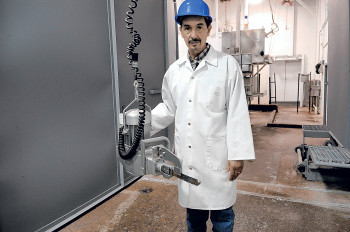
Rick De Los Santos, owner of Valley Meat Co. in Roswell, stands in the slaughterhouse where he plans to butcher horses for the foreign meat market. (PAT VASQUEZ-CUNNINGHAM/JOURNAL)
Animal welfare advocates are preparing for a legal showdown after a federal appeals court this week temporarily banned the slaughter of horses in New Mexico and Missouri, with the activists pledging to continue to fight for the welfare of domestic horses nationwide.
The issue of slaughtering domestic horses has been divisive nationwide, spurring debate inCongress and dividing horse rescue and animal welfare groups, ranchers, politicians and Indian tribes.
The last U.S. horse slaughterhouse closed in 2006, the same year Congress essentially banned the practice by eliminating funding for inspections of those facilities. The funding was restored in 2011, prompting several companies nationwide to seek permission to open plants.
Since then, various courts have issued conflicting decisions on whether horses can once again be killed for their meat.
The 10th U.S. Circuit Court of Appeals in Denver on Monday issued a temporary injunction barring the Department of Agriculture from inspecting the plants. That ruling came just days after a federal judge in Albuquerque dismissed a lawsuit by groups that alleged the department failed to conduct proper environmental studies when it issued permits to the slaughterhouses.
“Horse slaughter is a predatory, inhumane business, and we are pleased to win another round in the courts to block killing of these animals on American soil for export to Italy and Japan. Meanwhile, we are redoubling our efforts in Congress to secure a permanent ban on the slaughter of our horses throughout North America,” Wayne Pacelle, president and chief executive of the Humane Society of the United States, said in a statement.
Activists say the government approval is premature in light of building momentum in Washington to continue the ban on horse slaughter.
Humane Society officials pointed out that the U.S. House and Senate appropriations committees have voted to halt all funding for horse slaughterhouse inspections for fiscal year 2014.
Advocates for horse slaughter say there is a foreign market for the meat, even if it’s not a staple on American dinner tables.
Both sides in the battle acknowledged that the latest court order is temporary.
“We don’t know how long the appeals process will take,” Stephanie Twining, a spokeswoman for the Humane Society, told The Times. “If they don’t rule in our favor, that’s the end of the road for our battle in federal courts.”
But there are other options, she said, such as taking action in state courts and pressing Congress to pull funding from horse slaughterhouse inspections.
“We’re not going to give up on this battle,” Twining said. “We’re going to keep looking for other options.”
Related Articles
- Appeals court grants temporary order preventing US horse slaughter (horsetalk.co.nz)
- Ban Horse Slaughter and Transport of Horses for Slaughter (rtfitchauthor.com)
- HORSE MEAT HALTCourt blocks plans to resume equine slaughter (foxnews.com)
- HSUS/FRER slaughter update (rtfitchauthor.com)
Thursday, November 7, 2013
Tuesday, November 5, 2013
What Does the Secretary of the Interior have against Wild Horses
The Desert Independent
By ROBERT WINKLER
The Desert Independent
The Desert Independent
November 4, 2013
You must remember that although Sally Jewell would seem to be a natural ally of the wild horses because of her affiliation with REI, the outdoor outfitters, that is just not the case when you think about the people REI serves. Most all of those customers of REI, and I must admit to being one of them, would rather not share the outdoors with wild or domesticated horses. Hikers and bikers, may not admit it, but they really don’t like having to move off trail when a group of horses come by. Just try to find any horse gear in an REI.
Even more important or detrimental to the wild horses depending on how you look at it, is Sally’s earlier career of 20 plus years as a banker making loans to the oil industry. These were the same people she worked for before going into banking!
Sally’s a very well rounded business woman capable of sending each and every wild horse off to a Mexican slaughterhouse with an entry on some Excel spreadsheet just for that purpose.
Shame on you Sally Jewell.
Monday, November 4, 2013
A Temporary Victory
From HSUS (Facebook): (Wayne Pacelle)
Breaking news from our legal team on horse slaughter: a federal court of appeals just issued an order temporarily blocking the resumption of horse slaughter in the United States – turning around our fortunes after a district court ruled against us late last week. This is a bit of a roller coaster ride, and it’s only temporary, but score this round for our side and for the horses. The horse slaughter industry killer buyers and traffickers need to know we’ll never relent in our quest to protect horses from the industry’s predatory and barbaric practices.
Breaking news from our legal team on horse slaughter: a federal court of appeals just issued an order temporarily blocking the resumption of horse slaughter in the United States – turning around our fortunes after a district court ruled against us late last week. This is a bit of a roller coaster ride, and it’s only temporary, but score this round for our side and for the horses. The horse slaughter industry killer buyers and traffickers need to know we’ll never relent in our quest to protect horses from the industry’s predatory and barbaric practices.
A Tale of Two Carriage Horses, both Named Roger
Straight from the Horse's Heart
 A New York City carriage driver tells the story in yesterday’s Daily News of how he rescued Roger, a broken down, emaciated and wound-covered Amish buggy horse, 15 years ago.
Amy Worden, Inquirer Staff Writer as published at Philly.com
“…horses and people need not be top athletes to enjoy a life of mutual respect and healthy fitness.”
 A New York City carriage driver tells the story in yesterday’s Daily News of how he rescued Roger, a broken down, emaciated and wound-covered Amish buggy horse, 15 years ago.
After months of rest, decent food and love, Roger was healthy and restored and began his new life as a Central Park carriage horse, gaining fame for carting around tourists and celebrities like Sarah Jessica Parker and Chris Noth in a “Sex and the City” episode.
Roger is set to retire soon at the age of 20.
The point of the column by Ian McKeever no doubt was to show New Yorkers that a well-cared for horse can thrive pulling carriages and that the alternative would have been bleak.
The carriage industry, long the bain of animal welfare advocates, is poised to end. Both mayoral candidates support banning carriages and the high-profile deaths and injuries of horses in traffic have spurred efforts to replace horses with antique automobiles.
Roger was on his way to a slow, torturous death at the hands of an Amish farmer who would likely have sent him directly to the “kill pen” at New Holland auction.
Livery drivers are sometimes no better, sending their horses off to “retirement” at New Holland.
Whether it’s Manhattan or Philadelphia, the city streets are hazardous for horses. Forcing horses to stand in extreme temperatures waiting for passengers is wrong.
But as McKeever rightly says, horses need jobs and exercise, be it pulling a carriage, controlling crowds as a member of a police mounted unit or rounding up cattle.
Watch a top flight performance horse, whether doing a horse/human ballet known as dressage, galloping across an Olympic cross country course or reining cattle, and you quickly learn that horses and humans can and do form wonderful bonds.
And horses and people need not be top athletes to enjoy a life of mutual respect and healthy fitness.
I was in McKeever’s shoes five years ago. Responding to a for-sale ad, I turned up at the barn of a Lancaster County Amish man who had been busted several months earlier for running a horrible puppy mill.
Inside the stall were two large draft horses sharing a single small stall, standing in 18 inches of manure. I bought them both – they were underweight, loaded with worms and highly suspicious of humans. I couldn’t leave them behind, or leave one behind, so I bought them both. Now there are three – our Belgian, Belle, was pregnant at the time – and all are thriving as backyard pleasure horses.
When I don’t get out enough to exercise Belle’s baby, four-year-old Chloe, it shows. Just yesterday she tore around our round pen in a frenzy fueled by the cooler weather and too many days lounging around the hay hut.
Draft horses, like many of those that pull New York carriages, are bred to pull loads. They are muscular and weigh 800 or 1,000 pounds more than the average horse.
An active, working horse who is fed well, housed well and treated kindly, is generally a happy horse. I am not on board with the “lawn ornament” crowd who believe that horses should sit in pastures. These are the horses that are destined for neglect, like Bridget, the blind roan, found roaming the roads of Adams County last month but now in the safe hands of our local SPCA in Gettysburg awaiting adoption along with her seeing eye goats.
Isn’t there a compromise to be reached on the New York carriage horse issue? I can’t understand why no one has suggested stabling the horses in Central Park. Would as many people object to carriages if the horses worked and lived in the park and therefore avoided the dangerous traffic and other street hazards to and from the stables?
The election of New York City’s next mayor comes just as a federal judge in New Mexico clears the way for horse slaughter plants to again open in the United States.
That surely would have been the fate of Roger had McKeever not plunked down $1,400 to save him. Now Roger, immortalized in “Sex and the City” reruns and star of his own Facebook page, heads off to retirement on a Long Island farm.
Those who follow in the hoofprints of Roger deserve the opportunity to live, work and retire humanely.
Click (HERE) to comment directly at Philly.com
Saturday, November 2, 2013
Exclusive Report: Where Have All the Wild Horses and Burros Gone?
Straight from the Horse's Heart


Twin Peaks Report from Kathy Gregg, Environmental Researcher and Craig C. Downer, Wildlife Ecologist, A.B., M.S., Ph.D. Candidature
Photographs by Craig Downer
Photographs by Craig Downer
There are no “excess” wild horses and burros on their legally designated land.

This wild horse looking across the vista appears to be wondering the same thing that continually crossed our minds during this three day journey …
“Where have all the wild ones gone”?
“Where have all the wild ones gone”?
Although a very few wild horses and burros were seen, the best way to describe our three days on the Herd Management Areas (HMAs) is “mile after mile and hour after hour seeing no wild horses or burros”.
During this three day ground survey there were two experienced wildlife observers with binoculars searching for wild horses and burros and other wildlife in the Twin Peaks, New Ravendale, Buckhorn and Coppersmith Wild Horse and Burro Herd Management Areas (HMAs). We traveled approximately 160 miles over 3 days and
17 hours in the herd management areas. We drove slowly with many stops along with some limited off-road hiking and we constantly looked for signs of wild horses and wild burros. A total of 23 wild horses and 18 wild burros were observed. All observed horses and burros and range conditions appeared to be in excellent health – the only good news.
Near Rye Patch Road, we saw two family groups traveling together. One family is Magic, our treasured son of the great Twin Peaks stallion BraveHeart who was captured in 2010 and Magic’s faithful mare Hope. The other family consists of a bay stallion, charcoal colored mare, their yearling and their new foal … and a burro! Although having been spotted earlier this year – safe and sound – these two families had been missing after the Rush fire raced through their home area last summer. It was an inspirational moment to see them safe after having escaped the massive 2010 capture and the uncontrolled Rush wild fire – the white/appy stallion again lived up to his name, “Magic”.
This public land is set aside by Congress principally for wild horses and burros, but there are very few that remain since the roundup of 2010. It is incredible and unbelievable when the BLM says there are 1,684 out here again…

Magic and Hope
Per the 1971 Congressional Act, the land is to be devoted PRINCIPALLY but not exclusively to the wild horses and wild burros welfare in keeping with the multiple-use management concept of public lands. Definition of “principally”: First, highest, foremost in importance, rank, worth or degree, chief, mainly, largely, chiefly, especially, particularly, mostly, primarily, above all, predominantly, in the main, for the most part, first and foremost.
There are no “excess” wild horses and burros on their legally designated land. The American people are being deceived by our government agencies that are mandated by Congressional Law to protect these animals. The wild horses and burros ALREADY have a place to live and it is not in governmental corrals. These animals and this land do NOT belong to the government … the wild horses and burros and the lands belong to you and me.
Please click (HERE) for the entire independent observers’ summary report and many photos.
More information:
See Twin Peaks Masters Thesis by Jesica Johnston: http://csus-dspace.calstate.edu/handle/10211.9/1492
See 2012 Rush Fire Report: http://rtfitchauthor.com/2012/10/08/twin-peaks-rush-creek-wild-fire-report-where-are-all-the-wild-horses-and-burros/
See Twin Peaks May 2013 Report: http://rtfitchauthor.com/2013/05/31/citizen-report-wild-horses-notably-absent-from-california-herd-area-after-blm-roundup-and-fire/
See Twin Peaks August 2013 Report: http://rtfitchauthor.com/2013/08/28/exclusive-wild-horse-and-wild-burro-good-news-and-bad-news-from-twin-peaks-hma/
Friday, November 1, 2013
EWA issues a slaughter update
Straight from the Horse's Heart
This is a new update from Equine Welfare Alliance:
AP issued a release today regarding the expiration of the TRO and that MO plans to open on Monday. The article was written by APs, Jeri Clausing, who continues to cite the GAO report knowing the information is bogus and appears to print anything uttered by slaughter supporters. The earliest NM could possibly open is February; a detail she conveniently left out.
An extension was filed today by HSUS and the groups suing the USDA.
Here is a link to the article but read carefully as the comments are from Dunn, Santo’s attorney. Like Wallis, he makes announcement after announcement after announcement…
Temporary order against horse slaughter expires
http://www.seattlepi.com/news/us/article/Temporary-order-against-horse-slaughter-expires-4946917.php
We’ll let you know as soon as we receive an update
Be sure to check out our Facebook page for updates!
Subscribe to:
Posts (Atom)


