Sunday, January 12, 2014


Friday, January 10, 2014
Thursday, January 9, 2014
Horse Slaughter: Permits Should All Be Denied
Straight from the Horse's Heart
 Rains Natural Meats has amended its previous application for a permit to slaughter horses, a permit application that was denied, and rightfully so, by theMissouri Department of Natural Resources.
Letter to the Editor by Lynne O’Toole as published in the News-Leader.com
“If pro-horse-slaughter folks were serious about their stated concern for unwanted horses they would look for permanent solutions.”
Rains Natural Meats has amended its previous application for a permit to slaughter horses, a permit application that was denied, and rightfully so, by theMissouri Department of Natural Resources.
Horse slaughter is a dangerous endeavor — not just for horses. In the United States, we do not keep permanent records of drugs given to horses. Those drugs, some banned by the FDA for use in animals intended for food, will end up in our water supply if we allow horse slaughter on our soil. The DNR should continue to deny permits to any plant hoping to slaughter horses in Missouri.
There is no real domestic market for horse meat. The European market is not as large as slaughter proponents claim and, more importantly, they are completely uninterested in adulterated horse meat from the United States.
If pro-horse-slaughter folks were serious about their stated concern for unwanted horses they would look for permanent solutions. Instead, they claim slaughter is the answer, but their argument is full of fallacies. Sick, starving cows and pigs don’t go to slaughter in this country. Neither will horses.
Horse slaughter is an economic drain on rural communities, provides few low-paying, dangerous jobs and is a serious threat to our environment and health. Missourians shouldn’t be subjected to the aftermath caused by horse slaughter just so a few greedy people can line their pockets.Most of the people trying to force horse slaughter on us are not from Missouri. Our health and welfare and the economic and environmental impact are not on their radar…(CONTINUED)
Click (HERE) to read the rest of the story and to comment
Tuesday, January 7, 2014
Q&A: John Holland, Equine Welfare Alliance
Off-Track Thoroughbreds


John Holland, president of the Equine Welfare Alliance with a couple of fillies
How an electrical engineer once heading up a robotics company servicing the nuclear industry came to be testifying against horse slaughterhouses later in life came down to a news article and a mare.
“It was 2003 when my wife Sheilah brought home an article about PMU mares” whose urine is harvested to create estrogen treatments for women “and that article led to our decision to adopt a PMU mare,” says John Holland. And that decision is what led to what he jokingly refers to as the “downward spiral” into horse-welfare advocacy work, which includes the founding and presidency of 501 (c) 4 organization Equine Welfare Alliance, and many hours spent networking, testifying, and organizing on behalf of the horse.
In this week’s Clubhouse Q&A, Holland discusses his ongoing role in the slaughter debate, and his passion for horses, including his OTTB Honey Rose.
Q: What is the Equine Welfare Alliance?
We formed in 2009 and envisioned we would be getting more into the political arena, but we wound up more in the educational arena instead.
Over the years our membership has grown and we’ve networked, and focused on becoming an information gathering and disseminating organization, which holds yearly conferences, and talks a lot about slaughter.
Q: The Alliance lists 66 pages filled with individual members and 37 pages filled with participating organizations, including the ASPCA and many horse charities. How did the Alliance get so big?
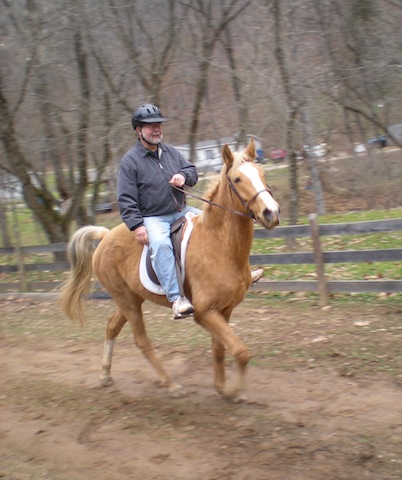
Holland enjoying the company of a treasured horse
Interestingly, we do not solicit members, and we don’t charge dues. In fact, we rarely solicit donations unless we have a specific project. We’ve been pretty amazed at the growth ourselves!
I think most of it comes from our insistence on accuracy in the information we present, and the fact that we offer so many resources that have been produced by our various members.
Early on, I was introduced at a conference hosted by the Equine Advocates in New York and co-founder Susan Wagner introduced me by saying, “I have checked them out and they are the real thing.”
Q: What is the goal of the Equine Welfare Alliance?
The goal of the Alliance is to improve the lives of equines worldwide. We are already thinking beyond the end of slaughter in the U.S. and working on strategies to reduce equine abuse and neglect. Considering all the money horses have made for us, all the universities that have equine programs, all the horse groups, the shows, the rodeos, and the indirect beneficiaries, it amounts to $102 billion a year according to the Deloitte Study, The National Economic Impact of the U.S. Horse Industry.
Our goal is to become the gold standard of information on equine welfare. We gather data from a wide range of government sites, from state animal control and veterinary services, etc.
We have different members of the Alliance specializing on certain information gathering. For example, one member tracks weekly slaughter records from the USDA and compiles them on spreadsheets. Another member with a commercial driver’s license is able to find and track trucking violation records (of horse haulers) … each of our members brings his or her own talents to the effort.
Q: Does the Alliance plan to lobby in Washington?
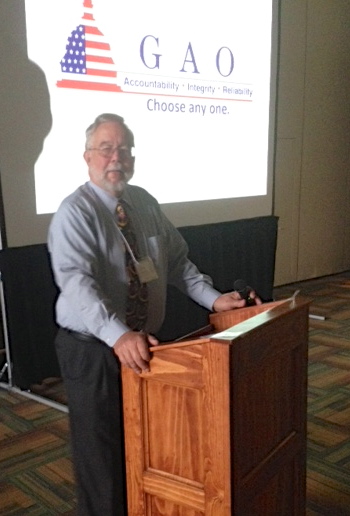
Holland is always at the ready to make the case for horses
We do not lobby in the true sense of the word. Instead, we try to provide government officials with information that they can use in the fight to lessen equine suffering, and we try to empower our members to establish relationships with their representatives, through which they can educate their representatives on main issues.
Q: In October you flew toNew Mexico to testify as a volunteer expert witness in a hearing related to an effort to bring a horse slaughterhouse online there.
The hearing I went to involved the plant getting a renewal of its discharge permits for waste.
I spoke about the possible impact on the water table, which is only about 10 feet below the surface, and offered my opinion on the plant’s proposal to build a lagoon lined with plastic, like a big coy pond, to handle discharge.
Q: Although the plant was successful in that hearing, and won its permit, you are encouraged by budget talks in Washington, which could impact horse slaughter efforts in the U.S.
The larger issue is that Agricultural appropriations committees of both the House and the Senate voted to kill inspections for horse slaughter plants. The president’s proposed budget also called for removing the ante mortem inspections, the before-death inspections, and this would greatly affect horse slaughter.
Moreover, the measure to de-fund meat inspection for horse slaughter passed by a super-majority vote.
Q: You’ve owned horses most of your life, and even own a special OTTB named Honey Rose.
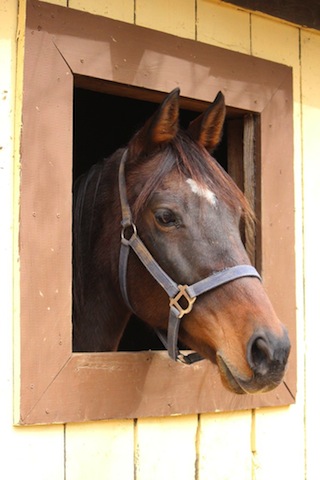
Honey Rose was so unused to life outside her stall that she spent weeks waiting by her paddock gate.
I got Honey Rose when she was 10. Her owner had died, and the horse had been kept in a stall her entire life. Although the rescuers did a great job getting her into good physical shape, she has deep insecurity from her life in isolation.
When she came here, I put her in the yard which has fences bordering three other horse areas. This allows new horses to get acquainted without the danger of fights breaking out. Unlike a normal horse, she was petrified by the vast expanse of a whole acre, so she invented an imaginary stall up next to the gate, and she didn’t leave it for two weeks.
It took her over a month to feel free to wander the entire yard.
I worried she would have a permanent lack of social skills, but the opposite was true. She quickly formed a friendship with another mare, who also had a hard time relating to the other horses. Soon, she was comfortable enough to integrate into the whole herd. She is just now getting trained, in fact, the trainer was here recently working on her ground manners and she is learning quickly.
Off-TrackThoroughbreds.com commends John Holland and members of the Equine Welfare Alliance for their dedication to a better life for our equine friends.
Hearing officer: Deny permit for horse slaughterhouse
Albuquerque Jounal
Posted: 2:47 pm
SANTA FE — A hearing officer is recommending that the New Mexico Environment Department deny a wastewater permit for a Roswell company that wants to slaughter horses.
The hearing officer cited what he called the company’s record of “willful disregard” of the state’s environmental laws.
Valley Meat Co. and the groups trying to block its opening now have 15 days to respond to the report before the environment secretary decides whether to renew the company’s permit.
Valley Meat is a former cattle slaughterhouse that has been fighting for two years to convert its operations to horses. The last domestic horse slaughterhouses closed in 2007.
Its efforts have sparked an emotional, national debate over whether horses are pets or livestock, and has prompted lawsuits by national animal protection groups and the state attorney general.
Monday, January 6, 2014
Horse slaughterhouse notifies New Mexico AG of intent to sue for slander
Habitat for Horses
Valley Meat Co owners feel ganged up on due to public pressure against horse slaughter. Now they want restitution in the form of a lawsuit against New Mexico’s Attorney General Gary King. May Valley Meat’s lawsuit get tossed out for the frivolous act it obviously is. ~ HfH

Blair Dunn, attorney for Valley Meat Co of Roswell, NM
ALBUQUERQUE, New Mexico — The owners of a Roswell company mired in legal disputes over its attempts to resume domestic horse slaughter have notified New Mexico Attorney General Gary King they intend to sue his office for slander, harassment, conspiracy and abuse of process.
Valley Meat Co. attorney Blair Dunn Monday sent letters to the state risk management division, giving the required 30-day notice of its planned legal filing.
King has filed a lawsuit that has blocked Valley’s planned opening this month, alleging the horse slaughter plant would violate state environmental and food safety laws.
Dunn contends the state lacks jurisdiction over the federally regulated plant.
A federal lawsuit brought by animal protection lawsuits was thrown out last year, and is currently on appeal. After the appellate court last month lifted an order blocking Valley and a plant in Missouri from opening, citing the plaintiffs’ inability to show a likelihood to prevail, King filed the state suit. A Santa Fe judge has issued another temporary order putting the business on hold until a hearing next week.
Dunn says King is conspiring with the animal protection groups, the Humane Society of the United States and Front Range Equine Rescue, to block a lawful business with a frivolous lawsuit to further his gubernatorial bid.
“They are trying to drive Valley out of business,” Dunn said. “They don’t agree with the lawful business so instead of changing the law they decided they will try to destroy Valley. HSUS and Front Range have stated their goal is to drive Valley out of business.”
Dunn has also accused King’s spokesman, Phil Sisneros, of making defamatory statements about him and questioning his legal capabilities.
Sisneros did not immediately respond to calls and emails seeking comment.
Valley Meat and companies in Missouri and Iowa last year won federal permits to become the first horse slaughterhouses to operate since Congress effectively banned the practice by cutting funding for inspections at plants in 2006. The last of the domestic plants closed in 2007. Congress in 2011 reinstated the funding.
Habitat for Horses is a 501.c.3 nonprofit equine protection organization supported solely by donations. We have around 200 donkeys and horses under our care, plus one ornery, old mule. Most of them are here because law enforcement removed them from their previous owner. Our ability to rehabilitate and rehome them comes from the financial support of people like you. Please support us by making a donation for the horses we all serve. Click HERE to donate
Sunday, January 5, 2014
The Year of the Horse Defined
Straight from the Horse's Heart
 It’s “Feel Good Sunday” and the holidays are over, maybe to the relief of some and the disappointment of others, but we are going to take a few moments and define what the ‘Year of the Horse’ REALLY means in the Chinese culture.
by R.T. Fitch ~co-founder/president of Wild Horse Freedom Federation
The Year of the Horse has yet to Begin
 It’s “Feel Good Sunday” and the holidays are over, maybe to the relief of some and the disappointment of others, but we are going to take a few moments and define what the ‘Year of the Horse’ REALLY means in the Chinese culture.
Over the past several days we have had a few ‘commenters” who have overstepped their freely allowed bounds and have attacked, in text, 1.3 billion Chinese citizens for the actions of a few. We will attempt to rectify that closed mindedness and those insults with a look at a culture that has been around for thousands of years longer than our European lineage.
The United States, Europe, the Americas, Africa, Australia and Asia all have issues with the humane treatment of not only animals but people. Today, we take a look at a 5,000 year old culture that will, this year, celebrate the horse.
Chinese New Year, also known as known as Spring Festival, will not occur until Jan. 31, 2014. The event is celebrated on a different day each year since the Chinese calendaris lunisolar — taking into account both the earth and moon’s movement.
In China, the holiday is the most important social and economic event of the year– traditionally linked to honoring the household, heavenly gods and ancestors. Today, China celebrates Jan. 1 as New Year’s Day, but the country continues to mark the Spring Festival as a time to spend with family and relax from work.
Typically the holiday begins on New Year’s Eve (according to the Chinese calendar) and lasts for 15 days. Families tend to clean their homes in the days leading up to the celebration but all dusts and brooms are hidden during holiday so that “good luck can not be swept away.” The holiday itself is usually spent with family, shopping, watching fireworks and in some cases – a religious ceremony honoring heaven, earth and other deities.
Each year corresponds to a different zodiac sign and animal. The Chinese zodiacconsists of 12 animals that denote a person’s birth known as shengxiao: rat, ox, tiger, rabbit, dragon, snake, horse, sheep, monkey, rooster, dog and pig. Each of the animals is named after one favored by the Buddha and is said to influence an individual’s personality.
In 2014, it will be the year of the Horse. Known as Wu, those born during the year of the Horse tend to be clever, possess good communication skills, are cheerful and stubborn. In 2014, they are expected to have a good year and are advised to be quiet and patient. Other predications call for people to make the most out of given opportunities, expect good health and a year where romance and career will be in harmony.
For equine advocates the Year of the Horse is the year that horse slaughter will forever be shuttered in the United States and the special interest, horse destructive BLM will be brought to it’s knees ensuring the future welfare, safety and security of America’s national icon will be alive and living free for generations to come.
2014 promises to be a very good year.
Related articles
Horse Slaughter In the U.S.: The Dumbest Business Idea Since New Coke
A Humane Nation
Wayne Pacelle's Blog
January 02, 2014

Horse Slaughter In the U.S.: The Dumbest Business Idea Since New Coke
Tomorrow, New Mexico Attorney General Gary King will be back in court seeking to block the opening of a horse slaughter plant in his state because of unresolved questions about waste disposal and unsafe chemicals in the meat. We hope he prevails. Attorney General King—joined by The HSUS and Front Range Equine Rescue—made similar arguments in the federal courts, which have produced a series of red and green lights for horse slaughter plant proponents over the last five months. Both King, as the state’s top law enforcement official, and the state’s Republican governor, Susanna Martinez, oppose the opening of a horse slaughter plant, so the state has hardly rolled out the welcome mat for the would-be horse butcherers and traders.
Kathy Milani/The HSUS
Taking a step back from the legal wrangles in the state and federal courts, I am amazed that the people behind horse slaughter continue to proceed with their thoroughly unpopular gambit, given the impossibly difficult regulatory and social environment they find themselves in. The only explanation for their perseverance must be that they have some financiers willing to bear the costs in their attempt to march healthy horses onto slaughterhouse floors. There’s just no way to view horse slaughtering as a viable business in the current environment, and its future, from a strictly economic perspective, is bleak as bleak can be.
You don’t find too many people seeking to open up whale processing facilities, or cockfighting arenas, on American soil, because any sane investor knows it’s a fool’s errand. There are just too many practical obstacles—legal, political, and social—in the way, even if the proponents had unfailing enthusiasm about the idea of killing whales or fighting roosters. The enterprise depends not only on the enthusiasm of the handful of boosters, but on society’s broader acceptance of the enterprise.
First, as the operators of proposed slaughter plants in Iowa, Missouri, and New Mexico have learned, there is major local opposition to their enterprises. They will have to contend with a battery of regulatory challenges, protests, and public criticism if they wish to operate.
Second, Congress is likely to shut the door on the industry, at least for the coming year. Both the House and Senate Appropriations Committees have language in their 2014 spending bills that forbids USDA from spending any money to inspect the plants, and that means the plants won’t be able to operate. Now that a budget agreement has been reached, Congress is expected to act on that legislation by January 15th. All along, this prospect has been looming, and it defies easy explanation that these slaughter plant operators would go to the expense of setting up plants and hiring staff even as Congress acts to put a stop to it all.
Third, there is a highly uncertain market for their product. While there’s never been any demand in the U.S. for horse meat, the industry has relied on markets overseas, principally in Europe. But demand there has been in decline, and according to Animal People, per capita consumption is more than a pound per year in just four of 28 EU nations. Since the scandal that saw horsemeat mislabeled and sold as beef in several countries, per capita consumption rates has declined further still, due to concerns about food safety and the changing tastes of consumers.
Some big money player is probably backing the horse slaughter plants, and allowing them to make totally irrational business decisions. But it’s an economic dead end. One way or another, Americans won’t let these plants operate, just like we wouldn’t allow dog and cat slaughter plants, whale processing, or cockfighting arenas to operate. We have a great entrepreneurial spirit in America, but we also have core values. Horse slaughter just doesn’t make the cut as a legitimate business in our great country.
Thursday, January 2, 2014
Subscribe to:
Posts (Atom)


