Monday, January 18, 2016

Sen. John McCain got it wrong about wild burros

Straight from the Horse's Heart

Unfortunately, Sen. McCain was misinformed if he thought there was an “exploding” burro population in Mohave County.  Wild burros are almost extinct in the United States due to mismanagement by the Bureau of Land Management.  You can contact Senator McCain HERE.
Source.  McCain.senate.gov

index.cfm

Senator McCain Urges Interior Department to Address Exploding Burro Population in Mohave County
Washington, D.C. – U.S. Senator John McCain (R-AZ) sent a letter to U.S. Department of Interior Director Sally Jewell this week urging the agency to address problems with managing the exploding burro herd population in Mohave County, which are damaging lands from over-grazing, harming other wildlife, and causing numerous car accidents in the area.
“The Interior Department’s mismanagement of the [Black Mountain Burro Herd Management Plan] has resulted in significant unintended consequences for Mohave County,” writes Senator McCain. “For example, burros have devastated the areas’ natural resources by over-grazing the land, which has subsequently harmed native wildlife like quail, rabbits, and doves. Furthermore, burros have migrated into residential neighborhoods in search of food, posing a significant public safety hazard to the community. In just over two years’ time, the burros have been responsible for 24 car accidents in Bullhead City, Arizona… I strongly believe that any update to the Black Mountain HMA must address public safety and natural resources concerns.”
The signed letter is here and the text of the letter is below.
The Honorable Sally Jewell
Secretary
U.S. Department of the Interior
1849 C Street NW
Washington, DC 20240

Dear Secretary Jewell:
I wish to bring to your attention the concerns of Mohave County, Arizona, regarding efforts by the Bureau of Land Management (BLM) to update the Black Mountain Burro Herd Management Plan.
As you know, Mohave County is home to the largest Herd Management Area (HMA) in Arizona, totaling approximately 1.1 million acres. The HMA was established in 1996 under BLM’s Black Mountain Ecosystem Plan at a time when HMA totaled just 478 head. However, reproduction rates have outpaced BLM’s ability to manage the herd. Today, the herd population in Mohave County has exploded to over 1,500 head while only 120 wild horses and burros are adopted each year on average.
The Interior Department’s mismanagement of the program has resulted in significant unintended consequences for Mohave County. For example, burros have devastated the areas’ natural resources by over-grazing the land, which has subsequently harmed native wildlife like quail, rabbits, and doves. Furthermore, burros have migrated into residential neighborhoods in search of food, posing a significant public safety hazard to the community. In just over two years’ time, the burros have been responsible for 24 car accidents in Bullhead City, Arizona (see attached).
Against this backdrop, I ask you to (1) indicate if you are aware of the public safety and natural resources concerns raised by Mohave County in connection with the Department’s mismanagement of burro herd populations in Mohave County; (2) outline a plan of action and associated milestones by which the Department intends to return burro population numbers to levels that can be more reasonably managed; and (3) identify what additional legislative authorities, if any, you need to address this problem.
I strongly believe that any update to the Black Mountain HMA must address public safety and natural resources concerns. The response you provide will be most appreciated, and I look forward to your timely reply.
Sincerely,
John McCain
United States Senator
###

Saturday, January 16, 2016

AZ Burros: Two Articles!

Mohave County Supervisors to discuss SHOOTING WILD BURROS on Jan. 19th at 9:30 am in KINGMAN, AZ


10644205_963828797025805_6562473198533213559_o
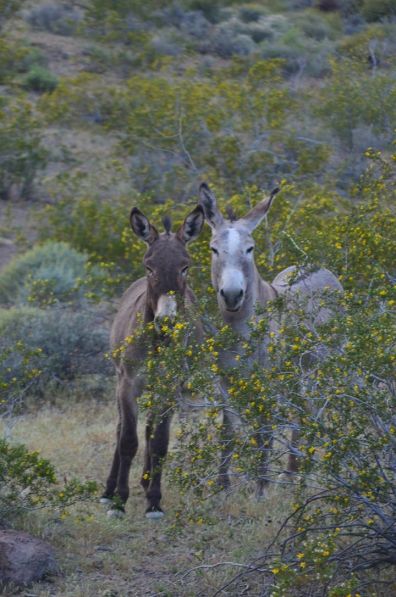
Black Mountain wild burros (photo: Marjorie Farabee)
by Marjorie Farabee, Dir. of Wild Burro Affairs, Wild Horse Freedom Federation
Shooting our wild burros is not an option!   (ACTION ALERT BELOW)
The threat:
“District 5 Sup. Steve Moss is asking staff to contact the Bureau of Land Management to reduce the burro population to 817. One option is to seek legislation to allow state agencies to issue hunting permits to bring the population under control.  Another option is to file a lawsuit against BLM.”
However, the fact is:
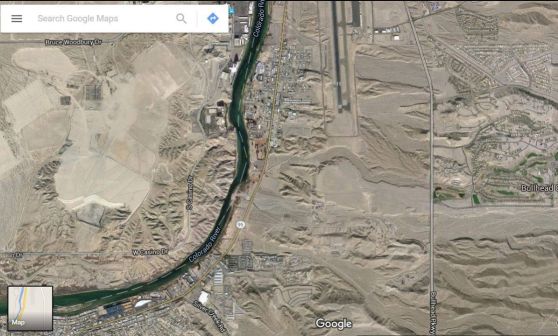
The Bullhead Parkway is in between the burros and the river, where the burros need to get water to survive.
12471542_963860700355948_7823642533908946511_o
Map showing that Bullhead Parkway is in between the burros and the river.
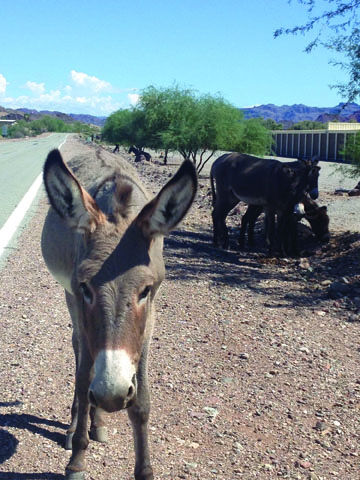
“Three burros were killed Dec. 27 in two separate incidents on the Bullhead Parkway.  Both drivers were unhurt but their cars were heavily damaged.  Another burro had to be euthanized after it collided with a car in February 2015, also on the Parkway.  A herd of about nine burros have recently been seen on the Parkway grazing on the side of the road and in the center median.”
The title of the article below should read: Supervisors vex wild burros!
ACTION ALERT:  What you can do:
Let the Mohave County Supervisors know that the burros are important to preserve.  Call them and politely explain why the burros should be protected.  Provide solutions.  Explain why the burros are important to protect.  Let them know about alternatives such as overpasses and underpasses to get to the Colorado river.  While these provisions are being built, they can provide stock tanks to keep the burros from crossing.
Those of you who live close to Kingman should go to this meeting and speak up for our burros.  The few remaining wild burros need you NOW.  Meeting Tuesday morning (1/19/16) at 9:30 a.m.
From the Mohave County Supervisor’s Agenda:
“Those wishing to address the Board at the Call to the Public regarding matters not on the Board agenda must fill out and submit to the Clerk a Call to the Public – Request to Speak Form located in the back of the room prior to the meeting. Action taken as a result of public comments will be limited to responding to criticism, referral to staff, or placing a matter on a future Agenda. Comments are restricted to items not on the Regular Agenda with the exception of the Consent Agenda, and must relate to matters within the jurisdiction of the Board.”
MOHAVE COUNTY SUPERVISOR BOARD:
700 West Beale Street
Kingman, AZ 86402-7000
Clerk of the Board Ginny Anderson
Telephone (928) 753-0731
FAX(928) 753-0732                                                                                                                                                                                                      TDD– (928) 753-0726
District 1 Gary Watson (928) 753-0722
District 2 Hildy Angius (928) 758-0713
District 3 Buster D. Johnson (928) 453-0724
District 4 Jean Bishop (928) 753-8618
District 5 Steven Moss (928) 758-0739
Kingman, Arizona 86402-7000
Website –www.mohavecounty.us

Mohave County AZ Supervisor Proposes Wild Burro Hunting


Haley Walters Today’s News-Herald
“The article, below, is unedited but please read with your eyes wide open as the numbers are skewed, again, and the bulk of the content is pure, unadulterated anti-burro propaganda.  We need people at the meeting on the 19th!” ~ R.T.

Supervisor Steve Moss says he wants to force BLM into action to control burro herd numbers

Highway along Colorado river has NO wildlife underpass or crossing


Mohave County District Supervisor Steve Moss is proposing hunting licenses to offset the over-abundant burro population in the area.
The Bureau of Land Management estimates there are between 1,400 and 1,800 burros in Mohave County, and supervisors said they want to see that number reduced to 817. This is still well above BLM’s recommendation of 478 burros for the region.
The proposal is on the agenda for Tuesday’s county supervisor meeting, but Moss said it was placed as a way to spark a reaction from the BLM.
“No one truly wants to hunt Burros, including the board of supervisors. And even if we did, neither the local nor state government has the power to issue permits,” Moss’s office said in a statement. “What we want is the BLM to come up with a solution, regardless of what it might be. We are hoping that the ‘shock’ value of the agenda item will motivate the BLM to direct the funding required towards adoption, sterilization, removal and relocation, fencing, etc. programs.”
Moss said if the BLM does not take long-term action to control the burro population, the county will pursue legal action against the Bureau for not carrying out its statutory duties outlined in The Wild Free-Roaming Horses and Burros Act of 1971.
“With that law, the federal government tied our hands as far as what we could do to control the burro population and gave the authority over to the BLM,” Moss said. “The legislation says it’s the BLM’s responsibility to control the burro herds but they’ve broken that promise and they’re not taking care of it.”
BLM Public Affairs Specialist Jayson Barangan said efforts to manage burro numbers have already been enacted, but it takes time to find the right solution.
“The situation [in Mohave County] has had our attention for a while and I think that with our toolkit and with our partnerships we’re trying to find a balanced approach to manage these animals,” Barangan said.
The BLM routinely rounds up wild burros for its Adopt a Wild Horse or Burro Program, and is currently conducting an environmental analysis to study the feasibility of antifertility inoculations.
“We’re working with some partners on a trial run on some fertility treatments of animals, but that hasn’t been set in stone yet,” Barangan said.
Still, Moss remains unimpressed with the BLM’s “token efforts” to control the burro population in the wake of numerous motorcycle and vehicle accidents involving burros.
“It’s only a matter of time until a burro goes through someone’s windshield and kills a family,” Moss said.
The BLM has placed fencing along Mohave County highways to dissuade burros from wandering into traffic, but the county still has the largest burro herd in the U.S., which is running out of space to roam.
“There is plenty of BLM land they can relocate the burros to,” Moss said. “I hope the BLM does that, or anything else, to get the local numbers under control as the current population is out of whack from what the habitat can support and is threatening public safety as the numbers are forcing the Burros to expand their range into Bullhead City and occupied subdivisions.”
The meeting will be held at the County Administration Building in Kingman on Tuesday at 9:30 a.m.

Saturday, January 9, 2016

It’s not just Wild Horses and Burros the Feds are Illegally Kicking off our Public Lands

Straight from the Horse's Heart

“A longtime reader and friend sent me the email I am posting below, with permission.  I am not condoning the actions of a few out in Oregon but the corruption of the BLM knows no bonds and the information below is rather startling, to say the very least.  Take a few moments and watch the enlightening video, it is truly eyeopening and probably seriously frighting.  How did we stray so far from the path?!?!?” ` R.T.
photo by Terry Fitch of Wild Horse Freedom Federation


If we want to know why wild horses are being booted off the land designated to them by federal legislation in 1971, we first need to understand that, according to the U.S. Constitution, this land nevershould have belonged to, or been set aside by, the federal government in the first place.     
In a new nine-minute video,constitutional attorney and educatorKrisanne Hall explains exactly which article, section, and clause in the Constitution confines the federal government’s legal property to (1) 100 square miles in Washington, D.C., and (2) the amount of land necessary for “forts and ports”—with “necessary” being determined by the states.  
In other words, the federal government, formed by the states to be the servant ofthe states, for the sole purpose of conducting foreign affairs—war, peace, negotiations, commerce—with other countries, has no constitutional right to own, take over, or trespass upon any other acreage in the entire United States of America. (Or elsewhere around the world, for that matter!)
With that fact in mind, please watch this video https://www.youtube.com/watch?v=T424sWq1SkE (below) and forward to whomever you think is ready to hear this non-partisan warning—whomever you think may be prepared to reclaim their constitutional rights.
When I think about it, it’s no wonder we feel helpless in the face of the wild horse and burro round-ups. For, having lost sight of how to defend our own rights, how can we possibly protect the rights of the creatures entrusted to our care?   
By the way, you’ll find all of Krisanne’s current and archived podcasts and videos about the U.S. Constitution—and the federal government’s constant encroachment on and subversion of it—at her website, www.KrisanneHall.com.
In the spirit of freedom for humans and horses alike,     
CQ
P.S. So long as we see this issue through partisan or ideological lens, we won’t be able to take back the property rights of states and individuals. We’re being required to rise above the Republican-vs.-Democrat, right-wing-vs.-left-wing divide (a “fight” that’s fomented by corrupt elements buried within the federal government and by their hidden “controllers”), so that we can unite against whomever and whatever would steal our God-given liberty.  

Monday, December 21, 2015

BLM to use Infrared to Count Wild Burros ahead of Stampede & Roundup

Straight from the Horse's Heart

Source: Multiple

“They blend into the background and they don’t run. They’ll just stand there and look at you…”

“I am sorry; maybe it is too early in the morning or perhaps I have not finished off enough coffee but the article, below, confuses the living daylights out of me.  It appears at first glance that the U.S. Geological Survey‘s science center in Colorado wants to do a five year study on the wild donkeys burros of the Sinbad herd inUtah.  And before the study is fully underway the BLM is going to swoop in, stampede the poor little guys and roundup and remove over 50% of the estimated Sinbad herd population.  Isn’t that ass-backwards or is it just me?  We all have known for years that the BLM cannot count nor cipher correctly so it is probably just more smoke and mirrors to further decimate the last, few wild burros that exist on this continent.  The BLM most assuredly speaks with a forked tongue…and I am not buying the hype!!!” ~ R.T.

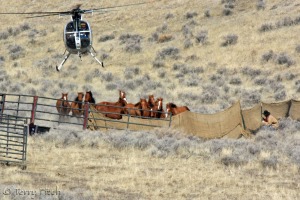
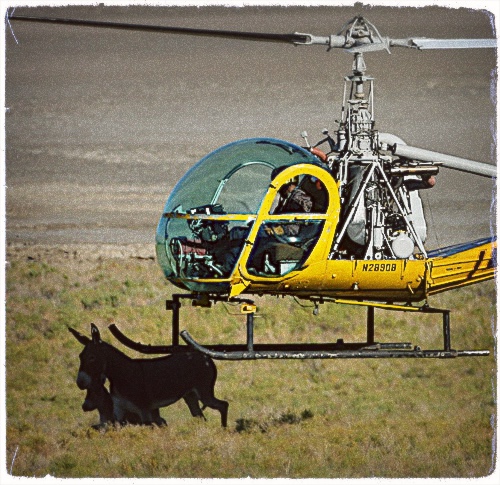
BLM's method of "humanely" rounding up wild burros
BLM’s method of “humanely” rounding up wild burros


Federal wildlife officials are planning to use infrared equipment to count the number of wild burros in an elusive eastern Utah herd ahead of a round-up next spring that’s part of a new in-depth study of the animals.
The Bureau of Land Management is using the equipment to sense the animals’ body heat because they tend to scatter and blend into the landscape, making them tough to count, the Deseret News reported.
“It’s cutting edge. We will be able to identify burros based off their heat signature,” said Gus Warr, wild horse and burro specialist for the BLM in Utah. “Burros are tough to identify and count because the jacks go off by themselves and the jennies and foals stick together. They blend into the background and they don’t run. They’ll just stand there and look at you.”
After the wild donkeys in the Sinbad herd are counted in January, the BLM plans to round them up and remove some because the herd has grown too large for the drought-parched land near Green River to support.
They’re looking to round up about 200 wild burros and remove about 130 of them from the range in March to get the herd closer to a sustainable 60 animals.
Wild burro captured by BLM ~ photo by Terry Fitch of Wild Horse Freedom Federation


The removal is also part of a larger effort to study the Sinbad herd, which is one of just two wild burro populations in the state. Relatively little is known about the animals that roam a nearly 100,000-acre range of tough terrain in the San Rafael Swell area about 200 miles southeast of Salt Lake City. Federal officials have done roundups of the Sinbad herd three times in the last two decades: in 1996, 2001 and 2008.
“There’s surprisingly been very little research done over the years,” Warr said. “This is a huge opportunity for us because there is not much data out there. This will provide us with better management tools.”
Researchers with the U.S. Geological Survey’s science center in Colorado are doing a five-year study looking at the dynamics of the herd, including factors like habitat, mortality, movements and survival rate by age.
“This is ground zero because you have to know how many of them are out there if you are going to manage them,” Warr said.
The research is an outgrowth of a 2013 report from the National Academy of Sciences criticizing the BLM for not using a more scientific approach to managing wild horses and burros on public lands.

Saturday, December 19, 2015

How the Federal Budget Package Protects Animals

Straight from the Horse's Heart

by  ~ASPCA President and CEO, as published on Huffington Post Blog

Horse Slaughter: To be clear, this is still a short-term and incomplete solution…

"Harley" (Ginerous Legacy) Saved from slaughter by Habitat for Horses and adopted by author R.T. Fitch and his wife Terry. Photo by Terry Fitch
“Harley” (Ginerous Legacy) Saved from slaughter by Habitat for Horses and adopted by author R.T. Fitch and his wife Terry. Photo by Terry Fitch
The massive, 2,000-page federal spending omnibus package President Obama signed today represents months of negotiations by the House and Senate. And while some of the loudest and largest passengers on that omnibus include defense spending, tax reform, and homeland security, a number of critical animal causes fortunately found seats as well.
Their inclusion wasn’t a sure thing, but in a process known for deep political compromises, it’s gratifying to see legislators not compromising animal welfare – particularly the protection of American horses and farm animals used in federal research for political gain.
First, the law will continue preventing the U.S. Department of Agriculture (USDA) from using taxpayer dollars to inspect horse slaughter facilities, effectively prohibiting such facilities on U.S. soil in the coming fiscal year.
To be clear, this is still a short-term and incomplete solution. It requires annual approval, and does not address the problem of horses being shipped to other countries for slaughter, a cruel process that can also endanger human health. This is why we encourage passage of the Safeguard American Food Exports (SAFE) Act of 2015, which would protect American horses from slaughter anywhere, permanently.
The federal spending measure also requires the USDA to improve animal welfare policies at federally-run agricultural facilities including the U.S. Meat Animal Research Center (USMARC) – a Nebraska facility where animals were subjected to horrible abuse and torture to help meat producers discover more effective ways to make money.
Combined with improved policies at the USDA, this spending measure will hold USMARC and other federal animal research facilities to the basic standards, inspections, and reporting requirements of the Animal Welfare Act.
Other included measures will help protect wild horses from slaughter and ensure proper oversight and enforcement of laws cracking down on puppy mills and ending horse soring.
Considering how these humane proposals were in doubt as recently as this week, it’s tempting to think that we – and these victimized animals – dodged a bullet, but it should never have come to that. Ensuring animals are not tortured for industry profit is not simply a good idea; it’s an imperative that represents some of our most basic values and obligations as Americans and as human beings.
Today, our leaders stepped up for those values. Making sure they do the same moving forward may depend on how loudly we – the people they represent – stand up and speak out. Please consider the many ways you can be a voice for stronger legal protections for animals.