Monday, September 9, 2013

Would BLM Sell Wild Horses to Slaughter? You betcha.

Straight from the Horse's Heart

SOURCE:  PPJ Gazette
By Debbie Coffey Copyright 2013 All Rights Reserved.
In memory of the late Dr. Patricia Haight, who worked hard for theConquistador Program, I decided to file a Freedom of Information Act (FOIA) request based on some records she managed to obtain via her FOIA request.
Patricia Haight’s FOIA response included teleconference notes between a “team” of BLM employees who talked about slaughtering wild horses, among other things.  Cindy McDonald (American Herds blog) posted Haight’s FOIA documents (including the BLM’s discussion of alternative management options) in her library.
Myth #2: The BLM is selling or sending wild horses to slaughter.
Fact: This charge is absolutely false. The Department of the Interior and the Bureau of Land Management care deeply about the well-being of wild horses, both on and off the range, and the BLM does not and has not sold or sent horses or burros to slaughter. Consequently, as the Government Accountability Office noted in a report issued in October 2008, the BLM is not in compliance with a December 2004 amendment (the so-called Burns Amendment to the 1971 Wild Free-Roaming Horses and Burros Act) that directs the Bureau to sell excess horses or burros “without limitation” to any willing buyer.
In a 2008 e-mail, Sally Spencer, the BLM’s Supervisory Marketing Specialist, WAS NEGOTIATING TO SELL 10,000 WILD HORSES to someone in Canada.  Who would buy 10,000 horses? And what for?  Certainly not to be used in movies or to graze on oil fields.
In this 2008 e-mail, Sally Spencer states:
“It was a pleasure to talk with you yesterday.  The horses that would be the easiest to get to Canada are the 10,000 sale-eligible horses (more than 10 years of age).  We recently sent a load of horses to Saskatchewan from a start point close to one of the Long Term Holding Pastures in Kansas.  A load is around 36 animals.  The total transportation cost was about $5,000.  Also you asked me about the cost of the horses in Long Term Holding.  We have estimated that the cost to care for the 10,000 sale eligible horses for the rest of their lives on Long Term Holding Pastures will be approximately $22 Million.
There are still details to be worked out, however please let me know if you are interested in purchasing any of the horses and if so, when you would be ready for them.
Thanks, and I look forward to talking with you in the future.  Sally”
Also, added in a hand written sentence below this (so there’s no telling when this part was written – in 2008 or when it had to be released in a FOIA request) is“Have $ from sale of horses be used to spare other 20,000 animals?”
Obviously, if the other 20,000 horses were to be “spared” (not killed), the person who wrote this knew that 10,000 horses would NOT be “spared” (and would be killed).
From the cheery tone of this e-mail, Spencer seemed to be selling horses to slaughter as easily as selling Tupperware.
To see the copy of Sally Spencer’s e-mail, click HERE.
So, would the BLM sell wild horses to slaughter? You betcha.  The cover letter I received from the Washington FOIA office informed me that this sale “never came to fruition,” but no documents were enclosed as proof that it didn’t come to “fruition.”  (And, you know I’ll ask for proof.)
Is this another example of how the BLM “cares deeply” about the well-being of the wild horses?
And a huge thank you to Cindy McDonald, who’s retired but keeps a wealth of information for wild horse & burro advocates on her American Herds blog site.  http://americanherds.blogspot.com/

Saturday, September 7, 2013

BLM’s questionable “uses” of public lands

Straight from the Horse's Heart

by Debbie Coffey                                     Copyright 2013                               All Rights Reserved.
950bd597-8f80-4baf-a9cf-5d4bbfa17761_RTX130JDIf you want to see how theBureau of Land Management (BLM) shows bias in Environmental Assessments, you only have to look at what the BLM writes in EAs to round up wild horses, and then compare it to what they wrote in an EA to approve the 2013 Burning Man Festival, where 68,000 people, and their vehicles, recently trampled the Black Rock Desert in Nevada.

Gene Seidlitz, BLM’s District Manager for the Winnemucca District gave aFinding of No Significant Impact (FONSI) to The Burning Man Festival.   It’s kind of funny how “uses” of public lands that bring in significant amounts of money always seem to get a Finding of No Significant Impact.
The June 2012 Environmental Assessment (EA) for Burning Man, states this:
“Black Rock City LLC is responsible for payment of the actual costs of administering the Special Recreation Permit, including all direct and indirect costs, in addition to the commercial use fees.  The fees that BLM collected for the designated event period in 2008, 2009 and 2010 ranged from $989,000 to nearly $1.3 million.  In 2010, the BLM’s cost recovery from BRC for issuing the permit totaled $795,533.55, and BRC’s commercial use fees totaled $500,483.98 (Aspen 2011).
Agency, city and county personnel get paid overtime, and Black Rock City reimburses this cost.”
(This means BLM employees get paid overtime and Black Rock City foots the bill.)  This almost seems like giving “bribes” to the agency, city and county, doesn’t it?
The EA also included this:  “Mr. Wayne Burke, Tribal Chairman, stated the following before the Nevada State Senate Select Committee on Economic Growth and Employment: Allowing Tribe members to become vendors to the Burning Man Festival will bring money into the Tribe.  We can offer resources to assist Tribe members to do that.  We are looking to have our current law and order code pass through the Tribal Council. When it is passed, we will be able to receive traffic citation fines (Nevada State Senate 2011).”
“The Paiute also have received additional funding from BRC outside of the event period.  Mr. Scott Carey, Tribal Planner testified before the Senate Select Committee, stating: The Tribe is proud of our partnership with Black Rock Solar, the fund-raising arm of the Burning Man Festival.  Using the solar demonstration systems program that the State Legislature approved, we have been able to construct eight solar projects on the reservation.  This has led to substantial savings for the Tribe.  For example, the community of Nixon has more solar panels per person than any other community in the United States. State Route 447 has more solar panels per mile than any other road in the United States and has been declared “America’s Solar Highway.”  We are looking to expand our solar projects into commercial-sized projects (Nevada State Senate 2011).”
(How are the Paiutes going to support solar without water?  Isn’t there a drought?)
The maps on p. 98 and p. 238 of the BLM’s Burning Man Festival EA don’t clearly indicate the outline of the Wild Horse & Burro HMAs in relation to the event area and roads/airstrip.
Under Wild Horse and Burros, the EA states:
“The cumulative effects study area for wild horse and burros includes the travel routes to and from the event and the air basin (see Figure 5-1).”
And then, “The wild horse gather plans would help BLM manage herds that currently have populations in excess of the Appropriate Management Level (AML).  While gathering horses and burros is stressful for the captured animals, managing herds at the AML is necessary to comply with the Wild Free-Roaming Horses and Burros Act and protect rangeland resources”.
Do you think removing wild horses is really about “protecting rangeland resources?”  Shouldn’t the BLM be equally concerned about (and prohibit) 68,000 people from entering the desert (and kicking up dust) for an event if the BLM wants to protect the rangeland?  The BLM is closing off roads to public lands in other areas to even a few cars.
The EA also states “Cumulative Impacts from the Proposed Action.  The incremental contribution of the Proposed Action to cumulative effects on wild horses and burros would be largely limited to the duration of the Burning Man 8-day event and immediately before and afterwards.  As such, the Proposed Action would not combine with other activities to result in cumulative impacts to wild horses and burros.”
This sort of minimizes the impact of building an airstrip, roads, and having 68,000 people trampling around in the desert, doesn’t it?  What exactly constitutes “cumulative” anyhow?  2 days?  8 days?  An annual event with 68,000 people?  It seems everything is open to interpretation (and money).
BLM’s decision-making and policies seem to be arbitrary and capricious, and seem to be in violation of the Administrative Procedures Act.
SOURCES:

Friday, September 6, 2013

UK’s Tesco Horsemeat Ad Banned for Damning Whole Food Industry

Straight from the Horse's Heart

Source: Multiple

“It’s about the whole food industry. And it has made us realise, we really do need to make it better.”

unexpected_horse_in_bagging_area_horsemeat_horseburgerTesco’s press ad entitled, “What burgers have taught us”, which it ran in the wake of the horsemeat scandal, has been banned for implying there are issues with meat standards across the whole food industry.
The ad, created by Wieden + Kennedy, appeared in national newspapers and said: “The problem we’ve had with some of our meat lately is about more than burgers and bolognese. It’s about some of the ways we get meat to your dinner table.
“It’s about the whole food industry. And it has made us realise, we really do need to make it better.
“We’ve been working on it, but we need to keep going, go further, move quicker. We know that our supply chain is too complicated. So we’re making it simpler.
“…Seriously. This is it. We are changing.”
Two complainants, including an independent butcher, challenged the ad’s wording and claimed it was misleading for implying that issues with meat standards ran across the whole food industry.
Tesco said the ad was published to show it was taking the horsemeat issue seriously and to demonstrate it was listening to customers. It argued that by being proactive in issuing the communication to the public, it showed its own commitment to customers to make its supply chain shorter, less complex and more transparent.
Despite Tesco outlining that at the time of the ad and the scandal, the media was naming brands and specific operators who had been directly implicated in the selling of horsemeat, the Advertising Standards Authority banned the ad for being misleading.
The ASA said the ad implied that all retailers and suppliers were likely to have sold products contaminated with horsemeat, and because relatively few instances of contamination had been identified at the time the ad appeared, it has been deemed misleading.

Wednesday, September 4, 2013

Video: Battle with the BLM over Burros

Straight from the Horse's Heart

(From June)

Source: By Lisa Myers and Michael Austin of NBC News
BLM defends the operations as humane – your tax dollars at work


Warning: Some viewers may find the video content to be extremely disturbing
Public criticism of roundups is not limited to wild horses. The Bureau of Land Management also conducts annual “gather” operations to remove “excess” wild burros from herd areas in the West.
In this video, advocates for the wild burros document “aggressive” roundup practices, including a helicopter hitting and flipping over a burro in the California desert in 2009 and a BLM contract wrangler manhandling a reluctant burro during a 2008 roundup in Arizona.
As with the wild horse roundups, the BLM defends the operations as humane and says that incidents such as these are both isolated and contrary to its contractor guidelines.
The BLM says there are about 5,800 wild burros living in the wild, mostly in Arizona, Nevada and California, but many advocates believe the wild burro population is much smaller and that burro roundups are unnecessary.

Tuesday, September 3, 2013

BLM & Forest Service Experimenting on Wild Horses

Straight from the Horse's Heart

by Debbie Coffey

PART 1 of a series on BLM & Forest Service Experimentation on Wild Horses and Burros

(Warning: the photos below may be disturbing to some)
At the upcoming BLM National Wild Horse & Burro Advisory Board meeting, the board will likely bring up the subject of the field spaying of wild mares.
It is important to keep in mind that the BLM and Forest Service are partnering inEXPERIMENTING on our wild horses (and, in the case of the Sheldon National Wildlife Refuge, “feral” horses).  This advisory board was even discussing tubal ligation for mares (which seems to have been in trials in 2004).
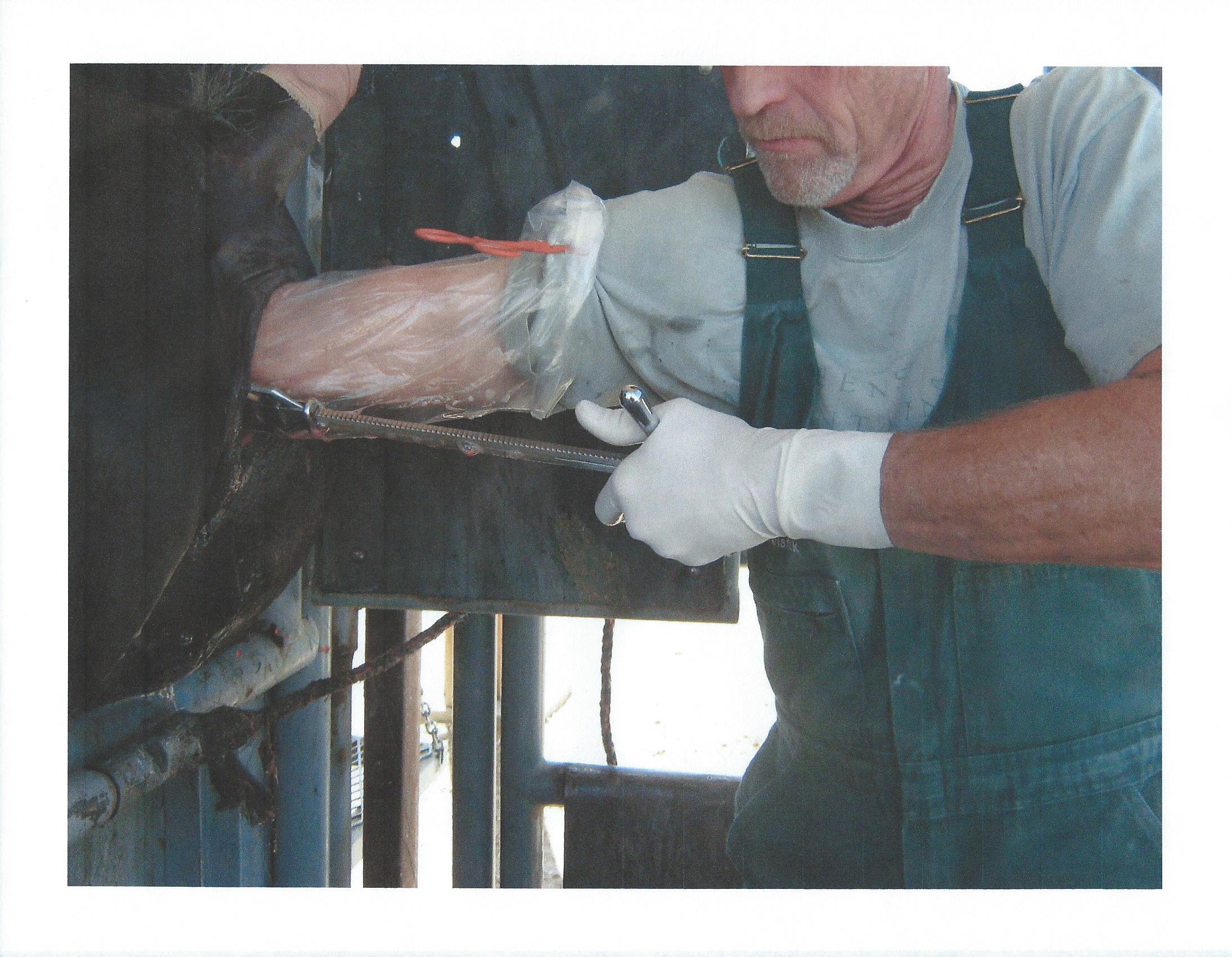
Below is a presentation seemingly by LEON PIELSTICK, DVM, the veterinarian who has been conducting experiments on the field spaying of mares, and it shows (possibly Leon Pielstick himself) spaying a mare at a wild horse sanctuary.  There are also photos of a wild stallion during a vasectomy procedure, presumably at Sheldon.
Your tax dollars are paying for this experimentation.
SOURCE:     POPULATION CONTROL IN WILD HORSES,  Leon Pielstick, DVM
(this is a portion of the presentation of an ovariectomy with chain ecraseur viacolpotomy incision)
Pielstick 1
Pielstick 2
Pielstick 3
Pielstick 4Pielstick 5
Pielstick 6
Pielstick 7
Pielstick 8
(And the presentation states this:)
pielstick 15
However, other veterinary sources are concerned about a high incidence of peri-operative complications, including post-operative myopathy/neuropathy, wound infections, wound dehiscence, eventration, vaginal adhesions, peritonitis, post-operative pain and hemorrhage.  Also, looking at the 3rd bullet point above, others estimate the prep time for surgery to be 10 minutes for standing sedation, 10-15 minutes for epidural anesthesia, and 10 minutes for the aseptic preparation.  And the part about this being a “One time treatment, no need for further round ups” – wouldn’t ”no need for further round ups” mean doing this to more than a few mares and could this create a NON-REPRODUCING HERD?
(Here is a portion of the presentation showing a vasectomy)
Pielstick 9
Pielstick 10
Pielstick 11
Pielstick 12
Do you think this is what Congress had in mind when they passed the Wild Free-Roaming Horses & Burros Act of 1971?  Or, do you think these government agencies are running amuck?
Please attend the BLM National Wild Horse & Burro Advisory Board Meeting at the Key Bridge Marriott in Arlington, Virginia on Sept. 9-11, 2013, and be a voice for our wild horses.  Remember, the BLM has only allotted a limited time on only one day for public comment, which is Sept. 10th from 3-5 p.m.
Sources:
Information about the BLM National Wild Horse & Burro Advisory Board meeting: http://www.blm.gov/wo/st/en/info/newsroom/2013/august/nr_08_09_2103.html

Sunday, September 1, 2013

Extraordinary Wild Mustang Journey from Patagonia to Alaska Concludes

Straight from the Horse's Heart

“Once again the light of ‘Feel Good Sunday’ is upon us and it is our distinct pleasure to share with you a personal letter that I received this week. 
Here at SFTHH and Wild Horse Freedom Federation we are hell bent on saving the last few native wild horses and burros from the morally bankrupt federal agency, the Bureuo of Land Management (BLM).  We are animatedly opposed to violently removing native, wild equines from their rightful land versus managing them on the range as even simple common sense would dictate.  But in all the clamor and all the drum beating we often forget the few shining bright stars that emerge triumphant from the BLM’s flagrant abuse and failings…and those bright lights are the horses themselves.
Many fine folks have adopted BLM abused wild horses and found them to be a stout and sturdy steed.  Perfect temperament, strong feet and outstanding endurance but today we share with you the opening chapter of a story that we will be following and sharing with you; an epic journey, a statement to the fortitude and stamina of our wild equines…I am both honored and humbled by the personal invitation to share this epic horse trek with all of you.
As most of you are aware, Terry and I have beat ourselves up with “extreme” horse treks across Outer Mongolia and Tibet over the past several years but what we did pales in comparison to what is presented here so please wet your collective appetites on the letter below and we are in and will maintain contact with the parties involved so that we can share with the advocacy the positive influence that our great American Wild Horses are sharing with world.  Keep the faith.” ~ R.T.
~~~~~~~~~~~~~~~~~~~~~~~~~~~~~~~~~~~~~~~~~~~~~~~~~~~~~~~~~~~~~~~~~~~~
To: R.T. Fitch – President, Wild Horse Freedom Foundation
From: CuChullaine O’Reilly – Director, The Long Riders’ Guild
Subject: Extraordinary Mustang Journey from Patagonia to Alaska
Concludes
CC: German Long Rider Guenter Wamser
Dear Mr. Fitch,
Long RidersMy name is CuChullaine O’Reilly and I am writing to you from the
Long Riders’ Guild, the world’s international association of
equestrian explorers and long distance travellers.
With Members in forty-five countries, every major equestrian
explorer alive today belongs to The Guild, including Hadji
Shamsuddin of Afghanistan, who recently rode a thousand miles
through that war-zone, Jean-Louis Gouraud of France, who rode
3,000 miles from Paris to Moscow, Claudia Gottet of Switzerland,
who rode 8,000 miles from Arabia to the Alps, Adnan Azzam of
Syria, who rode 10,000 miles from Madrid to Mecca, and Vladimir
Fissenko of Russia, who rode 19,000 miles from Patagonia to
Alaska.
At two-thousand plus pages, and still growing, and having now been
visited by more than three million people world-wide, The Long
Riders’ Guild website is the repository of the largest collection
of equestrian travel information in human history.
www.thelongridersguild.com
I am writing to you today so as to alert you to the fact that an
extraordinary journey has been accomplished with the help of BLM
mustangs.
Guenter Wamser is a Founding Member of the Long Riders’ Guild, a
talented author, and a fine photographer. He is also rightly
considered Germany’s most important living equestrian explorer.
The latter fact is based upon the extraordinary journey he has
undertaken from the bottom of Patagonia up to Alaska.
The first portion of the trip was done using two Criollo geldings.
Having reached the Texas border, American authorities refused to
allow the horses entry because they were found to be infected with
piroplasmosis.
After finding his horses a good home in Mexico, the Guild helped
Guenter locate BLM American mustangs to continue the trip. These
horses had been trained in Colorado by prisoners in a special
training programme.
Those mustangs have now carried the German Long Rider to the top
of Alaska!
Because the Guild has assisted Long Riders to complete journeys on
every continent except Antarctica, I seldom comment publicly on a
particular mission. However I have stopped my work so as to
contact you, as I believe the implications of this unique journey
might be of tremendous help in terms of re-homing BLM mustangs.
By using Criollos from the Pampas, and Mustangs from the Plains,
both parts of Guenter’s amazing journey have been done on native
horses which originated at either end of the Americas. These great
horses have turned out to be extraordinary examples of how good,
strong, affordable native horses are so well suited for equestrian
travel.
During his many years in the saddle, this German Long Rider has
literally ridden thousands of miles. Yet his treatment of his
horses has always been of paramount importance. He has never
rushed them, abused them or over-ridden either the Criollos or the
Mustangs. That is why even though his BLM mustangs have travelled
thousands of miles across some of the world’s most challenging
terrain, Guenter’s horses are all in superb condition.
Guenter is therefore a great example of how an ethical equestrian
traveller can overcome all kinds of dangers and challenges, all
the while remaining true to his horses and protecting their
interests. And having assisted hundreds of equestrian explorers, I
can say with conviction that if there is a modern “hero of the
mustang,” which represents both North and South America, then Long
Rider Guenter Wamser has earned that honour!
He is, in a word, a fine example of the equestrian ethics which
the international Long Riders’ Guild strives to promote.
Guenter is currently in the back country of Alaska, which has left
him temporarily out of touch with the internet.
However he is due to conclude his journey very soon.
When he does, I believe that the news of such a historic journey
should be shared with the world, especially the supporters of the
American mustang movement.
I have attached an example of the many beautiful photographs
which Guenter has taken of his horses and the journey.
In closing, I hope that this brief note finds you well.
Kind regards,
CuChullaine O’Reilly FRGS

Saturday, August 31, 2013

Just a reminder...


Remember to visit us on Facebook!


Signs of Hope for the West’s Wild Horses?

Straight from the Horse's Heart

Source: By Kerry Drake as published at WyomingNews.com

“The BLM has failed in its mission 100 percent, on purpose,”

Ken Salazar may not have totally destroyed the Wild Horse and Burro Management Program while he was head of the Interior Department, but he made an already terrible situation far worse.
Now advocates for the animals hope a change at the top leads to some positive changes in a program they believe has been a disaster since it was created by Congress in 1971.
Cloud and family after release from BLM capture in 2009 ~ photo by Terry Fitch of Wild Horse Freedom Federation
Cloud and family after release from BLM capture in 2009 ~ photo by Terry Fitch of Wild Horse Freedom Federation
Ginger Kathrens, a filmmaker who has spent the past 19 years documenting the activities of the Pryor Mountain wild horse herd in Wyoming and Montana, said Salazar was a rancher who viewed the animals as pests and implemented policies that treated them as such.
He left office dodging questions about the sale of 1,700 wild horses to one of his Colorado neighbors, who had them slaughtered. The matter is still under investigation.
Under Salazar, the program’s budget more than doubled while most of its efforts failed miserably. The agency now spends 60 percent of the program budget on expenses related to the more than 50,000 horses it rounded up.
The rest is spent “managing” the remaining 38,000 wild horses left roaming the West. But as a damning report issued in June by the National Academy of Sciences noted, that estimate is nothing but a guess.
Kathrens, who lives on a ranch in Westcliffe, Colo., said BLM has just wanted to see wild horses gone, literally managed to extinction. Jeannine Stallings, a long-time animal advocate in Cheyenne, agrees.
“The BLM has failed in its mission 100 percent, on purpose,” Stallings charged.
Stallings, 83, has watched the agency for years. When I interviewed her about the wild horse program in 1987, she said the agency had ignored its studies “because they didn’t get the results they wanted.”
Wearing a yellow T-shirt that proclaims, “Americans Don’t Eat Horses,” Stallings said while she voted for Barack Obama twice and considers him a good president, “He certainly hasn’t been a friend to wild horses.”
Why should anything be different now?
Kathrens said that Sally Jewell, the new secretary of Interior appointed by Obama, doesn’t have the personal animosity toward wild horses that Salazar had.
“She brings with her a love of the wild and open spaces,” she explained. “If she appoints people to key positions who agree with her … things could change.”
Time will tell if Jewell is able to n or even wants to n change the program’s direction, but in the meantime, the lives of thousands of wild horses are at risk here and in nine other Western states.
“In Wyoming, we have a tragedy in the making,” Kathrens said, referring to BLM’s plan to “zero out” the Rock Springs herd on private land.
That will mean taking all of the horses off public land as well. The animals would be rounded up and moved to Salt Wells and Adobe Town in the Red Desert, where forage is scarce.
The Rock Springs herd has become a great tourist attraction, she noted, but under BLM’s plan, people would no longer have access to see the horses.
Kathrens has likely done more than anyone else to raise the public’s awareness of the multitude of problems facing America’s wild horses. She has produced three films for PBS’s “Nature” series, focusing on the Pryor Mountain herd and in particular the life of Cloud, a wild pale palomino stallion.
Stallings said Cloud has been rounded up several times up by BLM but always freed.
“They could never take Cloud off the range,” she said. “They know the public just wouldn’t stand for it.”
The nonprofit Cloud Foundation started by Kathrens is dedicated to preventing the extinction of Cloud’s herd through education, media events and public involvement. It is also dedicated to protecting other wild horse herds on public lands, especially isolated herds with unique characteristics and historical significance.
For years, BLM has defended its management program and maintained that the roundups are necessary. But some former BLM officials are now decrying what the agency is doing.
What should happen to the 50,000 wild horses being kept in pens by the feds? Kathrens said the obvious solution is to “take some of the 24 million acres of public land where the herds have been ‘zeroed out’ and put them back on the range.”
Her fear, though, is that the agency will surreptitiously get rid of the animals by selling them to be slaughtered when the public isn’t paying attention.
Stallings shares her concern.
“The fact is that BLM is winning and we’re losing,” she said. “Things have always been bad, but it’s much worse today, and it’s going to take a national outcry (for things to improve). I just hope it doesn’t end in a horrendous, final tragedy.”
Thanks to Stallings, Kathrens and other animal advocates’ abilities to stir up the public, wild horses have not disappeared from the range yet.
But they’ve been right about these issues for decades and are still largely ignored by the federal government. It’s time someone in charge seriously listens to them, and I hope Jewell is the one who does.
Veteran Wyoming journalist Kerry Drake is the editor-in-chief of The Casper Citizen, a nonprofit, online community newspaper.

Click (HERE) to join the conversation atWyomingNews.com