Forbes
Every small-town mayor is bedeviled by something. For Paula Bacon of Kaufman, Texas, it was Dallas Crown, which slaughtered horses next door to her friend Mary Nash’s 40-acre farm off Highway 175. Read MORE...
Showing posts with label Horse Slaughter. Show all posts
Showing posts with label Horse Slaughter. Show all posts
Wednesday, January 11, 2012


Take a Stand Against Horse Slaughter at Town Hall Meetings in Your Community
Animal Welfare Institute
It is time to put a face to the message that horse slaughter must end immediately! The most direct way for you to help educate your elected officials on the importance of banning horse slaughter is to talk with them face-to-face. The easiest way to do this is to attend local town hall meetings hosted by your U.S. Senators and Representative and urge them to cosponsor and support the American Horse Slaughter Prevention Act, if they haven't already done so. If your Senators and/or Representative are already cosponsors, a public thank you can help motivate them to action when back in Washington, D.C., as well as educate others at the town hall meeting. Your voice can make a difference!
In light of November’s passage of the FY2012 Agriculture Appropriations bill - which for the first time since 2005 did not include language blocking the use of federal funds for USDA horse meat inspections - the door has once again been opened for horse slaughter in the U.S. We must respond to this failure by redoubling our efforts to pass the American Horse Slaughter Prevention Act, which would once and for all ban horse slaughter in the U.S. and prevent the export of horses for the same purpose.
In past years, you faithfully emailed and called your legislators’ offices to let them know where you stand. This potent new threat calls for renewed action that puts a face to the message: speaking on behalf of horses at town hall meetings held by your legislators in your local communities. These town hall meetings are likely to take place in convenient settings in your community, and their formats make it easy for you to voice your opposition to horse slaughter directly to legislators and urge their support of the American Horse Slaughter Prevention Act.
Horse slaughter proponents are spreading a great deal of misinformation through the media in an attempt to cloak the grim realities of horse slaughter. It is important for legislators to get the facts and know that their constituents do NOT support horse slaughter and want a complete ban on the practice.
What You Can Do
Your legislators’ district offices can tell you when and where town hall meetings are scheduled in your community. Call their offices, or visit their websites to see if information on the meetings is posted online. You can visit AWI’s online Compassion Index to obtain contact information for the local offices of your U.S. Representative and Senators. Once you determine the time and place of such meetings, invite friends to attend with you so they can speak up for the horses as well. We have provided some talking points below for you to consider. If you discover a legislator has no town hall meetings planned, inquire why not - you should then request a meeting with your legislator (not staff) when they are next in town!
After you have attended a town hall meeting or met with your legislator please take a minute to visit AWI’s Compassion Index again and fill out the follow up survey. It will allow you to easily provide valuable feedback to AWI that will help in our efforts to educate Congressional staff in Washington, D.C. Be sure to fill this form out after each event you attend.
Please share this Dear Humanitarian eAlert with friends, family and coworkers, and encourage them to take action today!
Sincerely,
Chris Heyde
Deputy Director
Government and Legal Affairs
Public speaking is not easy for many people - but the more you do it, the easier it gets. Brief, clear, and polite comments receive the most regard from lawmakers. To help guide you, we have drafted talking points around which you can frame your presentation. You should also review our more detailed fact sheet on the subject before you go.
1. I am here today to express my opposition to the slaughter of American horses and to request you cosponsor the American Horse Slaughter Protection Act (H.R. 2966/S. 1176) which would end this gruesome practice.
Date:
Wednesday, January 11, 2012
S. 1176/H.R. 2966 - American Horse Slaughter Prevention Act of 2011
Dear Humanitarian:It is time to put a face to the message that horse slaughter must end immediately! The most direct way for you to help educate your elected officials on the importance of banning horse slaughter is to talk with them face-to-face. The easiest way to do this is to attend local town hall meetings hosted by your U.S. Senators and Representative and urge them to cosponsor and support the American Horse Slaughter Prevention Act, if they haven't already done so. If your Senators and/or Representative are already cosponsors, a public thank you can help motivate them to action when back in Washington, D.C., as well as educate others at the town hall meeting. Your voice can make a difference!
In light of November’s passage of the FY2012 Agriculture Appropriations bill - which for the first time since 2005 did not include language blocking the use of federal funds for USDA horse meat inspections - the door has once again been opened for horse slaughter in the U.S. We must respond to this failure by redoubling our efforts to pass the American Horse Slaughter Prevention Act, which would once and for all ban horse slaughter in the U.S. and prevent the export of horses for the same purpose.
In past years, you faithfully emailed and called your legislators’ offices to let them know where you stand. This potent new threat calls for renewed action that puts a face to the message: speaking on behalf of horses at town hall meetings held by your legislators in your local communities. These town hall meetings are likely to take place in convenient settings in your community, and their formats make it easy for you to voice your opposition to horse slaughter directly to legislators and urge their support of the American Horse Slaughter Prevention Act.
Horse slaughter proponents are spreading a great deal of misinformation through the media in an attempt to cloak the grim realities of horse slaughter. It is important for legislators to get the facts and know that their constituents do NOT support horse slaughter and want a complete ban on the practice.
What You Can Do
Your legislators’ district offices can tell you when and where town hall meetings are scheduled in your community. Call their offices, or visit their websites to see if information on the meetings is posted online. You can visit AWI’s online Compassion Index to obtain contact information for the local offices of your U.S. Representative and Senators. Once you determine the time and place of such meetings, invite friends to attend with you so they can speak up for the horses as well. We have provided some talking points below for you to consider. If you discover a legislator has no town hall meetings planned, inquire why not - you should then request a meeting with your legislator (not staff) when they are next in town!
After you have attended a town hall meeting or met with your legislator please take a minute to visit AWI’s Compassion Index again and fill out the follow up survey. It will allow you to easily provide valuable feedback to AWI that will help in our efforts to educate Congressional staff in Washington, D.C. Be sure to fill this form out after each event you attend.
Please share this Dear Humanitarian eAlert with friends, family and coworkers, and encourage them to take action today!
Sincerely,
Chris Heyde
Deputy Director
Government and Legal Affairs
Public speaking is not easy for many people - but the more you do it, the easier it gets. Brief, clear, and polite comments receive the most regard from lawmakers. To help guide you, we have drafted talking points around which you can frame your presentation. You should also review our more detailed fact sheet on the subject before you go.
1. I am here today to express my opposition to the slaughter of American horses and to request you cosponsor the American Horse Slaughter Protection Act (H.R. 2966/S. 1176) which would end this gruesome practice.
a. If you have a horse and/or have rescued a horse be sure to include this in your opening presentation.
b. If your Member of Congress is already a cosponsor, please thank him/her for their support and encourage their assistance in getting the bill adopted. Members are rarely thanked by their constituents, so this gesture is much appreciated.
2. American tax dollars should not be paying for horse slaughter.a. We don’t eat horse meat in the U.S.
b. Horse slaughter is not a job creator and is a burden on local communities.
c. The government shouldn’t be spending tax dollars to inspect plants that will support foreign industries.
d. Horses give their hearts to us. They helped us settle this country, carried us into battle, and continue to work hard for us every day. It is a betrayal to sell them to foreign butchers.
3. Slaughter is not humane euthanasia. It is animal cruelty.a. Horses’ instinctual flight response makes them ill-suited for stunning, so they often endure repeated blows and sometimes remain conscious during their dismemberment.
b. U.S. government documents graphically indicate cruelty was widespread at the former U.S. plants, even with USDA oversight. Instead of regulating abuse poorly, we should ban the practice entirely.
c. Part of responsible horse ownership is providing a humane end for a horse through euthanasia, not slaughter. That is what the majority of horse owners do already.
Thursday, July 14, 2011
Update: Prison Horses Found in Waco
Horseback Magazine
Story and Photos by Steven Long
 HOUSTON, (Horseback) – At least some of the horses once belonging to the State of Texas and in custody of the Texas Department of Criminal Justice have been found after being sold at auction. The TDCJ prison horses were located at a facility owned by a former Texas prison inmate and equine kill buyer whose wife confirmed that the horses were the same ones purchased Monday night at a Huntsville, Texas livestock auction.
“We are not selling these horses for food,” said TDCJ chief spokeswoman Michelle Lyons. “They were sold at a public auction to the public.”
The horses were sold as culls from the prison system’s extensive livestock program.
“We cannot speak intelligently as to the buyers’ intent,” Lyon’s told Horseback Magazine late Thursday, “but have been informed by the auction house that there were at least 10 different buyers of TDCJ horses.”
Asked if TDCJ was aware of recent concerns raised about the chemicals used to medically treat U.S. horses, Lyons said “Without an extensive review of the horses’ veterinary records, we cannot make assurances regarding what medications they have or have not taken.”
Drugs such as phenylbutazone (Bute), wormers, and a variety of other drugs routinely administered to horses here, possibly including prison horses, are strictly prohibited for use in food animals.
One of the most genetically perfect herds of horses in North America was hit hard by the selloff of 61 animals at a public auction, their most likely destination, a Mexican slaughterhouse notorious for unspeakable cruelty. The herd is genetically and historically important because they have been part of a captive breeding program for more than a century with little outside genetic influence. On the rare occasions other horses have been introduced, they have been foundation pedigreed lines.
The horses were part of a herd of 1,600 owned by the State of Texas and managed by the Texas Department of Criminal Justice in Huntsville, according to Lyons.
The state’s captive herd is subject to the most advanced breeding techniques and is held to exacting standards that are world class. The horses are not grade horses but are beneficiaries of the very best techniques of modern agricultural science. The livestock managers are products of the renowned schools of agriculture at Texas A&M University and the nearby Sam Houston State University. The horses are primarily Quarter Horses with substantial Percheron blood.
The information that the horses had been sold at auction came to Horseback Online Monday night when a confidential source who was at the Huntsville cattle auction called and said that a large number of prison horses had been sold to slaughter and had been loaded on a truck south heading down I-45.
“People who work at the prison are really upset about this,” the man said during a phone call to the magazine’s offices.
The Texas prison system holds “Premium Auctions” of horses only rarely where the public is invited to bid after extensive advertising of the sale. No such ads were placed for the 61 horses sold Monday. They were quietly sent to auction where a large truck was already waiting, according to the source who said the horses sold for about 40 cents a pound.
Lyons confirmed the prison system auctions 90-100 “cull” horses each year from its program.
Livestock auctions are the primary sources of horses sent abroad for food.
The Texas prison system breeds big horses, big enough to hold a 300 pound guard for an eight hour shift in the fields, hence the draft horse bloodlines brought into the herd. The stout corrections officer is known in prison parlance as “The Boss.” The horses and their human counterparts guard men dressed in white garb as they work fields with a garden hoe called by the derisive name, an “aggie.” The horses are bread for Texas’ 176 prison units which boast approx. 75 mounted guards or more.
There is one boss for each 25 inmates.
The prison horses are almost as wide as their bellies are deep. They hold saddles made behind the walls. The animals and men herd the system’s 20,000 cattle that are sold on the open market by the state. None of the meat is kept by TDCJ. The cheaper cuts fed to prisoners are bought at market price for the institution’s commissaries. Officials are quick to point out that prison inmates don’t eat steak but consumers may be lucky enough to eat beef raised behind prison walls.
Besides security and agriculture duty, the horses follow dogs chasing escaped convicts.
The state’s ideal prison horse is three quarters Quarter Horse and one quarter draft horse. Throughout his life a prison horse is freeze branded so that extensive records can be maintained in the system. The markings include a tattoo on the inside of the lip, a Texas star, the birth year, and ID number on the back left, and an additional identification on the horses left cheek near the anus. Like their fellow inmates, the horses have no name, only their number to identify them. The records are so extensive that a manager can track the record of a 20 year old horse and know every significant event of its life just by looking up his record.
The auction buyers Monday didn’t get the records of the horses they bought. When a horse leaves the prison system, only its Coggins certificate and ID sheet follow.
The state has achieved its ideal confirmation of broadness, horses that have hardly any withers, and are short of back.
Story and Photos by Steven Long
HOUSTON, (Horseback) – At least some of the horses once belonging to the State of Texas and in custody of the Texas Department of Criminal Justice have been found after being sold at auction. The TDCJ prison horses were located at a facility owned by a former Texas prison inmate and equine kill buyer whose wife confirmed that the horses were the same ones purchased Monday night at a Huntsville, Texas livestock auction.“We are not selling these horses for food,” said TDCJ chief spokeswoman Michelle Lyons. “They were sold at a public auction to the public.”
The horses were sold as culls from the prison system’s extensive livestock program.
“We cannot speak intelligently as to the buyers’ intent,” Lyon’s told Horseback Magazine late Thursday, “but have been informed by the auction house that there were at least 10 different buyers of TDCJ horses.”
Asked if TDCJ was aware of recent concerns raised about the chemicals used to medically treat U.S. horses, Lyons said “Without an extensive review of the horses’ veterinary records, we cannot make assurances regarding what medications they have or have not taken.”
Drugs such as phenylbutazone (Bute), wormers, and a variety of other drugs routinely administered to horses here, possibly including prison horses, are strictly prohibited for use in food animals.
One of the most genetically perfect herds of horses in North America was hit hard by the selloff of 61 animals at a public auction, their most likely destination, a Mexican slaughterhouse notorious for unspeakable cruelty. The herd is genetically and historically important because they have been part of a captive breeding program for more than a century with little outside genetic influence. On the rare occasions other horses have been introduced, they have been foundation pedigreed lines.
The horses were part of a herd of 1,600 owned by the State of Texas and managed by the Texas Department of Criminal Justice in Huntsville, according to Lyons.
The state’s captive herd is subject to the most advanced breeding techniques and is held to exacting standards that are world class. The horses are not grade horses but are beneficiaries of the very best techniques of modern agricultural science. The livestock managers are products of the renowned schools of agriculture at Texas A&M University and the nearby Sam Houston State University. The horses are primarily Quarter Horses with substantial Percheron blood.
The information that the horses had been sold at auction came to Horseback Online Monday night when a confidential source who was at the Huntsville cattle auction called and said that a large number of prison horses had been sold to slaughter and had been loaded on a truck south heading down I-45.
“People who work at the prison are really upset about this,” the man said during a phone call to the magazine’s offices.
The Texas prison system holds “Premium Auctions” of horses only rarely where the public is invited to bid after extensive advertising of the sale. No such ads were placed for the 61 horses sold Monday. They were quietly sent to auction where a large truck was already waiting, according to the source who said the horses sold for about 40 cents a pound.
Lyons confirmed the prison system auctions 90-100 “cull” horses each year from its program.
Livestock auctions are the primary sources of horses sent abroad for food.
The Texas prison system breeds big horses, big enough to hold a 300 pound guard for an eight hour shift in the fields, hence the draft horse bloodlines brought into the herd. The stout corrections officer is known in prison parlance as “The Boss.” The horses and their human counterparts guard men dressed in white garb as they work fields with a garden hoe called by the derisive name, an “aggie.” The horses are bread for Texas’ 176 prison units which boast approx. 75 mounted guards or more.
There is one boss for each 25 inmates.
The prison horses are almost as wide as their bellies are deep. They hold saddles made behind the walls. The animals and men herd the system’s 20,000 cattle that are sold on the open market by the state. None of the meat is kept by TDCJ. The cheaper cuts fed to prisoners are bought at market price for the institution’s commissaries. Officials are quick to point out that prison inmates don’t eat steak but consumers may be lucky enough to eat beef raised behind prison walls.
Besides security and agriculture duty, the horses follow dogs chasing escaped convicts.
The state’s ideal prison horse is three quarters Quarter Horse and one quarter draft horse. Throughout his life a prison horse is freeze branded so that extensive records can be maintained in the system. The markings include a tattoo on the inside of the lip, a Texas star, the birth year, and ID number on the back left, and an additional identification on the horses left cheek near the anus. Like their fellow inmates, the horses have no name, only their number to identify them. The records are so extensive that a manager can track the record of a 20 year old horse and know every significant event of its life just by looking up his record.
The auction buyers Monday didn’t get the records of the horses they bought. When a horse leaves the prison system, only its Coggins certificate and ID sheet follow.
The state has achieved its ideal confirmation of broadness, horses that have hardly any withers, and are short of back.
Wednesday, July 13, 2011
Texas Prison Horses May be on One Way Trip to the Mexican Border
Horseback Magazine
Story and Photos by Steven Long
 HUNTSVILLE, (Horseback) – One of the most genetically perfect herds of horses in North America was hit hard by the selloff of 61 animals at a public auction, their most likely destination, a Mexican slaughterhouse notorious for unspeakable cruelty. The herd of Texas prison horses that were sold had been part of a contingent of animals so remarkable, and even historic, they were subject of a February 2004 cover story in Horseback Magazine’s predecessor publication, Texas Horse Talk.
The horses were part of a herd of 1,600 owned by the State of Texas and managed by the Texas Department of Criminal Justice in Huntsville, according to Michelle Lyons, chief TDCJ spokeswoman.
“These were what we call cull horses,” she told Horseback Magazine.
The horses that prison livestock managers call “culls” boast some of the purest blood lines in the nation dating back to the mid nineteenth century. The state’s captive herd is subject to the most advanced breeding techniques and is held to exacting standards that are world class. The livestock managers are products of the renowned schools of agriculture at Texas A&M University and the nearby Sam Houston State University. Only the finest bloodlines are introduced into the herd, and that is done rarely. The horses are primarily Quarter Horses with substantial Percheron blood.
The information that the horses had been sold at auction came to Horseback Online Monday night when a confidential source who was at the Huntsville cattle auction called and said that a large number of prison horses had been sold to slaughter and had been loaded on a truck south heading down I-45.
“People who work at the prison are really upset about this,” the man said during a phone call to the magazine’s offices.
 The Texas prison system holds “Premium Auctions” of horses only rarely where the public is invited to bid after extensive advertising of the sale. No such ads were placed for the 60 highly blooded horses sold Monday. The were quietly sent to auction where a large truck was already waiting, according to the source who said the horses sold for about 40 cents a pound.
Lyons confirmed the prison system auctions 90-100 “cull” horses each year from its program.
Livestock auctions are the primary sources of horses sent abroad for food. Yet Lyons categorically denies the Huntsville prisons sent their horses to auction with the knowledge they would be sold for slaughter.
“We have had calls from a woman who claims this very thing, and probably is the same person who claims to have witnessed this,” Lyons said. “She alleged that 70 horses went to one bidder. We only had 61 horses in the auction – we don’t know how many non-TDCJ horses was also part of the auction.”
“The fact is that we participate in these public auctions as a way to keep the horses (from) going to a slaughterhouse – we don’t condone the sale of our horses for slaughter,” Lyons said.
The primary source for horses going to slaughter is public auctions.
Lyons was asked to provide the name of the buyer of the large number of TDCJ horses that went to auction on Monday. She said prison livestock managers didn’t know who bought the horses. Asked by Horseback if they would call the auction house to ask the name of the buyer, she said the men declined.
Horseback Magazine called Huntsville Livestock Services, Inc. and spoke with manager Tommy Oates who declined to name the buyer of the TDCJ horses, saying “I don’t have to tell you a damned thing, ask the state,” before slamming down the phone on the reporter.
The Texas prison system breeds big horses, big enough to hold a 300 pound guard for an eight hour shift in the fields, hence the draft horse bloodlines brought into the herd. The stout corrections officer is known in prison parlance as “The Boss.” The horses and their human counterparts guard men dressed in white garb as they work fields with a garden hoe called by the derisive name, an “aggie.” The horses are bread for Texas’ 176 prison units which boast approx. 75 mounted guards or more.
There is one boss for each 25 inmates.
The prison horses are almost as wide as their bellies are deep. They hold saddles made behind the walls. The animals and men herd the system’s 20,000 cattle that are sold on the open market by the state. None of the meat is kept by TDCJ. The cheaper cuts fed to prisoners are bought at market price for the institution’s commissaries. Officials are quick to point out that prison inmates don’t eat steak but consumers may be lucky enough to eat beef raised behind prison walls.
Besides security and agriculture duty, the horses follow dogs chasing escaped convicts.
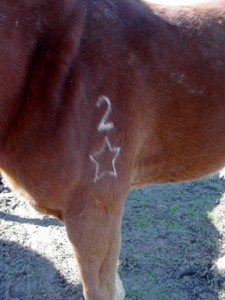
The state’s ideal prison horse is three quarters Quarter Horse and one quarter draft horse. Throughout his life a prison horse is freeze branded so that extensive records can be maintained in the system. The markings include a tattoo on the inside of the lip, a Texas star, the birth year, and ID number on the back left, and an additional identification on the horses left cheek near the anus. Like their fellow inmates, the horses have no name, only their number to identify them. The records are so extensive that a manager can track the record of a 20 year old horse and know every significant event of its life just by looking up his record.
The auction buyers Monday didn’t get the records of the horses they bought. When a horse leaves the prison system, only its Coggins certificate and ID sheet follow.
While most of the horses aren’t registered, some boast the bloodlines of pure Texas equine royalty including pedigrees from the famed Waggoner Ranch. TDCJ has also bought other Foundation Quarter Horse stallions as well. Other bloodlines go back to the days when the state first built prisons. The Walls unit in Huntsville dates to 1849 shortly after the end of the Republic of Texas. The state’s prison captive breeding program is indeed, very, very, old. The prison herd has been steadily improved for nearly 162 years, and dramatically improved in recent years.
The state has achieved its ideal confirmation of broadness, horses that have hardly any withers, and are short of back – no long backed high withered horses such as a Thoroughbred are allowed.
The horses are tough, powerful, and as potent as the 300 pound guards who ride them.
And when they go to an auction where the public is given notice, prison horses sell for considerably more than 40 cents a pound.
Story and Photos by Steven Long
HUNTSVILLE, (Horseback) – One of the most genetically perfect herds of horses in North America was hit hard by the selloff of 61 animals at a public auction, their most likely destination, a Mexican slaughterhouse notorious for unspeakable cruelty. The herd of Texas prison horses that were sold had been part of a contingent of animals so remarkable, and even historic, they were subject of a February 2004 cover story in Horseback Magazine’s predecessor publication, Texas Horse Talk.The horses were part of a herd of 1,600 owned by the State of Texas and managed by the Texas Department of Criminal Justice in Huntsville, according to Michelle Lyons, chief TDCJ spokeswoman.
“These were what we call cull horses,” she told Horseback Magazine.
The horses that prison livestock managers call “culls” boast some of the purest blood lines in the nation dating back to the mid nineteenth century. The state’s captive herd is subject to the most advanced breeding techniques and is held to exacting standards that are world class. The livestock managers are products of the renowned schools of agriculture at Texas A&M University and the nearby Sam Houston State University. Only the finest bloodlines are introduced into the herd, and that is done rarely. The horses are primarily Quarter Horses with substantial Percheron blood.
The information that the horses had been sold at auction came to Horseback Online Monday night when a confidential source who was at the Huntsville cattle auction called and said that a large number of prison horses had been sold to slaughter and had been loaded on a truck south heading down I-45.
“People who work at the prison are really upset about this,” the man said during a phone call to the magazine’s offices.
 The Texas prison system holds “Premium Auctions” of horses only rarely where the public is invited to bid after extensive advertising of the sale. No such ads were placed for the 60 highly blooded horses sold Monday. The were quietly sent to auction where a large truck was already waiting, according to the source who said the horses sold for about 40 cents a pound.
Lyons confirmed the prison system auctions 90-100 “cull” horses each year from its program.
Livestock auctions are the primary sources of horses sent abroad for food. Yet Lyons categorically denies the Huntsville prisons sent their horses to auction with the knowledge they would be sold for slaughter.
“We have had calls from a woman who claims this very thing, and probably is the same person who claims to have witnessed this,” Lyons said. “She alleged that 70 horses went to one bidder. We only had 61 horses in the auction – we don’t know how many non-TDCJ horses was also part of the auction.”
“The fact is that we participate in these public auctions as a way to keep the horses (from) going to a slaughterhouse – we don’t condone the sale of our horses for slaughter,” Lyons said.
The primary source for horses going to slaughter is public auctions.
Lyons was asked to provide the name of the buyer of the large number of TDCJ horses that went to auction on Monday. She said prison livestock managers didn’t know who bought the horses. Asked by Horseback if they would call the auction house to ask the name of the buyer, she said the men declined.
Horseback Magazine called Huntsville Livestock Services, Inc. and spoke with manager Tommy Oates who declined to name the buyer of the TDCJ horses, saying “I don’t have to tell you a damned thing, ask the state,” before slamming down the phone on the reporter.
The Texas prison system breeds big horses, big enough to hold a 300 pound guard for an eight hour shift in the fields, hence the draft horse bloodlines brought into the herd. The stout corrections officer is known in prison parlance as “The Boss.” The horses and their human counterparts guard men dressed in white garb as they work fields with a garden hoe called by the derisive name, an “aggie.” The horses are bread for Texas’ 176 prison units which boast approx. 75 mounted guards or more.
There is one boss for each 25 inmates.
The prison horses are almost as wide as their bellies are deep. They hold saddles made behind the walls. The animals and men herd the system’s 20,000 cattle that are sold on the open market by the state. None of the meat is kept by TDCJ. The cheaper cuts fed to prisoners are bought at market price for the institution’s commissaries. Officials are quick to point out that prison inmates don’t eat steak but consumers may be lucky enough to eat beef raised behind prison walls.
Besides security and agriculture duty, the horses follow dogs chasing escaped convicts.
The state’s ideal prison horse is three quarters Quarter Horse and one quarter draft horse. Throughout his life a prison horse is freeze branded so that extensive records can be maintained in the system. The markings include a tattoo on the inside of the lip, a Texas star, the birth year, and ID number on the back left, and an additional identification on the horses left cheek near the anus. Like their fellow inmates, the horses have no name, only their number to identify them. The records are so extensive that a manager can track the record of a 20 year old horse and know every significant event of its life just by looking up his record.
The auction buyers Monday didn’t get the records of the horses they bought. When a horse leaves the prison system, only its Coggins certificate and ID sheet follow.
While most of the horses aren’t registered, some boast the bloodlines of pure Texas equine royalty including pedigrees from the famed Waggoner Ranch. TDCJ has also bought other Foundation Quarter Horse stallions as well. Other bloodlines go back to the days when the state first built prisons. The Walls unit in Huntsville dates to 1849 shortly after the end of the Republic of Texas. The state’s prison captive breeding program is indeed, very, very, old. The prison herd has been steadily improved for nearly 162 years, and dramatically improved in recent years.
The state has achieved its ideal confirmation of broadness, horses that have hardly any withers, and are short of back – no long backed high withered horses such as a Thoroughbred are allowed.
The horses are tough, powerful, and as potent as the 300 pound guards who ride them.
And when they go to an auction where the public is given notice, prison horses sell for considerably more than 40 cents a pound.
Monday, July 11, 2011
PLEASE sign petition on change.org

OVERVIEW
SAN BERNABE IS THE LARGEST ILLEGAL UNREGULATED LIVESTOCK MARKET IN MEXICO. It makes a mockery of humanity and is one of the most shameful examples of animal brutality and ill health in Mexico. The San Bernabe market has existed for over 60 years. Origin of horses at the San Bernabe market – Estado de Mexico, Chihuahua, Michoacan and the United States.
It is located at the 22.5 km northeast of the city of Toluca, on the Toluca-Atlacomulco road which belongs to the Municipality of Almoloya de Juárez, and in turn the Mayorazgo community of Leon, Estado de Mexico.
The institutions and authorities, federal and local governments, have full powers of inspection and surveillance, and therefore have the capacity to solve the problem, but remain passive and sluggish. The market is a place for animal trafficking, extreme dirt and dismal sanitary conditions, and tremendous cruelty to the animals being sold. The San Bernabe footage and photos have appeared on many news reports and national TV, so the authorities cannot feign ignorance.
Seen for sale on site are donkeys, horses, mules, dogs and wildlife, whose origins are uncertain and many are visibly sick, arrive and depart transported in sadistic and deplorable conditions with exposed fractures, bleeding open wounds and ulcers. Others are hung with ropes, when they no longer have the strength to stand upright. These suffering “animal waste” are kept alive just because a kilo of live meat costs twice that of a dead one. If an animal finally ends its agony and dies it is cut open right there and its vescera is extracted and thrown on the ground in the middle of the market.
There is no animal health control. Animals are sold directly for two purposes either privately as live animals (for work or food) or to a slaughterhouse (called the “rastro”). Obviously, the sale of live animals is done in less cruel way than that of animals that are sold to the rastro, since the horses going to the slaughterhouse are considered waste and therefore are treated in a very brutal manner, they are kicked, poked with electric barbs that are prohibited for horses. Bats and pipes are used to hit animals, they are tied with ropes. Animals suffer fractures or they fall dead, others arrive with broken limbs because the owners want to get some extra money by selling them and the animals are forced to walk down to the transport truck in these conditions. In the best case, the animals are transported sick, infected with tumors or open wounds, and later sold to the highest bidder. At worst, their corpses are left on the ground without being buried, with animal viscera strewn about in violation of standard NOM-024-ZOO-1995.
Water troughs often don’t contain water, the pens are underutilized – some are overcrowded, others are empty. There is a shed that was scheduled to install a sacrifice room for broken or injured animals that cannot continue the trip. It is important to mention that it is a living sacrifice room and not a slaughterhouse, and has created problems of assessment with the authorities i.e. the Ministry of Agriculture, Livestock, Rural Development, Fisheries and Food (SAGARPA) because they do not accept the installation of a slaughterhouse, in the absence of the necessary infrastructure to do so.
Another problem is the presence of federal local police who sometimes, instead of asking for documentation and health guidance, ask for a financial share to allow access to trucks. Recently, it has become known that there is a dispute between groups to control the market of San Bernabe. Meanwhile, there is total anarchy in violation of animal protection laws, the state and official rules for the transportation of animals, and livestock markets.
Over the years, people of recognized knowledge, experts and advocacy groups for animal rights have talked with local, state and federal agencies, seeking to bring order to the problems of the San Bernabe market. However, the sanitary conditions and the treatment of the animals have not improved. Often laws and rules are not enforced, either because the authorities are unaware of their existence, or they simply ignore them. The Health Ministry has taken up the matter even though there are no laws in place of hygiene and public health. There are dead animals and scattered viscera in the trucks, along with live horses, since they are gutted and the carcasses are transported together with the live animals to the slaughterhouse. No water is available. There is no animal inspection by the SAGARPA, or monitoring of transport by the Federal Highway Police or the Ministry of Communications and Transport.
For several years the market has been controlled by a municipal councilor. The market is located on both sides of the road and while it also sells cars and clothes, most activity is in the trade in live animals. We know that this market has generated a lot of profit that is not quantified, including fees for land use, collection of bills for sale of animals in addition to other fees paid by those who provide service for the sellers of food, fruits, vegetables, shoes, clothing, etc.
The San Bernabe market is in violation of two federal and four state sanitary laws concerning animal health, ecological balance and environmental protection, which state the importance of dignified and respectful treatment of animals.
At San Bernabe, in many cases the cattle are slaughtered without any restriction. They are beaten with sticks, pipes, rods, or touches on the genitals causing them high levels of stress in breach of standard NOM-033-ZOO-1995. In addition, the market does not have appropriate landing ramps, so that the legs of the animals break constantly. Some animals are mixed in the pens, where cattle have injuries, trauma, fractures, wounds or worms. The most obvious abuse is called “scrap yards” where the animals are in poor condition and are sold to be taken directly to slaughterhouses.
A brief description of a horse slaughterhouse in Mexico:
“… The horse shakes its head frantically when the door killing box is closed and trapped within it. A worker buried in his back, around his neck, a small, sharp knife, seven, eight, nine times. She, with her eyes wide, frantically lowers and raises her head while the worker stabs her again and again. On the tenth stroke of the knife, she falls to the ground, bloodied and paralyzed, but still alive. She lays there for two minutes before being hoisted by her leg and lifted into the air, hung upside down to be bled slaughtered in the midst of terrible pain, fully conscious and terrified … “
What happens in San Bernabe is not a new topic, since the flea market has been operating for 60 years every Monday in the same place, and it is estimated that the site has sold over 10, 000 different animals of various species.
Since September 2007 Animal Protection Association of Mexico (APASDEM), has worked hard on a campaign to protect the animals sold at the San Bernabe Market.
En Almoloya de Juárez, Estado de México, se encuentra el Mercado llamado San Bernabé, donde se comercia principalmente, con caballos mulas y burros, en condiciones de crueldad y falta de higiene extremas, violando consistente y permanentemente, las leyes de protección animal y de sanidad. Las autoridades, teniendo plena facultad y pruebas para clausurar el sitio (a través de imágenes mostradas en múltiples medios), han hecho caso omiso a este reclamo.
Los animales en venta, en su mayoría, están visiblemente enfermos; son transportados en condiciones deplorables, y arrastrados sádicamente, sin importar que tengan fracturas expuestas, estén sangrando o tengan llagas. Cuando ya no pueden sostenerse en pie, son colgados con mecates para simular que aún tienen fuerza. Carecen de atención médica, agua y alimento y si mueren antes de llegar al rastro, son abiertos en el mismo sitio en que se encuentran, tirando sus vísceras al piso.
Les llaman "animales de desecho", y se les mantiene con vida hasta el último momento, en una lenta y gran agonía, porque el kilo de carne viva cuesta casi el doble que el de la muerta. Read Petition Letter
CLICK HERE to Sign Petition!
Animal Welfare organizations unite to close the cruel San Bernabe Slaughter Auction in Mexico
Animals' Angels
 Equine Welfare organizations around the world are responding to an appeal by their Mexican counterparts requesting support in forcing an end to the blatant cruelty and abuse at the San Bernabe Slaughter Auction in the Municipality of Almoloya de Juárez.
A first petition with over 5,000 signatures was delivered to the Mexican embassy in Washington on June 27. The continuing appeal and a petition being circulated are calling for the Mexican government to shut down the facility. San Bernabe, the largest such unregulated facility in Mexico, has been in operation for 70 years and is well known for the extremely abusive treatment of animals in violation of many federal regulations.
American horse owners should be very concerned because U.S. horses are sent to this facility. It should be noted that US Horses were being sent to Mexican slaughter facilities long before the U.S. plants closed. Between the years 1989-2006, 775,474 U.S. horses were exported for slaughter to Canada, Mexico and Japan.
As long as horse slaughter exists, U.S. horses are in jeopardy of being sent to this and other facilities.
Animals’ Angels along with the Equine Welfare Alliance, Animal Protection Association of Mexico, Animal Law Coalition, APASDEM, Animal Recovery Mission, Commission for San Bernabe Market and Anti-Fur Society call for global support to join us in an appeal to Enrique Peña Nieto to shutter the doors of San Bernabe forever.
We are appealing to all members of the U.S. Congress to prevent American horses from enduring the fate awaiting them at San Bernabe by swiftly passing federal legislation (S. 1176) to prohibit horse slaughter in the U.S. and export over our borders.
Link to Examiner newspaper article:
Link to Horseback magazine article:
Link to sign the petition
Please also send the following pre-written letter, which has been provided for your convenience in Spanish, to Governor Enrique Peña Nieto. PLEASE SEND EMAILS TO BOTH EMAIL ADDRESSES PROVIDED FOR GOVERNOR ENRIQUE PENA NIETO’S REVIEW.
Animal Welfare organizations unite to close the cruel San Bernabe Slaughter Auction in Mexico
Equine Welfare organizations around the world are responding to an appeal by their Mexican counterparts requesting support in forcing an end to the blatant cruelty and abuse at the San Bernabe Slaughter Auction in the Municipality of Almoloya de Juárez. A video appeal was released on July 3, revealing the common place abuse of equines heading to slaughter. In an incident that is said to be typical of the mistreatment, a pregnant mare with a broken foot was pushed off a ramp that resulted in her breaking both of her knees. In obvious agony, she was dragged off to slaughter.
A first petition with over 5,000 signatures was delivered to the Mexican embassy in Washington on June 27. The continuing appeal and a petition being circulated are calling for the Mexican government to shut down the facility. San Bernabe, the largest such unregulated facility in Mexico, has been in operation for 70 years and is well known for the extremely abusive treatment of animals in violation of many federal regulations.
American horse owners should be very concerned because U.S. horses are sent to this facility. It should be noted that US Horses were being sent to Mexican slaughter facilities long before the U.S. plants closed. Between the years 1989-2006, 775,474 U.S. horses were exported for slaughter to Canada, Mexico and Japan.
As long as horse slaughter exists, U.S. horses are in jeopardy of being sent to this and other facilities.
Animals’ Angels along with the Equine Welfare Alliance, Animal Protection Association of Mexico, Animal Law Coalition, APASDEM, Animal Recovery Mission, Commission for San Bernabe Market and Anti-Fur Society call for global support to join us in an appeal to Enrique Peña Nieto to shutter the doors of San Bernabe forever.
We are appealing to all members of the U.S. Congress to prevent American horses from enduring the fate awaiting them at San Bernabe by swiftly passing federal legislation (S. 1176) to prohibit horse slaughter in the U.S. and export over our borders.
Link to Examiner newspaper article:
Link to Horseback magazine article:
Link to sign the petition
Please also send the following pre-written letter, which has been provided for your convenience in Spanish, to Governor Enrique Peña Nieto. PLEASE SEND EMAILS TO BOTH EMAIL ADDRESSES PROVIDED FOR GOVERNOR ENRIQUE PENA NIETO’S REVIEW.
Disclaimer: The picture used in this article was not taken by Animals' Angels
Sunday, July 10, 2011
Monday, June 27, 2011
GAO Study Wastes Time and Tax Dollars
Animal Welfare Institute

Monday, June 27, 2011
Washington, D.C. -- After almost two years and tens of thousands of tax dollars, the Government Accountability Office (GAO) has released its report, HORSE WELFARE: Action Needed to Address Unintended Consequences from Cessation of Domestic Slaughter with two conflicting conclusions: restore horse slaughter or ban horse slaughter. Really?
The GAO was given the responsibility of assessing horse welfare from 2007 forward following the closure of the last three foreign-owned horse slaughter plants in the U.S. However, and vital to understanding horse welfare, the GAO was not asked to consider the impact slaughter had on America’s horses while plants were operating in the U.S. or what it would be like for the horses if restored. In the end, one of two contradictory recommendations was to ban slaughter in the U.S. and the export of horses for the same purposes (what the Animal Welfare Institute has said for years).
In addition to this being the best alternative for the horses, this will also virtually eliminate any regulatory burden whatsoever to the USDA. In this time of economic strife, it is ludicrous to expend taxpayer dollars to benefit a few foreign investors (whether the plants are located in the U.S. or abroad). The only way to stop the abuse inflicted on American horses by the slaughter industry is for Congress to pass the American Horse Slaughter Prevention Act, banning horse slaughter domestically and prohibiting the export of horses to Mexico and Canada.
To offer the option of restoring horse slaughter in the U.S. as the other recommendation ignores the cruelty inflicted on American horses’ right under the nose of grossly underfunded and highly inadequate USDA inspection capabilities. There is ample documentation from the USDA, private investigations and the first hand observations by AWI staff, substantiating the inhumane treatment of horses at plants when they were operating in the U.S., and there is documentation of the inhumane treatment of horses at plants that are operating outside the U.S. First and foremost, it should be acknowledged that slaughter is not a form of humane euthanasia as claimed by horse slaughter advocates. Second, though the report touched on neglect and abuse of horses, all this does is introduce a separate horse welfare issue with no substantiated relevance to slaughter. Everyone agrees that neglect and abuse of horses is horrendous, however, it is happening irrespective of the horse slaughter issue and needs to be addressed - as the separate welfare issue it is.
The Animal Welfare Institute urges Congress to swiftly pass the S. 1176, the American Horse Slaughter Prevention Act, sponsored by Senator Mary Landrieu (D-LA) and Senator Lindsey Graham (R-SC). To do otherwise will only perpetuate animal abuse.
Chris Heyde, (202) 446-2142, chris@awionline.org
Monday, June 27, 2011
Washington, D.C. -- After almost two years and tens of thousands of tax dollars, the Government Accountability Office (GAO) has released its report, HORSE WELFARE: Action Needed to Address Unintended Consequences from Cessation of Domestic Slaughter with two conflicting conclusions: restore horse slaughter or ban horse slaughter. Really?
The GAO was given the responsibility of assessing horse welfare from 2007 forward following the closure of the last three foreign-owned horse slaughter plants in the U.S. However, and vital to understanding horse welfare, the GAO was not asked to consider the impact slaughter had on America’s horses while plants were operating in the U.S. or what it would be like for the horses if restored. In the end, one of two contradictory recommendations was to ban slaughter in the U.S. and the export of horses for the same purposes (what the Animal Welfare Institute has said for years).
In addition to this being the best alternative for the horses, this will also virtually eliminate any regulatory burden whatsoever to the USDA. In this time of economic strife, it is ludicrous to expend taxpayer dollars to benefit a few foreign investors (whether the plants are located in the U.S. or abroad). The only way to stop the abuse inflicted on American horses by the slaughter industry is for Congress to pass the American Horse Slaughter Prevention Act, banning horse slaughter domestically and prohibiting the export of horses to Mexico and Canada.
To offer the option of restoring horse slaughter in the U.S. as the other recommendation ignores the cruelty inflicted on American horses’ right under the nose of grossly underfunded and highly inadequate USDA inspection capabilities. There is ample documentation from the USDA, private investigations and the first hand observations by AWI staff, substantiating the inhumane treatment of horses at plants when they were operating in the U.S., and there is documentation of the inhumane treatment of horses at plants that are operating outside the U.S. First and foremost, it should be acknowledged that slaughter is not a form of humane euthanasia as claimed by horse slaughter advocates. Second, though the report touched on neglect and abuse of horses, all this does is introduce a separate horse welfare issue with no substantiated relevance to slaughter. Everyone agrees that neglect and abuse of horses is horrendous, however, it is happening irrespective of the horse slaughter issue and needs to be addressed - as the separate welfare issue it is.
The Animal Welfare Institute urges Congress to swiftly pass the S. 1176, the American Horse Slaughter Prevention Act, sponsored by Senator Mary Landrieu (D-LA) and Senator Lindsey Graham (R-SC). To do otherwise will only perpetuate animal abuse.
##30##
Media Contact:Chris Heyde, (202) 446-2142, chris@awionline.org
Sunday, June 26, 2011
YOU HAVE 4 CHOICES, and The First 3 Don’t Count.
The Persian Horse's Blog
Dedicated to the Horses who have Shed their Blood, Lost their Freedom, and Given their Lives for BLM.

GAO REPORT
WE NOW HAVE FOUR CHOICES.
- DO NOTHING…JUST WAIT AND SEE WHAT THE DECISION MAKERS ARE GOING TO DO……NOT A GOOD CHOICE.
- SUPPORT LAWS REQUIRING HUMANE TRANSPORT TO SLAUGHTER IN OTHER COUNTRIES…..Does that make sense to “Humanely” Transport Horses to be Tortured and Murdered? Oxymoron.
- SUPPORT OPENING OF SLAUGHTER HOUSES IN THE U.S. SO HORSES DON’T HAVE TO BE IN-HUMANELY TRANSPORTED TO SLAUGHTER, AND INHUMANELY SLAUGHTERED IN FOREIGN COUNTRIES. Another Oxymoron…There is no such thing as “Humane Slaughter”.
- SUPPORT BILL S. 1176, WHICH IS ALREADY PENDING IN THE SENATE, WHICH WOULD BAN TRANSPORT OF AMERICAN HORSES ANYWHERE TO BE SLAUGHTERED FOR HUMAN CONSUMPTION.
S. 1176: American Horse Slaughter Prevention Act of 2011 is a bill to amend the Horse Protection Act to prohibit the shipping, transporting, moving, delivering, receiving, possessing, purchasing, selling, or donation of horses and other equines to be slaughtered for human consumption, and for other purposes.
IF YOU OPPOSE THE TRANSPORT OF AMERICAN HORSES ANYWHERE TO BE SLAUGHTERED FOR HUMAN CONSUMPTION, AND FOR OTHER PURPOSES, HERE ARE 2 THINGS YOU CAN DO. CLICK ON THIS LINK, Click on YOUR STATE, Find YOUR SENATORS, AND ASK THEM TO PLEASE CO-SPONSOR SENATE BILL S. 1176. Please Call, Fax and Email. There are currently only 17 CO-SPONSORS of S. 1176. Contact YOUR SENATORS immediately and ask them to please CO-SPONSOR S. 1176.
THEN
CLICK ON THIS LINK, Senate Committee on Commerce, Science and Transportation. Please find the committee member from YOUR State, and Call, Fax and Email him, asking him to “report” the bill, S-1176, favorably to the Senate as a whole allowing it to receive consideration by the full body and move forward.
~~~~~~~~~~~~~~~
PLEASE REVIEW THIS INFORMATION ABOUT “COMMITTEES”….WE DO NOT WANT THIS BILL, S 1176 TO DIE IN COMMITTEE, LIKE H.R.503 DIED. PLEASE REVIEW THESE INSTRUCTIONS CAREFULLY, AND THEN CONTACT THE COMMITTEE MEMBER WHICH IS FROM YOUR STATE.
Committees are like “mini Congresses”. Most bills begin by being considered by one or several congressional committees which may “report” the bill favorably or unfavorably to the Senate or House as a whole allowing it to receive consideration by the full body and move forward, or may fail to consider a bill at all preventing the bill from moving forward. Most bills never receive any committee consideration and are never reported out. House bills start in House committees and enter Senate committees only after being passed by the House and received by the Senate, and similarly for Senate bills.
Information on committee proceedings is notoriously opaque: committees vary in what information they make public and often do not provide basic public information such as the results of votes electronically or in an understandable format. Furthermore, if your Member of Congress does not sit on any committee relevant to this bill, you generally have no opportunity to voice your opinion on the bill while the bill is receiving its most important consideration.
~~~~~~~~~~~~~~~~~~~~~~~~~
REALITY – THERE IS NO SUCH THING AS HUMANE SLAUGHTER
Saturday, June 25, 2011
Gary Morris Horse Collecting Station, Muleshoe, TX 5/16/11-5/18/11
Animals' Angels

Animals’ Angels observed the collecting station of known slaughter buyer Garry Morris. There were approx. 40 horses in the pen area. One pen held a severely emaciated red roan Appaloosa, which was probably less than 3 years old. The horse, which was a BCS 1.5 on the Henneke chart, was obviously sick, since thick, purulent discharge was dripping from his mouth and nostrils. There also was discharge from the eyes and he had a dry cough, all symptoms of a severe strangles infection. The horse shared the same pen with numerous other horses, a few minis and an approx. 8 month old foal. Investigators never saw the horse move, he was standing very still with his head low. After documenting his condition, investigators called local law enforcement, since it is a violation of Texas law to keep a horse in this condition without providing veterinary care.
  The first officer who arrived at the scene appeared cooperative, took pictures of the horse and called Morris. A woman answered and informed him that the horse was going to slaughter. The officer then left to present the information to his supervisor, Sheriff Wills. When AA talked to the Sheriff shortly thereafter, he stated that he saw the horse and that it had food and water and that was all that was needed. He refused to take any further action.
  Investigators returned to the premises early the next morning. Mr. Morris had moved the horse away from the road to a pen that was less visible. The horse was laying down now and coughing. Next to the pen area, investigators noticed piles of manure with partially decayed horse parts and bleached bones exposed. Investigators then left and returned to the Sheriff’s office to try to convince the Sheriff to enforce the law and to obtain a copy of the police report. The Sheriff was extremely unfriendly and still refused to do anything. The police report said nothing about the condition of the horse and none of the pictures the deputy took were included. Investigators then contacted the County Judge, the local USDA office, animal control, and the Humane Society of West Texas and the Texas State Police. Nobody was willing to help the horse. At the end of the day, investigators had to leave to catch the plane back home. When AA called the County Judge again, she informed them that she went to the Morris premises the same day the AA investigators had left and did not see the horse. She stated that the Sheriff assured her the situation “had been taken care off”. The investigation proved again that there is a direct connection between horse slaughter and animal cruelty. It was also another sad example of law enforcement unwilling to do their job. Complaints about local officials, insufficient composting and DOT violations have been filed.
Animals’ Angels observed the collecting station of known slaughter buyer Garry Morris. There were approx. 40 horses in the pen area. One pen held a severely emaciated red roan Appaloosa, which was probably less than 3 years old. The horse, which was a BCS 1.5 on the Henneke chart, was obviously sick, since thick, purulent discharge was dripping from his mouth and nostrils.
 There also was discharge from the eyes and he had a dry cough, all symptoms of a severe strangles infection. The horse shared the same pen with numerous other horses, a few minis and an approx. 8 month old foal. Investigators never saw the horse move, he was standing very still with his head low. After documenting his condition, investigators called local law enforcement, since it is a violation of Texas law to keep a horse in this condition without providing veterinary care.
  The first officer who arrived at the scene appeared cooperative, took pictures of the horse and called Morris. A woman answered and informed him that the horse was going to slaughter. The officer then left to present the information to his supervisor, Sheriff Wills. When AA talked to the Sheriff shortly thereafter, he stated that he saw the horse and that it had food and water and that was all that was needed. He refused to take any further action.
  Investigators returned to the premises early the next morning. Mr. Morris had moved the horse away from the road to a pen that was less visible. The horse was laying down now and coughing. Next to the pen area, investigators noticed piles of manure with partially decayed horse parts and bleached bones exposed. Investigators then left and returned to the Sheriff’s office to try to convince the Sheriff to enforce the law and to obtain a copy of the police report. The Sheriff was extremely unfriendly and still refused to do anything. The police report said nothing about the condition of the horse and none of the pictures the deputy took were included. Investigators then contacted the County Judge, the local USDA office, animal control, and the Humane Society of West Texas and the Texas State Police. Nobody was willing to help the horse. At the end of the day, investigators had to leave to catch the plane back home. When AA called the County Judge again, she informed them that she went to the Morris premises the same day the AA investigators had left and did not see the horse. She stated that the Sheriff assured her the situation “had been taken care off”. The investigation proved again that there is a direct connection between horse slaughter and animal cruelty. It was also another sad example of law enforcement unwilling to do their job. Complaints about local officials, insufficient composting and DOT violations have been filed.
Friday, June 24, 2011
Here it is: Tea Party Darling Kristi Noem (R-SD) on Horse Slaughter:
Horseback Magazine
WASHINGTON-U.S. Representative Kristi Noem (R-SD) responded to a recently released Government Accountability Office report on horse welfare and slaughter saying that it confirms the fact that there are significant problems with the current restrictions.
“This report confirms what most ranchers already know. The ending of horse slaughter and processing here in the United States has increased neglect and abandonment and depressed horse prices,” said Noem.
The last horse processing facilities in Texas and Illinois closed in 2007, thus ending all processing in the U.S. This was the result of Congress stripping the USDA of funding for food safety inspections at processing plants. The USDA continued to provide inspections on a fee-for-service basis until a federal judge ruled against the arrangement. Since then horses have been transported to Mexico and Canada for processing.
The GAO report explains that from 2006 to 2010 the number of horses exported to Mexican processing plants rose 660%. The number of horses exported to Canada for processing increased 148% during the same time period. Additionally, the report said, “closing domestic horse slaughtering facilities significantly and negatively affected lower-to-medium priced horses by 8 to 21 percent.”
The GAO also said that while comprehensive national data was unavailable, state, local government, and animal welfare organizations report a rise in investigations for horse neglect and more abandoned horses since 2007.
Noem concluded, “While opponents of horse slaughter here in the U.S. claim they are acting in the name of humane horse treatment, their policies are in fact adding to the inhumane treatment of horses. I hope this new GAO report makes slaughter opponents reassess their position.”
Wallis Issues Statement From Congressional Pal
Noem: GAO Confirms Problems With Horse Processing RestrictionsWASHINGTON-U.S. Representative Kristi Noem (R-SD) responded to a recently released Government Accountability Office report on horse welfare and slaughter saying that it confirms the fact that there are significant problems with the current restrictions.
“This report confirms what most ranchers already know. The ending of horse slaughter and processing here in the United States has increased neglect and abandonment and depressed horse prices,” said Noem.
The last horse processing facilities in Texas and Illinois closed in 2007, thus ending all processing in the U.S. This was the result of Congress stripping the USDA of funding for food safety inspections at processing plants. The USDA continued to provide inspections on a fee-for-service basis until a federal judge ruled against the arrangement. Since then horses have been transported to Mexico and Canada for processing.
The GAO report explains that from 2006 to 2010 the number of horses exported to Mexican processing plants rose 660%. The number of horses exported to Canada for processing increased 148% during the same time period. Additionally, the report said, “closing domestic horse slaughtering facilities significantly and negatively affected lower-to-medium priced horses by 8 to 21 percent.”
The GAO also said that while comprehensive national data was unavailable, state, local government, and animal welfare organizations report a rise in investigations for horse neglect and more abandoned horses since 2007.
Noem concluded, “While opponents of horse slaughter here in the U.S. claim they are acting in the name of humane horse treatment, their policies are in fact adding to the inhumane treatment of horses. I hope this new GAO report makes slaughter opponents reassess their position.”
Thursday, June 23, 2011
The Way Forward on Horse Welfare
Michael Markarian: Animals & Politics
Thursady, June 23,2011
The Government Accountability Office released a new report yesterday, “Horse Welfare: Action Needed to Address Unintended Consequences from Cessation of Domestic Slaughter,” and some proponents of horse slaughter are using it as a rallying cry to re-open equine abattoirs on American soil. But the GAO report is a lot more nuanced than the horse slaughter industry suggests, and the report provides some good insights into better policy solutions for horse welfare. And it confirms what we have long known: that shipping horses long distances in double-decker trailers and killing them for food exports isn’t good for the horses.
The report indicates that since Congress blocked the use of tax dollars for USDA to conduct horse slaughter inspections in 2005, and since state legislation shut down the last remaining plants in Illinois and Texas in 2007, there have been anecdotal accounts of an increase in horse neglect and abandonment, and a decline in horse prices. Given that this time period has coincided with the worst economic downturn since the Great Depression, the GAO can’t conclude whether these problems are due to a closure of U.S. horse slaughter plants or to the country’s financial crisis. However, the report clearly shows that the number of horses being sent to slaughter, more than 130,000 each year, has not changed all that much since the closure of the domestic plants (due to an increase in export of horses for slaughter to Canada and Mexico), suggesting that the same number of irresponsible owners—not more—are still sending their horses to slaughter.
 Industries that want to profit from horse slaughter, and the export of American horse meat to Europe and Asia, will claim that we need to re-open horse slaughter plants in the U.S. so that horses are not traveling long distances to Canada and Mexico, and that Congress should fund USDA oversight of horse slaughter, potentially adding millions of dollars to the federal budget and distracting agency inspectors from other food safety responsibilities. But when a handful of slaughter plants did operate in the U.S., horses still traveled long distances across the country in dangerous double-decker trucks, and the transport and slaughter processes involved were inherently inhumane. There’s no reason to believe that slaughter plants would spring up in every community to make the transport distances shorter, or that horses would evolve into a species that no longer has a flight response, which makes the stunning and slaughter process very difficult and clumsy. It’s like saying the U.S. should repeal its child labor laws because bad actors are using Mexican children to work in factories or transporting American children across the border to Mexico to work in response to U.S. law.
Instead, the GAO report offers a menu of options for lawmakers and regulators to consider, some of them very good: The report recommends that “Congress may wish to consider instituting an explicit ban on the domestic slaughter of horses and exports of U.S. horses intended for slaughter in foreign countries.” That’s the right response for Congress to stem the tide of American horses going over our borders for slaughter in Canada and Mexico and ensure that this inhumane practice doesn’t resume in this country. That’s exactly what the American Horse Slaughter Prevention Act aims to do. The Senate bill, S. 1176, was introduced this month by Sens. Mary Landrieu, D-La., and Lindsey Graham, R-S.C. The House-passed agriculture spending bill retains the current de-funding provision to block funds for horse slaughter, and we’ll be working to make sure that the right language holds up in the Senate and that key members of the Appropriations Committee don’t attempt to subvert the House position when they hammer out the final bill in conference committee. Congress needs to ban exports of horses for slaughter, not try to create a new network of U.S. slaughter plants.
 The GAO report also confirms that the use of double-decker trailers in the transport of horses represents a significant threat to animal welfare, recommending that “USDA issue a final rule to protect horses through more of the transportation chain to slaughter.” Double-decker trailers are designed for animals such as cattle and pigs—shorter-necked species than horses, who require more headroom than double-decker trailers afford. Horses often throw their heads to maintain balance, and injure themselves easily in such vehicles. In 2006, a double-decker truck hauling 41 horses in Missouri crashed, killing 16 horses. In 2007, a double-decker carrying 59 horses in Illinois struck another vehicle after blowing through a stop sign. It took five hours to rescue the horses from this mangled truck, resulting in the death of nine of them; six died later due to injuries sustained. In both instances, the design of the trailers caused horses to lose parts of their legs or break their backs. A few were crushed under the weight of other horses falling on top of them.
Such a rule to prevent injury and death was first proposed by USDA in 2007, and we call on the agency to finalize it without delay, banning the use of double-decker trailers for the transport of horses to all points en route to slaughter.
In addition to policy solutions, more education of horse owners is needed. The cost of horse ownership has gone up significantly, at a time when the average horse owner’s ability to afford that cost has fallen drastically. This situation can only be resolved by greater outreach and information about the private responsibilities and expense of horse ownership, and the options available to struggling horse owners such as adoption and rescue groups. We also need a continued reduction in breeding of new horses while the economy is creating fewer, not more, horse owners—a practice that many responsible horsemen are currently following.
The horse slaughter industry, along with their allies in the agribusiness lobby and some veterinarians aligned with industry, are the ones who have blocked legislation to stop long-distance transport of horses to foreign countries for the purpose of slaughter, and have created the major problem identified by the GAO report. These horse exports exist only because of their obstructionism, and Congress can solve this aspect of the problem by passing the American Horse Slaughter Prevention Act. It’s time for all sides to come together and act with great haste to close our national borders to the horse slaughter pipeline.
The Government Accountability Office released a new report yesterday, “Horse Welfare: Action Needed to Address Unintended Consequences from Cessation of Domestic Slaughter,” and some proponents of horse slaughter are using it as a rallying cry to re-open equine abattoirs on American soil. But the GAO report is a lot more nuanced than the horse slaughter industry suggests, and the report provides some good insights into better policy solutions for horse welfare. And it confirms what we have long known: that shipping horses long distances in double-decker trailers and killing them for food exports isn’t good for the horses.
The report indicates that since Congress blocked the use of tax dollars for USDA to conduct horse slaughter inspections in 2005, and since state legislation shut down the last remaining plants in Illinois and Texas in 2007, there have been anecdotal accounts of an increase in horse neglect and abandonment, and a decline in horse prices. Given that this time period has coincided with the worst economic downturn since the Great Depression, the GAO can’t conclude whether these problems are due to a closure of U.S. horse slaughter plants or to the country’s financial crisis. However, the report clearly shows that the number of horses being sent to slaughter, more than 130,000 each year, has not changed all that much since the closure of the domestic plants (due to an increase in export of horses for slaughter to Canada and Mexico), suggesting that the same number of irresponsible owners—not more—are still sending their horses to slaughter.
Instead, the GAO report offers a menu of options for lawmakers and regulators to consider, some of them very good: The report recommends that “Congress may wish to consider instituting an explicit ban on the domestic slaughter of horses and exports of U.S. horses intended for slaughter in foreign countries.” That’s the right response for Congress to stem the tide of American horses going over our borders for slaughter in Canada and Mexico and ensure that this inhumane practice doesn’t resume in this country. That’s exactly what the American Horse Slaughter Prevention Act aims to do. The Senate bill, S. 1176, was introduced this month by Sens. Mary Landrieu, D-La., and Lindsey Graham, R-S.C. The House-passed agriculture spending bill retains the current de-funding provision to block funds for horse slaughter, and we’ll be working to make sure that the right language holds up in the Senate and that key members of the Appropriations Committee don’t attempt to subvert the House position when they hammer out the final bill in conference committee. Congress needs to ban exports of horses for slaughter, not try to create a new network of U.S. slaughter plants.
Such a rule to prevent injury and death was first proposed by USDA in 2007, and we call on the agency to finalize it without delay, banning the use of double-decker trailers for the transport of horses to all points en route to slaughter.
In addition to policy solutions, more education of horse owners is needed. The cost of horse ownership has gone up significantly, at a time when the average horse owner’s ability to afford that cost has fallen drastically. This situation can only be resolved by greater outreach and information about the private responsibilities and expense of horse ownership, and the options available to struggling horse owners such as adoption and rescue groups. We also need a continued reduction in breeding of new horses while the economy is creating fewer, not more, horse owners—a practice that many responsible horsemen are currently following.
The horse slaughter industry, along with their allies in the agribusiness lobby and some veterinarians aligned with industry, are the ones who have blocked legislation to stop long-distance transport of horses to foreign countries for the purpose of slaughter, and have created the major problem identified by the GAO report. These horse exports exist only because of their obstructionism, and Congress can solve this aspect of the problem by passing the American Horse Slaughter Prevention Act. It’s time for all sides to come together and act with great haste to close our national borders to the horse slaughter pipeline.
Animal Law Coalition Responds to GAO Horse Slaughter Report
Straight from the Horse's Heart
Animal Law

Article by Laura Allen of Animal Law Coalition
A bill, S.B. 1176, is already pending in the Senate that would do just that.
The report issued yesterday was requested by the Senate Appropriations Committee in 2010 and purports to examine “(1) the effect on the U.S. horse market, if any, since domestic slaughter for food ceased in 2007; (2) the impact, if any, of market changes on horse welfare and on states, local governments, tribes, and animal welfare organizations; and (3) challenges, if any, to USDA‘s oversight of the transport and welfare of U.S. horses exported for slaughter.”
Americans trying to stop the slaughter of U.S. horses believe the report was requested as a stall tactic to avoid a vote on a ban of this sleazy, cruel and unnecessary practice. Indeed, the GAO report appears to have been leaked before its formal release today to horse slaughter proponents. Industry lobbyist, former Rep. Charlie Stenholm read parts of it to members of Congress in trying to convince his former colleagues to approve funding for inspections of horses, something that could mean commercial horse slaughter for human consumption would be legal once again in the U.S.
Fortunately, they didn’t listen to him.
The GAO not only recommends as an alternative a ban on the export of horses for slaughter, the agency also reiterates criticisms made in a September, 2010 report by the Office of Inspector General of the USDA’s Animal and Plant Health Inspection Service (APHIS) enforcement of the Commercial Transportation of Equines to Slaughter regulations. The OIG found that:
The GAO was also critical that “APHIS stopped entering information from owner/shipper certificates into an automated database in 2005“. GAO observed that “automating the certificate data would make it easier for the agency to analyze them to, for example, identify potential problem areas for management attention and possible enforcement action, such as patterns of violations or other problems associated with particular shippers, border crossings, or slaughtering facilities. It would also allow the agency to easily identify buying trends and common shipping routes. Furthermore, automating data from the certificates on the number of horses in each shipment could potentially provide USDA a more accurate count of the number of U.S. horses exported for slaughter…. APHIS’s lack of a reliable means of collecting, tracking, and analyzing owner/shipper certificates constitutes an internal control weakness and leaves the agency without key information and an important management tool for enforcement of the transport regulation.”
GAO found “certificates returned by C[anadian]F[ood] I[nspection] A[gency] from 2005 through 2009… were not properly completed by either the shipper or CFIA officials. …[A]bout 52 percent of certificates were missing key information that should have been filled in by either the shipper (e.g., loading date and time, or certification that the horses were fit for transport) or CFIA (e.g., arrival date and time, or slaughtering facility identification). In addition, … about 29 percent of certificates returned to APHIS were missing some or all of the information to be provided by CFIA officials at the slaughtering facility”. …[F]rom 2008 through 2009, the 2 years after the cessation, we estimate that about 60 percent of certificates were missing key information“.
APHIS does not receive official cooperation from Mexican or Texas officials. “As a consequence, owner/shipper certificates may not be correctly filled out by the shippers and collected, completed, and returned to APHIS from either the border crossing or the Mexican slaughtering facility with information about shipment dates and times and horse conditions….[A]bout 48 percent of these certificates from 2005 through 2009 were missing key information to be provided by either shippers or … officials. Moreover, about 54 percent of certificates from 2008 through 2009 were missing such information”.
GAO notes that APHIS claims the restrictions on federal funds to inspect horses “makes it difficult to ensure that horses are transported humanely to slaughter and to collect information on potential violations that is needed ….to pursue enforcement actions…. APHIS officials speculated that compliance with the transport regulation has suffered because shippers are aware that the program can no longer leverage the assistance of USDA personnel in slaughtering facilities to ensure the completion of shipping paperwork or note the condition of individual horses in a shipment”.
Really? When were horses ever transported humanely? Remember the 2005 FOIA to USDA revealed that well before the defunding of inspections and closing of domestic slaughter plants, there was little or no enforcement of transport regulations and horses en route to slaughter suffered terribly.
Indeed, Animals Angels investigations have established the shocking cruelty of the slaughter pipeline and the failure of USDA to enforce the transport regulations. It was Animals Angels and Animal Law Coalition that requested GAO examine the cruelty inherent in the slaughter pipeline and APHIS’ miserable lack of enforcement of transport regulations.
According to the GAO report, there are only 2 APHIS staff members assigned to enforce the equine transport regulations. “The two program officials stated that the program’s limited funding, particularly for travel, has significantly curtailed their ability to provide coverage at border crossings and to work with shippers and inspectors in foreign slaughtering facilities to ensure compliance with the transport regulation.” USDA also lacks subpoena authority to help enforce the transport regulations.
So, is the answer more taxpayer dollars to fund USDA’s APHIS inspectors whose enforcement of the transport regulations was abysmal long before the “cessation” of the domestic horse slaughter facilities? GAO knows that won’t work. That’s why banning slaughter altogether was recommended.
Slaughter and the economy
According to the GAO report, “USDA is not aware of any domestic facility slaughtering horses for any purpose, including for zoos, as of the end of 2010. USDA identified at least three establishments-in Colorado, Nebraska, and New Jersey-that import horsemeat for repackaging and distribution to purchasers in the United States who feed the meat to animals at zoos and circuses. With the cessation of domestic slaughter, U.S. exports of horses intended for slaughter increased to Canada and Mexico, the current locations of all North American horse slaughtering facilities. As of the end of 2010, Canada had four such facilities, and Mexico three, that were the principal destinations of U.S. horses exported for slaughter…. Taken together, the 137,984 U.S. horses that were sent to slaughter in Canada or Mexico in 2010 is approximately equal to the total number of horses slaughtered in 2006.”
State veterinarians and some in the horse industry told GAO that since the closing of the U.S. horse slaughter plants, there have been fewer auctions and sales because of lower prices for some horses and higher energy and other operating costs in transporting horses across the border.
The GAO claims “that the cessation of domestic horse slaughter led to an 8- to 21-percent decline-depending on sale price-in the per head price of horses sold at those auctions. As illustrated in figure 6, we estimate that price reductions were greatest, in percentage terms, for lowest-priced horses, gradually declined as prices increased, and became insignificant for horses in the higher price categories. For example, the average per head price decreased by nearly 21 percent for horses in the lowest price category (20th percentile) and about 8 percent at the median, whereas the price change per head was not statistically significant for higher price categories…-Our estimates show that the economic downturn… was associated with a consistent decline of about 5 percent in price across all price categories”.
It might have been helpful had the GAO interviewed economists rather than veterinarians or those with a vested interest in slaughter. Simple economics would indicate if the number of horses going to slaughter has remained the same since the closing of the domestic slaughter plants, then the drop in prices resulted from a decline or change in other demands for horses, like recreational buyers. In other words, it was the economy! It also underscores that the salvage market created by slaughter doesn’t support horse prices or contribute much to the economy.
Horses are not suffering because of lack of slaughter
The GAO does underscore there is no data to support claims of widespread abandonment and abuse or neglect of horses. Indeed, GAO could have mentioned the studies establishing many of these reports are simply untrue, obviously planted in the media to suggest a crisis.
Of course horses are in trouble, but the evidence is that is the result of the economy, not lack of slaughter. After all, GAO states horses are going to slaughter in the same numbers as before closure of the plants. Again, a decline in horse welfare can only be attributed to the terrible economy.
There is also the issue of overbreeding or poor breeding practices that slaughter actually enables.
GAO notes that local politicians, state veterinarians and some in the industry continue to blame “cessation of domestic slaughter” as well as the poor economy for the rise in incidents of abandonment and abuse and neglect. GAO points out, “Other factors that they generally cited include poor weather conditions (e.g., drought in western states); the cost of horse disposal methods (e.g., veterinarian-assisted euthanasia); the increasing costs of feeding and caring for horses; and the lack of auction markets to sell horses….
“Among the factors affecting horse owners, the State Veterinarians said a horse owner’s decision to abandon a horse generally related to (1) cessation of domestic slaughter, (2) poor economic conditions, and (3) low horse prices or lack of sale opportunities. They also said the factors most often related to a horse owner’s neglect of a horse were (1) poor economic conditions, (2) the cost of horse care and maintenance, and (3) lower horse prices…. regarding neglect, some State Veterinarians, noting that people are more inclined to take care of that which has value, said that the drop in horse prices affected some owners’ interest in caring for their animals, especially if their financial situation had declined.”
GAO’s report supports that while some believe closing of domestic slaughter plants contributed in some part to cases of abandonment, abuse and neglect, the evidence is that it is really the result of a host of economic factors. Indeed, it makes no sense to blame lack of domestic slaughter plants if the same numbers of horses are going to slaughter as before the closings.
What they also ignore is that numbers of horses going to slaughter is determined largely by a demand for horsemeat in other countries, not numbers of abandoned, abused or neglected horses.
The GAO report does not mention that slaughter creates a salvage market that actually encourages overbreeding. The excess horses driving down prices in a poor economy are from overbreeding. Without slaughter, there would be a reduction in breeding and numbers of excess horses.
Indeed, the GAO notes, “Other officials, including those from animal welfare organizations, questioned the relevance of the cessation of domestic slaughter to the rise in abandoned and neglected horses, which they attributed more to the economic downturn. …[T]here has been no documented rise in abuse and neglect cases in California since the 1998 ban. …[T]here was no documented rise in abuse and neglect cases in Illinois following the 2-year closure of the horse slaughtering facility in that state in 2002.”
Read more about the economics of horse slaughter that actually results in more, not fewer, excess horses. Read Equine Welfare Alliance’s report to the GAO, detailing study after study that disputes that numbers of abandoned, abused or neglected horses have anything to do with the availability of domestic slaughter plants. In fact, it is the availability of slaughter that drives the production of too many horses.
GAO Confirms FSIS is not capable of enforcing Humane Methods of Slaughter Act
GAO does not dispute that the Food Safety Inspection Service(FSIS) was grossly ineffective in protecting horses from cruelty during slaughter. In 2004 the GAO found the most frequent violation noted by inspectors in slaughter houses was ineffective stunning, meaning “in many cases ..a conscious animal reach[ed] slaughter” in violation of Humane Methods of Slaughter Act, 7 USCS § 1902(a); 9 C.F. R. §313.15, 9 C.F.R. §313.50(c). See GAO-04-247, GAO-08-686T. GAO also noted there had been no effort made to stop the ineffective stunning and the records kept by inspectors were so poor, it was impossible to tell even by 2008 that there had been any improvement. Also, in 2008, USDA’s Office of Inspector General reported that FSIS management controls over preslaughter activities should be strengthened to minimize the possibility of egregious cruelty.
By 2010 GAO was adamant “[a]ctions are needed to strengthen enforcement” of the Humane Methods of Slaughter Act. GAO noted despite years of reports and highly publicized incidents of abuse at slaughterhouses, FSIS enforcement remains grossly inconsistent and in many places, non-existent. GAO 10-203
This is the agency that proponents of horse slaughter want us to believe will protect our horses from cruelty?
BLM and Slaughter
One last note of interest in the GAO report: The BLM actually claims the re-opening of commercial slaughter facilities in the U.S. will help protect wild horses and burros.
The report states, “USDA has been less able to help BLM prevent the slaughter of wild horses and burros. Wild horses and burros may be adopted, but title does not pass to the adopter until 1 year after the adoption, upon a determination that the adopter has provided humane conditions, treatment, and care for the animal over that period. Upon transfer of title, the animals lose their status as wild free- roaming horses and burros. As we reported in 2008, from 2002 through the end of domestic slaughter in September 2007, about 2,000 former BLM horses were slaughtered by owners to whom title to the horses had passed.
“When horses were slaughtered domestically, FSIS inspectors in slaughtering facilities watched for horses bearing the BLM freeze mark indicative of the wild horse and burro program. They would then alert BLM officials so that the title status of these animals could be checked to ensure that BLM horses were not slaughtered.
“As a result of FSIS’s assistance during the same time period, at least 90 adopted wild horses that were still owned by the government were retrieved from slaughtering facilities before they could be slaughtered. However, now that the slaughter of U.S. horses occurs in Canada and Mexico, FSIS can no longer provide this assistance.
“Furthermore, shippers are not required to identify BLM horses on owner/shipper certificates, but in reviewing nearly 400 owner/shipper certificates, we found indications that six adopted BLM horses had been shipped across the border for slaughter.”
It would be far better to repeal BLM’s sale authority and prohibit title from passing to adopters. It would also help if BLM stopped rounding up and warehousing wild horses and burros and in so doing, facilitating the loss of so many into the slaughter pipeline.
Animal Law
Article by Laura Allen of Animal Law Coalition
Legal Implications Clarified
The Government Accountability Office has issued its report, GAO 11-228, on action needed to address unintended consequences of the 2007 closing of domestic slaughter facilities. A principal recommendation: “Congress may wish to consider instituting an explicit ban on the domestic slaughter of horses and export of U.S. horses intended for slaughter in foreign countries.”A bill, S.B. 1176, is already pending in the Senate that would do just that.
The report issued yesterday was requested by the Senate Appropriations Committee in 2010 and purports to examine “(1) the effect on the U.S. horse market, if any, since domestic slaughter for food ceased in 2007; (2) the impact, if any, of market changes on horse welfare and on states, local governments, tribes, and animal welfare organizations; and (3) challenges, if any, to USDA‘s oversight of the transport and welfare of U.S. horses exported for slaughter.”
Americans trying to stop the slaughter of U.S. horses believe the report was requested as a stall tactic to avoid a vote on a ban of this sleazy, cruel and unnecessary practice. Indeed, the GAO report appears to have been leaked before its formal release today to horse slaughter proponents. Industry lobbyist, former Rep. Charlie Stenholm read parts of it to members of Congress in trying to convince his former colleagues to approve funding for inspections of horses, something that could mean commercial horse slaughter for human consumption would be legal once again in the U.S.
Fortunately, they didn’t listen to him.
The GAO not only recommends as an alternative a ban on the export of horses for slaughter, the agency also reiterates criticisms made in a September, 2010 report by the Office of Inspector General of the USDA’s Animal and Plant Health Inspection Service (APHIS) enforcement of the Commercial Transportation of Equines to Slaughter regulations. The OIG found that:
APHIS does not deny authorization [to ship] horses to shippers with a record of inhumanely transporting horses intended for slaughter…., even if unpaid fines are pending for previous violations. The OIG also found deficiencies in how APHIS tags horses that have been inspected and approved for shipment to foreign slaughtering facilities.The GAO notes APHIS has to date continued to fail to issue a final rule that would ban use of double decked trailers to transport horses at every point in the slaughter pipeline. The current law still basically allows transporters to use double decked trailers to transport horses for all except the last leg of the journey to the slaughter house. For more on the suffering caused by use of these trailers…
For example, the agency requires shippers to mark such horses with backtags, which are intended to allow APHIS to trace horses back to their owner and also to verify that horses have passed inspection by an accredited veterinarian. However, APHIS lacked an appropriate control to track individual horses by backtag number on approved shipping documents so that it could perform reconciliations, investigate violations, and initiate enforcement actions, as appropriate.
In addition, the OIG noted that APHIS needs to obtain the resources necessary to adequately oversee the transport program and issue in final a proposed rule that would broaden the scope of the agency’s regulation of horses being shipped to foreign slaughtering facilities.
The GAO was also critical that “APHIS stopped entering information from owner/shipper certificates into an automated database in 2005“. GAO observed that “automating the certificate data would make it easier for the agency to analyze them to, for example, identify potential problem areas for management attention and possible enforcement action, such as patterns of violations or other problems associated with particular shippers, border crossings, or slaughtering facilities. It would also allow the agency to easily identify buying trends and common shipping routes. Furthermore, automating data from the certificates on the number of horses in each shipment could potentially provide USDA a more accurate count of the number of U.S. horses exported for slaughter…. APHIS’s lack of a reliable means of collecting, tracking, and analyzing owner/shipper certificates constitutes an internal control weakness and leaves the agency without key information and an important management tool for enforcement of the transport regulation.”
GAO found “certificates returned by C[anadian]F[ood] I[nspection] A[gency] from 2005 through 2009… were not properly completed by either the shipper or CFIA officials. …[A]bout 52 percent of certificates were missing key information that should have been filled in by either the shipper (e.g., loading date and time, or certification that the horses were fit for transport) or CFIA (e.g., arrival date and time, or slaughtering facility identification). In addition, … about 29 percent of certificates returned to APHIS were missing some or all of the information to be provided by CFIA officials at the slaughtering facility”. …[F]rom 2008 through 2009, the 2 years after the cessation, we estimate that about 60 percent of certificates were missing key information“.
APHIS does not receive official cooperation from Mexican or Texas officials. “As a consequence, owner/shipper certificates may not be correctly filled out by the shippers and collected, completed, and returned to APHIS from either the border crossing or the Mexican slaughtering facility with information about shipment dates and times and horse conditions….[A]bout 48 percent of these certificates from 2005 through 2009 were missing key information to be provided by either shippers or … officials. Moreover, about 54 percent of certificates from 2008 through 2009 were missing such information”.
GAO notes that APHIS claims the restrictions on federal funds to inspect horses “makes it difficult to ensure that horses are transported humanely to slaughter and to collect information on potential violations that is needed ….to pursue enforcement actions…. APHIS officials speculated that compliance with the transport regulation has suffered because shippers are aware that the program can no longer leverage the assistance of USDA personnel in slaughtering facilities to ensure the completion of shipping paperwork or note the condition of individual horses in a shipment”.
Really? When were horses ever transported humanely? Remember the 2005 FOIA to USDA revealed that well before the defunding of inspections and closing of domestic slaughter plants, there was little or no enforcement of transport regulations and horses en route to slaughter suffered terribly.
Indeed, Animals Angels investigations have established the shocking cruelty of the slaughter pipeline and the failure of USDA to enforce the transport regulations. It was Animals Angels and Animal Law Coalition that requested GAO examine the cruelty inherent in the slaughter pipeline and APHIS’ miserable lack of enforcement of transport regulations.
According to the GAO report, there are only 2 APHIS staff members assigned to enforce the equine transport regulations. “The two program officials stated that the program’s limited funding, particularly for travel, has significantly curtailed their ability to provide coverage at border crossings and to work with shippers and inspectors in foreign slaughtering facilities to ensure compliance with the transport regulation.” USDA also lacks subpoena authority to help enforce the transport regulations.
So, is the answer more taxpayer dollars to fund USDA’s APHIS inspectors whose enforcement of the transport regulations was abysmal long before the “cessation” of the domestic horse slaughter facilities? GAO knows that won’t work. That’s why banning slaughter altogether was recommended.
Slaughter and the economy
According to the GAO report, “USDA is not aware of any domestic facility slaughtering horses for any purpose, including for zoos, as of the end of 2010. USDA identified at least three establishments-in Colorado, Nebraska, and New Jersey-that import horsemeat for repackaging and distribution to purchasers in the United States who feed the meat to animals at zoos and circuses. With the cessation of domestic slaughter, U.S. exports of horses intended for slaughter increased to Canada and Mexico, the current locations of all North American horse slaughtering facilities. As of the end of 2010, Canada had four such facilities, and Mexico three, that were the principal destinations of U.S. horses exported for slaughter…. Taken together, the 137,984 U.S. horses that were sent to slaughter in Canada or Mexico in 2010 is approximately equal to the total number of horses slaughtered in 2006.”
State veterinarians and some in the horse industry told GAO that since the closing of the U.S. horse slaughter plants, there have been fewer auctions and sales because of lower prices for some horses and higher energy and other operating costs in transporting horses across the border.
The GAO claims “that the cessation of domestic horse slaughter led to an 8- to 21-percent decline-depending on sale price-in the per head price of horses sold at those auctions. As illustrated in figure 6, we estimate that price reductions were greatest, in percentage terms, for lowest-priced horses, gradually declined as prices increased, and became insignificant for horses in the higher price categories. For example, the average per head price decreased by nearly 21 percent for horses in the lowest price category (20th percentile) and about 8 percent at the median, whereas the price change per head was not statistically significant for higher price categories…-Our estimates show that the economic downturn… was associated with a consistent decline of about 5 percent in price across all price categories”.
It might have been helpful had the GAO interviewed economists rather than veterinarians or those with a vested interest in slaughter. Simple economics would indicate if the number of horses going to slaughter has remained the same since the closing of the domestic slaughter plants, then the drop in prices resulted from a decline or change in other demands for horses, like recreational buyers. In other words, it was the economy! It also underscores that the salvage market created by slaughter doesn’t support horse prices or contribute much to the economy.
Horses are not suffering because of lack of slaughter
The GAO does underscore there is no data to support claims of widespread abandonment and abuse or neglect of horses. Indeed, GAO could have mentioned the studies establishing many of these reports are simply untrue, obviously planted in the media to suggest a crisis.
Of course horses are in trouble, but the evidence is that is the result of the economy, not lack of slaughter. After all, GAO states horses are going to slaughter in the same numbers as before closure of the plants. Again, a decline in horse welfare can only be attributed to the terrible economy.
There is also the issue of overbreeding or poor breeding practices that slaughter actually enables.
GAO notes that local politicians, state veterinarians and some in the industry continue to blame “cessation of domestic slaughter” as well as the poor economy for the rise in incidents of abandonment and abuse and neglect. GAO points out, “Other factors that they generally cited include poor weather conditions (e.g., drought in western states); the cost of horse disposal methods (e.g., veterinarian-assisted euthanasia); the increasing costs of feeding and caring for horses; and the lack of auction markets to sell horses….
“Among the factors affecting horse owners, the State Veterinarians said a horse owner’s decision to abandon a horse generally related to (1) cessation of domestic slaughter, (2) poor economic conditions, and (3) low horse prices or lack of sale opportunities. They also said the factors most often related to a horse owner’s neglect of a horse were (1) poor economic conditions, (2) the cost of horse care and maintenance, and (3) lower horse prices…. regarding neglect, some State Veterinarians, noting that people are more inclined to take care of that which has value, said that the drop in horse prices affected some owners’ interest in caring for their animals, especially if their financial situation had declined.”
GAO’s report supports that while some believe closing of domestic slaughter plants contributed in some part to cases of abandonment, abuse and neglect, the evidence is that it is really the result of a host of economic factors. Indeed, it makes no sense to blame lack of domestic slaughter plants if the same numbers of horses are going to slaughter as before the closings.
What they also ignore is that numbers of horses going to slaughter is determined largely by a demand for horsemeat in other countries, not numbers of abandoned, abused or neglected horses.
The GAO report does not mention that slaughter creates a salvage market that actually encourages overbreeding. The excess horses driving down prices in a poor economy are from overbreeding. Without slaughter, there would be a reduction in breeding and numbers of excess horses.
Indeed, the GAO notes, “Other officials, including those from animal welfare organizations, questioned the relevance of the cessation of domestic slaughter to the rise in abandoned and neglected horses, which they attributed more to the economic downturn. …[T]here has been no documented rise in abuse and neglect cases in California since the 1998 ban. …[T]here was no documented rise in abuse and neglect cases in Illinois following the 2-year closure of the horse slaughtering facility in that state in 2002.”
Read more about the economics of horse slaughter that actually results in more, not fewer, excess horses. Read Equine Welfare Alliance’s report to the GAO, detailing study after study that disputes that numbers of abandoned, abused or neglected horses have anything to do with the availability of domestic slaughter plants. In fact, it is the availability of slaughter that drives the production of too many horses.
GAO Confirms FSIS is not capable of enforcing Humane Methods of Slaughter Act
GAO does not dispute that the Food Safety Inspection Service(FSIS) was grossly ineffective in protecting horses from cruelty during slaughter. In 2004 the GAO found the most frequent violation noted by inspectors in slaughter houses was ineffective stunning, meaning “in many cases ..a conscious animal reach[ed] slaughter” in violation of Humane Methods of Slaughter Act, 7 USCS § 1902(a); 9 C.F. R. §313.15, 9 C.F.R. §313.50(c). See GAO-04-247, GAO-08-686T. GAO also noted there had been no effort made to stop the ineffective stunning and the records kept by inspectors were so poor, it was impossible to tell even by 2008 that there had been any improvement. Also, in 2008, USDA’s Office of Inspector General reported that FSIS management controls over preslaughter activities should be strengthened to minimize the possibility of egregious cruelty.
By 2010 GAO was adamant “[a]ctions are needed to strengthen enforcement” of the Humane Methods of Slaughter Act. GAO noted despite years of reports and highly publicized incidents of abuse at slaughterhouses, FSIS enforcement remains grossly inconsistent and in many places, non-existent. GAO 10-203
This is the agency that proponents of horse slaughter want us to believe will protect our horses from cruelty?
BLM and Slaughter
One last note of interest in the GAO report: The BLM actually claims the re-opening of commercial slaughter facilities in the U.S. will help protect wild horses and burros.
The report states, “USDA has been less able to help BLM prevent the slaughter of wild horses and burros. Wild horses and burros may be adopted, but title does not pass to the adopter until 1 year after the adoption, upon a determination that the adopter has provided humane conditions, treatment, and care for the animal over that period. Upon transfer of title, the animals lose their status as wild free- roaming horses and burros. As we reported in 2008, from 2002 through the end of domestic slaughter in September 2007, about 2,000 former BLM horses were slaughtered by owners to whom title to the horses had passed.
“When horses were slaughtered domestically, FSIS inspectors in slaughtering facilities watched for horses bearing the BLM freeze mark indicative of the wild horse and burro program. They would then alert BLM officials so that the title status of these animals could be checked to ensure that BLM horses were not slaughtered.
“As a result of FSIS’s assistance during the same time period, at least 90 adopted wild horses that were still owned by the government were retrieved from slaughtering facilities before they could be slaughtered. However, now that the slaughter of U.S. horses occurs in Canada and Mexico, FSIS can no longer provide this assistance.
“Furthermore, shippers are not required to identify BLM horses on owner/shipper certificates, but in reviewing nearly 400 owner/shipper certificates, we found indications that six adopted BLM horses had been shipped across the border for slaughter.”
It would be far better to repeal BLM’s sale authority and prohibit title from passing to adopters. It would also help if BLM stopped rounding up and warehousing wild horses and burros and in so doing, facilitating the loss of so many into the slaughter pipeline.
Click (HERE) to visit Animal Law Coalition
Subscribe to:
Posts (Atom)