Sunday, January 3, 2010

Rep. “Slaughterhouse” Sue Wallis: Slicing and Dicing a Wild Horse near You

Straight from the Horse's Heart

An Opinionated Update on the Woman that every Horse Loves to Hate

by R.T. Fitch – Equine Advocate and author of  “Straight from the Horse’s Heart“

Wyoming Rep. "Slaughterhouse" Sue Wallis - A wild horse in every pot
Over the past several weeks the bulk of the world celebrated the birth of new beginnings and entertained nostalgic visions of festive celebration, peace on earth and goodwill towards men.
But out in a remote area of beautiful Wyoming a small time, local politician continued to plot against and spread a web of deception about one of the last, true icons of the American West; our Wild Horse.  Well known for her twisted visions of Mustang Burgers garnished with large sums of Greenbacks to horrific scenes of bloody horse butchering, Rep. “Slaughterhouse” Sue Wallis couldn’t leave well enough alone and live out her remaining years underneath the rock of lies she has created.  No, she had to launch another impotent and misguided attack on the horses of the United States.
A self-proclaimed poet and, again, self-appointed CEO of an alleged 501(c)(3) organization that is  potentially an illegal “front” for the likewise alleged 501(c)(3) of the United Horseman’s Front who actively lobby, against IRS rules, to bring back bloody horse slaughter to the US and wipe indigenous mustangs from our public lands, (take a breath here) Wallis has sent an email to Congress in an open attempt to further her cause of killing off every free standing horse in the United States.
Wallis has a long history of tempting both law and fate with her efforts to personally promote her beef business while forming alliances with everything from pig farmers to Quarter Horse breeders.  Her common call to battle is that the ban on horse slaughter, in the US, is the cause of all the country’s fiscal woes and her tool for spreading her lies resides in everything from her ridicules “cowgirl poetry” to her illegal raffles to obtain funds to press for the return of bloody horse slaughter to the United States.
Just a little insight into this mind filled with spiders and cockroaches; an excerpt from one of her poems which is linked from her government web site:
know my place in the food chain.
Whether worms or cougars
get me first
depends on time and chance.

Don’t like to kill,
know how to butcher,
how to hunt,
think flesh is good,
and pure and food
for souls
and kids.

And, how can I possibly explain
that racing horseback,
loose and wild through
treacherous enchanting terrain,
sailing loops from
rope swung, weary shoulders
to catch wily mustang mares
is the most exciting,
and addicting occupation
known to
womankind.


“Mmmmmm, finger licken good, I am warm and tingly all over.  Is Freddy Kruger in the audience?”
That one ought to have Child Services knocking on someone’s door…and chasing down publicly owned Mustangs; isn’t that against Federal law?  But then again, flesh is good…bet those ole Wild Horse Hamburgers tasted good on the campfire.
Add to that her recent illegal “Raffle” fiasco.  Her original, flawed plan did not get off the ground so now she is hyping the across state lines gambling operation on her own website, in violation of her own state’s gaming laws…here’s just a little taste of the dialogue under the Dodge Truck that you might be able to win so that you, too, can drag your horse to slaughter.
We are excited to be proposing proactive legislation in 2010 at both the state and federal level that will actually improve conditions for horses, not advance some subversive agenda. We are better positioned than we ever have been before, but we need the full engagement of our grassroots to succeed.
We need your financial support, and we need you to spread the word to everyone that you know who understands why it is so important to address the two big issues that negatively impact the welfare of horses, and the equine industry today:

1) reinstituting horse processing the the U.S.; and
2) controlling the overpopulation of wild horses on public lands.

If you care about the ranching and rodeoing way of life, if you want to protect our private property rights and do what is right for horses and horse people-contribute $100 (or more…you’ll receive a chance for every $100) and receive your ticket TODAY!
Ain’t it great, kill the horses on all fronts…and remember, she is an ELECTED official in the state of Wyoming.  “Hello IRS, hello Attorney General, is anybody out there listening?”
And now for her latest, mindless attempt to destroy the equines of the US; a petition and letter to the Federal government, certainly there are an abundant number of Feds that want to be aligned with her philosophy…oh wait, there’s the Department of Interior and the BLM that would find this to be a tasty morsel:
Sue W. | Recluse, WY
To my colleagues in the US Congress, to the Obama Administration, and to the leaders of the various federal agencies who deal with the horse problem: Beware of, and do not allow radical animal rights activists and extreme environmental organizations the ability to determine the fate of the horses, the land, or the people. Those groups have no real connection, and only seek to line their own pockets by emotionally manipulating those who have no way of knowing any better.
Sincerely,
Rep. Sue Wallis, Wyoming
sue.wallis@unitedorgsofthehorse.org

Oh, Sue honey, I bet you wasted your entire holiday season thinking that nonsense up and only God knows how many pencil erasers sacrificed their lives while you attempted to construct those two, measly little sentences, what a pity.
Sadly, in the 48 hours that your little note has been posted only one other person joined your cause and that was probably either your self-admitted mustang murdering pal, Conrad Burns or Montana’s other buffoon, Rep. “Red” Ed Butcher.  What wonderful company you do keep.
Darling, listen closely, the major “horse problem” that our country has is you, only you are the one who does not get it.  And the pro-horse activists, preferred reference is “advocate”, that I know all own horses, most live on their own farms, eat normal diets and finance their own advocacy.  After many years in the horse rescue and advocacy circles, trust me, it ain’t about money coming in, it’s all about money going out.  Check our legitimate tax returns and you would see.  (Unlike yourself, we adhere to Federal IRS law)
So, sweetheart, crawl back into that dank corner that you slithered out of and lick your wounds while you await election day; as your judgment is coming.  That pin prick of white light that you see on the horizon is the blazing headlight of a freight train full of Karma headed right in your direction and it has the souls of thousands of equines onboard who have your name branded onto their tortured souls…and it ain’t gonna be pretty, but then again, neither is your public facade.


Bookmark and Share

Preliminary Wildhorse Report out of Indian Lakes,NV:

This is a preliminary report.  Some additional information will be added and in its final form it will be included in the final Calico observation report. Visit to Indian Lakes (Fallon) contract facility.
Saturday, January 2, 2010
Persons present:
Sharon Lamm, LRTC
Chuck Matton, Wild Horse Preservation League
Betty Retzer, Let 'Em Run Foundation
Willis Lamm, LRTC (report author)
John Neill, BLM, Manager, Palomino Valley Center
Rich Sanford, DVM, BLM holding facility veterinarian
Objectives:
The purpose of this visit was to observe the new contract facility, get a sense as to the most current designs being used for holding and preparing BLM horses, and to ascertain the overall condition of the horses removed from the Black Rock East HMA, Calico Mountains Complex.
Note:  All but about 19 of the horses gathered from Black Rock East had arrived at the facility, with the remainder in transit.  The gather at Black Rock East has concluded and it was reported that the trap site was being dismantled.
Facility Observations:
As we expected to find in a brand new facility, the design was modern and the layout was spacious.  The primary holding areas consisted of multiple 70,000 square foot (1.6 acre) corrals connected by a network of wide alleyways.  The facility has the capacity to theoretically hold up to 3,000 horses.
Straw used to insulate concrete pads was left in the corrals.  Several of the horses used the straw to paw out "beds" to lay down on, although all stood up and were watchful when we approached.

On the south side of the corral complex were a number of smaller special use corrals for horses that for one reason or another were being kept separate from the larger populations.  In this instance one of the smaller corrals was used for two mares with nursing foals and the orphan from the debilitated mare that was euthanized at the trap site.  Another corral held three saddle horses that were work horses at the facility.
Near the front of the corral system was a vetting and preparation area that was somewhat similar in design to the one used at Palomino Valley Center.  Workers were still installing some of the equipment.  A portable vetting squeeze was on hand in the event any of the horses present at the facility required veterinary attention.
Horses in the larger corrals were fed through feeding panels.  (When horses have to reach through the panels to eat they cannot easily try to bite each other nor are less dominant horses going to be pushed off their feed by more dominant horses.  The feeding panels were set on a ten foot wide strip of concrete.  The concrete will facilitate cleaning the area and help prevent the horses from ingesting dirt or sand.  The feed provided was oat hay.


Hay, heavy equipment and other materials were stored on what appeared to be another 160 acre parcel adjacent to and behind the corral system.
Horse Observations:
Our horse observations started at the mare and foal pen.  Two of the youngsters were still nursing and were in with their dams.  The orphan foal appeared to have socially bonded with one of the nursing mares and her foal.  The first two photos show the orphan foal on the left and the third shows interesting markings on one of the nursing foals..


The stallions from Black Rock East were all placed in one corral.  They appeared to be in relatively good flesh.  What was interesting was that the corrals had not be graded flat or natural vegetation removed, so the horses had some contour and some natural vegetation.


The mares were in the next of the large corrals and appeared to be in nearly as good condition as the stallions.  (A slight difference would be expected since most of the mares had either nursed foals, were gestating foals, or both.)


Foals old enough that they were weaned or old enough to be weaned were located in the next large corral adjacent to the mares.  Hay had been scattered about throughout the pen and the foals were divided into social groups, for the most part snuffling hay.

Each of he horses was marked with a red dorsal stripe that identified them as coming from the Black Rock East HMA.  Since the groups of horses from different HMAs are not combined until after the animals are freezemarked, distinctive color markings prevent horses that may be removed from their pens for one reason or another from being inadvertently placed with horses from another gather location.

Other notes:
BLM Personnel confirmed that these horses would likely be rested a couple of weeks before being freezemarked and vaccinated.  Horses coming in from other HMAs would be similarly rested.
It was confirmed that the horses would not likely be moved or made available for adoption until well into spring.  Historically some of the horses from this region come in with upper respiratory conditions.  The crew had no reason to expect anything different this year and the horses would likely all need ot be cleared before the veterinarian would allow them to be removed for adoption and/or long term holding.
The contract for this facility did not include accommodations for public adoption, however BLM staff will be working on a plan to facilitate some form of local adoption opportunity for the Calico horses prior to their being assigned out to other districts for transport to satellite adoptions.  By law (the Burns stealth rider) the older horses will be hip branded and assigned to sale authority / long term holding.  Since it could be months before the horses are cleared for release, John Neill asked everyone to be patient and indicated that BLM would publicize when the horses will be available.
Gary Snow's expired holding contract has been extended for up to 90 days.  Some of the horses at Snow's will be sent to long term holding.  Adoptable mares are expected to be sent to the Canon City program.  The geldings have been taken for placement by the Mustang Heritage Foundation.
Summary:
The facility was modern and in keeping with, and in some instances exceeded, customary design standards.  We observed no safety issues.
The sorted horses gathered from the same HMA were kept in pens that were adjacent to each other.
The horses appeared to be in better condition than we would have expected from that particular winter range.  I have to add the disclaimer that the horses were in winter coat and might have appeared slightly better in condition from a distance than one might discern from close inspection.  However those horses that did come relatively close to us looked healthy and the horses generally behaved in a robust manner.
A couple of horses moved about as if they were sore footed but we did not notice any visible injuries or profound lameness.
We didn't try to count the horses, but the estimated population present appeared to represent the numbers of horses BLM reported as being trapped and removed.
While we would prefer greater emphasis on management strategies other than permanent removals of horses from the range, considering that these these horses have been removed, they have been placed in a facility that is more than capable of providing good care.

This draft will be reviewed by the others present for errors and omissions before the final version is released.
Willis Lamm

Saturday, January 2, 2010

Cornell Vet Raises Health Concerns for Captured BLM Mustangs

Horseback Magazine


By Steven Long
HOUSTON, (Horseback) – A Cornel University academic veterinarian has raised concerns for the health of Mustangs captured by the Bureau of Land Management – concerns that go far beyond the current “gather” in the Calico Mountains of Northern Nevada.
Dr. Nena Winand, DVM/Ph,D, says many horses adopted from the BLM suffer a condition known as “metabolic syndrome.” Her comments were posted on the website of billionaire and wild horse activist Madeleine Pickens. Winand’s comments were harsh and unforgiving, charging the agency with callous treatment of the horses it takes from the wilderness and ignorance of medical conditions of some of those adopted by the hapless public later develop.
“Sorry, but are these BLM people on crack?” Winand asked. “How do they propose to manage all the Mustangs in their proposed Eastern and Midwestern refuges that will certainly develop metabolic syndrome?”
Interior Secretary Ken Salazar has proposed moving a very limited number of the animals from there arid natural habitat to seven holding facilities in the Midwest and East where they would serve as tourist attractions so the public can see the wild horses. Critics charge the agency is attempting to make the wild horse extinct through widespread birth control and removal from the land. They claim the agency is in league with ranchers who covet wild horse habitat for cheap grazing land.
Winand says the condition is “common in Mustangs (and other breeds) that are removed from their natural habitat and brought out here (the East). It can be very difficult to manage and can have devastating consequences.”
The "gathers," as BLM prefers to call the roundups, have sparked a perfect storm of protest from coast to coast and even abroad. Petitions are being signed to send to President Obama to stop the practice of stampeding horses with a low flying helicopter into pens the agency terms as "traps."
Winand speaks with first hand knowledge of the condition saying, “I should know, I have one and have to deal with this daily, and have managed many others, and watched many owner/adopters fail to manage still others with ghastly consequences.”
The Cornell vet says that many in the BLM at the ground level are ignorant of the dietary condition. Cornell is located in Ithaca, New York.
“Once I addressed this with the BLM wranglers that auction horses here every year or two,” she says. “I suggested that they mention this syndrome in their presentation to potential adopters, so that they would be better prepared to manage their horse’s needs. They looked at me like I was an alien - they had no clue.”
Winand charges higher ups at the agency have left their line personnel unprepared of dealing with, or even knowing what metabolic syndrome is.

”Obviously the BLM people lack adequate experience actually managing these horses to be aware that this will be a huge problem. It is time to demand that they enlist the expertise of qualified people (veterinarians, geneticists, etc) in developing their management plans and they should be stopped by Congress or whatever supervisory entity they answer to, until they put such an advisory structure in place.”

The vet says Mustangs are very good at making do in very limited circumstances. When wild horses come into the civilized world of modern horsekeeping, things change radically for them.
“Basically many Mustangs in captivity are the type of horse, along with many Morgans, Arabians, and Quarter Horses, that are extreme easy keepers that become obese and develop characteristic fat deposits, cresty necks in particular, if they are not very carefully fed and exercised or when they don't live like they do in nature - to a large extent they are adapted to slim pickings and big rough territories.”
“In many cases they become insulin resistant, and if the condition is not controlled, they can develop laminitis,” Winand said. “The outcome of laminitis depends on rapid intervention and treatment of the acute hoof problems, longer term farrier care, as well as life-long management of the underlying metabolic/endocrine problem. Uncontrolled laminitis leads to rotation of the coffin bone and a non ambulatory horse in excruciating pain-as happened to Barbaro (different mechanism but same outcome).”
“Wild Mustangs, which get a huge amount of exercise foraging for a pretty restricted caloric intake - they are fit, or even undesirably thin, but they are not fat. Now think of putting them on flat or rolling hills like we have out here with pretty good grass cover. Since I've dealt with a herd kept like that even on crap pasture, I can tell you they get limited exercise - Richard Simmons is not coaching them - and they eat like hogs. Food and reproduction are their lives,” she said.
Winand’s own Mustang leads an austere but well managed life.
“She must be fed separately so she does not eat other horse's food (their appetites are ravenous),” she said. “I need to exercise her like trotting and/or cantering five miles a day every day to keep her weight controlled - MINIMALLY. Also, my pasture that she is eating from is not well managed intentionally so it goes to very scant grass by August. Often these horses are kept on dry lots and fed only hay, but I'm trying to avoid that - poor life quality for a Mustang.”
Winand is critical of plans to move mustangs off the rangelands they have occupied for centuries.
“How does the BLM propose to manage upwards of 30,000 horses out East, and presumably rely on private individuals to supervise them?” she asks. “Not all Mustangs would be predisposed to develop this problem, but certainly some will if not managed with insight and oversight. Who pays for that?”
Winand says there are also genetic issues she has raised with other vets.
In short, she sums up her feelings regarding BLM’s veterinary treatment of wild horses in four words.
“It is an outrage,” she says.
Winand has high praise for Madeleine Pickens plan to house wild horses captured by the BLM on a million acre facility in the West. Thus far, the billionaire wife of philanthropist T. Boone Pickens has been rebuffed by the BLM.

Winand is an executive board member of Saving America’ Horses, and is a founding member of Veterinarians for Equine Welfare. She works at the Department of Molecular Medicine at the College of Veterinary Medicine at Cornell University


I am the American Wild Horse

Horseback Magazine

By Jeff Tomlinson

I am the American Wild Horse
and this is my plight,
WHO among you will join my fight?
We are rounded up
horrible, NOISY, machines
chasing us down
through crippling revine's.
Out of our homes
in the hills and MOUNTAINS
across this once great land.
No quarter given
to young, or old,
ALL are to be taken,
to be bought and sold.
We are run into canyons
worn down from the chase,
FOOD,WATER,
NEITHER, in this place
No time to recover
we are forced into pens
seperated and tagged
thats when the horror begins.
Now packed into metal cars,
that smell of fear and death
packed in so tight
you lose the fight
and take a final breath.
Emaciated and bloody
we are dragged out
placed into another prison
"give em some food and water" I hear the shout!
but, not much is finally given.
Days go by as we suffer and wait,
CANADA or MEXICO
now, our fate.
Men and women arrive
in their fancy, trucks and cars
the weight we gained
hides the bones,
but, does nothing to hide the scars.
some still barely able to stand
are dragged in front,
the callous crowd's
DEMAND.
pennies on the pound
is what they pay,
in hopes of putting us on
a plate someday.
Is this what we are worth to you?
just another way to make a buck!
Well coming straight from this horse's mouth
I think you all SUCK!
To let this happen, after all we've done!
from pulling wagon's
over the Oregon trail,
to carrying generals
on fields of battles won.
We have led PRESIDENTS and HEROES
to their final place of rest
only to have some wondering,
which way is HORSE served best.
To the MANY who have already spoken;
there are still as MANY
yet to be woken.
I am the American Wild Horse
and this is my plight,
Who among you will join my fight?

let the beauty
of what you love
be what you do.
~rumi

Barbi Twins Join Film & Speak out To Save America's Horses!


Posted: 31 Dec 2009 12:52 PM PST
WFLF Humanion Films
Los Angeles, CA
FOR IMMEDIATE RELEASE
Dec. 31, 2009

WFLF Humanion Films is pleased to announce that the Barbi Twins have joined the film production as members of the Cast for Saving America's Horses A Nation Betrayed! LISTEN TO THEIR SOUND BITES HERE!!

Shane and Sia Barbi lend their names in support of shutting down horse slaughter and they speak out to gain global support for the worldwide protest of the cruel and senseless BLM round ups. “Shane and Sia say that it’s illegal and unconstitutional”. Shane and Sia Barbi are former horse trainers, they've bred and shown horses but have turned into full time animal activists. Shane and Sia rescue and care for many animals needing to be fed. The Barbi Twins became celebrities as a result of their top selling calendar and posters around the world. In 1997, Ken Wahl married one of the Barbi Twins and stated that one of the things that cemented their relationship is their love for animals. Now dedicating their lives to rescuing horses, the Barbi Twins are doing everything possible to help raise exposure. “One of the best things about the Barbie Twins is that they quit everything to use their fame to raise awareness for animal abuse and the destruction of wildlife habitat all over the world” said Ken Wahl.

Check out the Preview Trailer for SAVING AMERICA’S HORSES A NATION BETRAYED on the official film website and also on YouTube. The Preview Trailer presents the inspirational tone of the film while also serving to raise awareness for the CAUSE. SAVING AMERICA’S HORSES A NATION BETRAYED depicts a country divided and inspires great hope for the protection of all horses and burros. It’s a tender yet honest look at the reality that our American horses are born into, the love, joy and respect they give us and in contrast, the complacent mindset of those who profit from the sordid practice of horse slaughter.

Production has also released a Series of Sneak Peeks which are available for viewing on the official film website and also on the Saving America’s Horses Channel at YouTube. Check out Film Sneak Peeks HERE!

Equine enthusiasts, humanitarians and animal lovers are requested to tell their friends and family about SAVING AMERICA'S HORSES A NATION BETRAYED. Donations are greatly needed to bring this film to completion. Please support this film and help us to save America's equines. “We are their voice and they need to be heard” – Katia Louise

LINK TO PDF OF THIS NEWS

Kate Dudley, Publicist
Email

Friday, January 1, 2010

Preliminary Report from the Calico Round-up

This is only an UNOFFICIAL report of what is going on out at Calico from advocates who were there ( Willis and Craig). It is only  a preliminary report but is very well detailed so please read carefully.Thanks! (From Charise!)


PRELIMINARY REPORT:  12/31/09 Calico Gather Observation Trip Please note:  This is a preliminary report, subject to revision and/or addition information.
Objective.
The objective of this observation was to get an "eyes on the ground" look at the region and gather activities, and to better understand the planning and rational behind this particular gather design and strategy.  It is not the intent of this report to delve into land use priorities, overall herd management strategies or political issues, although some options are discussed later in this report.
Background.
The Calico Mountains Complex is a very large and in some instances a diverse region that includes several distinct herd management areas. Trapping operations have been scheduled to take place in multiple locations, with the trap site corrals and related equipment being relocated throughout the complex throughout the gather period..
Environmental conditions can vary between the locations where horses are to be gathered.
Geography, range size and other factors (e.g., weather, impacts on wildlife) appear to make water trapping not a desirable or practical option for this complex.  As we are all aware, BLM decided to conduct gathers using aircraft in this complex.
Observations.
The Dec. 31 gather location was on private land in an area known as Paiute Meadows.  This is a semi-arid mountainous open range that is roughly north of, and relatively close to, the Black Rock Desert.  It consists primarily of steep, rugged hills separated by relatively wide valleys.  Vegetation is limited to floor level plant species such as grasses and sage.  The area has no natural trees.  On December 31, the valley floors were covered with about two inches of powder snow so identification of the various types of available forage was not practical.
The footing in this area is generally rocky, although by Nevada standards I wouldn't describe this particular area as being overly rocky.  The snow pack was light and relatively moist (as opposed to melted and refrozen ice slicks) and traction was surprisingly good.
The trap site appeared to take advantage of natural land forms and an accessible road.  Trap wings were placed at the easterly down slope end of a broad valley that had a relatively light longitudinal slope.  The topography allowed the trap and sorting corrals to be connected as one large unit (as opposed to remote trap sites where horses have to be loaded into trailers, then trucked down to the sorting corrals to be sorted and loaded again for transport.)  What appeared to be a significant amount of private fencing (fence wire and posts) had been temporarily removed to facilitate orderly movement of the horses.


View of wings and entrance to the corral structure.


 As expected, the trap site and main corral system included connecting holding pens for separating "special needs" horses from the general population.


View of pens near the loading chute.


Shortly after our arrival we experienced a snow squall that grounded air operations so actual observations were limited to the trap site layout and configuration.
This particular trap site appeared to be configured according to expected standards, making effective use of local topography, placed in an area where horse travel did not require movement over steep terrain and where the helicopter pilot could observe, and not lose sight of, all the horses in a band being brought in.  If actual air operations are conducted as they should be, this particular site should not require the running of horses over long distances as a competent pilot could "herd" them down the length of the valley at a relatively easy walk, at least until the horses reached the trap wings.
I observed no unusual circumstances or safety problems with the trap site layout.


Overall trap site layout.
Discussions and other issues.
Since there were no active gather operations this day, some of the on-site time was spent in Q & A and discussions between observers and BLM personnel.  Some of that information is relevant to understanding BLM's strategy with respect to this gather and therefore I am including it in this report.
Craig Downer raised questions relative to the standing of the horses on BLM public lands, particularly in regards to their status as defined by Congress.
BLM explained that there is a difference in standing with respect to herd areas (areas managed primarily for horses) and herd management areas (multiple use areas where horses are present, but not managed as the primary component.)  In the herd management areas horse management priorities fall within a much larger matrix of land use and management laws and regulations.
The issue was raised relevant to some herd areas being redesignated as herd management areas.  That was not a topic that the field personnel were prepared to address since such decisions came out of Washington, DC.
The issue was raised relevant to gathering in the winter.  BLM's position was that throughout most of this complex, it was safer to move the horses in winter than in late summer (after the spring foaling season) due to heat and in some instance alkali dust and rocky valley floors.  So long as traction remained good in the snow, it resolved the dust problems and provided a cushion over the rocks.  Being relatively flat terrain where the horses would likely be moved, this explanation appeared to have merit.
Craig Downer raised the question of the helicopter producing flying snow from the rotor wash and its potential impacts on the horses' respiratory system.  The APHIS veterinarian on site acknowledged that this could be an issue, but suggested that the incidence of airborne snow should be minimal, and less problematic than summer dust.  In my opinion if aerial operations are conducted correctly, the amount of "exposure" to wind blown snow would be less than that experienced on a typical Nevada windy day with powdered snow on the ground.
A discussion took place regarding an aged mare that had been euthanized.  This was one of a few areas where different personnel had a different take on what actually took place.
What was consistent in the explanations was that an aged and debilitated mare had been observed nearby that had become disassociated with her band.   (This is typical situation involving  elder "end stage" horses who eventually can no longer keep up with their bands and there was no evidence that this was an instance where her band had been driven away and she had been left behind.)  The mare was moved to the trap site where the veterinarian determined that the mare was well into her twenties, had naturally declined and would not survive the winter.  The mare was then shot and disposed of.
The decision to euthanize this mare was not unreasonable.  Later discussions revealed that she also had what was described as a long yearling colt with her.  Being disassociated from he protection of their band, the colt was also vulnerable to predators.  While it clearly is a myth that older horses (aged 10 or older) cannot adapt to a managed enclosed environment or even successfully be adopted, the relocation outcome for debilitated elder horses is seldom good and it may not only be inhumane, but illegal in Nevada to load a severely debilitated horse into a transport along with robust horses for a several hour trip.
Since each circumstance is unique and since it is not always easy to administer IV injections to a wild horse at a trap site, I am not going to speculate over the decision to use a rifle rather than barbiturates to euthanize this mare.
My personal problem with this euthanasia is that the carcass was buried which in my opinion was a waste of otherwise available nutrition for wildlife.  If the mare had been allowed to die of natural causes, her protein would have been available to the ecosystem.  Since the mare was not euthanized by use of barbiturates, a more eco-appropriate disposal would have been to relocate the carcass to an suitable location available to wildlife.
Another discrepancy arose as to the condition of the horses coming in.  The veterinarian graded the horses as being in poorer condition than did the personnel who were actually receiving the horses.  (We were given permission to go to Fallon to view the horses that had just been shipped to the facility, however I experienced mechanical problems with my truck and will have to reschedule that visit.)  This is a minor issue since the criteria for BLM's decision in removing horses is based on population, not body condition, however I would like to view the horses to resolve these inconsistencies.
A third discrepancy arose regarding possible upper respiratory issues with the horses. In my opinion the APHIS veterinarian was not candid on this issue and appeared to have selected his words carefully, that he had not diagnosed any upper respiratory issues with the horses that were gathered.  I have a personal problem when public officials try to tell us one thing when our years of experience have shown the facts to be otherwise.
There is some latent disease in some of the herd areas.  Disease is part of the environment and is one of the natural forces that cull weaker members of a herd.  One of the more notable events in this region involved the Jackson Mountains salmonella outbreak in 2007.  http://www.kbrhorse.net/news/pvcsalm07.html
Some of the horses in this region occasionally exhibit some signs of an upper respiratory condition often referred to as "strangles." This is an illness that is caused by the streptococcus equi bacterium.  The disease got the nickname "strangles" as it can produce swelling of the lymph nodes in the horse's throat latch area and in some instances produce noisy respirations.  http://www.ag.ndsu.edu/pubs/ansci/horse/v541w.htm
This disease isn't some horrible plague.  It is limited to horses.  The disease spreads by direct contact, generally among members of a band.  While the bacteria don't live long in the "environment," it can be present in locations such as watering holes that are frequented by various horse populations.
Strangles is generally not a serious threat to healthy mature horses.  It can be harder on younger horses that have not developed immunity to the disease and to debilitated horses that are immune compromised.  BLM's horses are not going to become vectors and spread the disease to the domestic horse population.
However in a closed facility where a great number of horses are sharing the same space, feeders, waterers, and are in contact with each other, the horses can experience what is sometimes described as a "flare up" of the disease until it runs its course and the population's immunity levels are sufficient to curb the bacteria's spread.  The epidemiology here is not that much different than school children coming together in a classroom and "sharing" a cold, except that strangles is bacteria caused and most "colds" are virus caused.
The relevant issue here is that by going to the Fallon facility, any horses that come in from the Calico that may be carrying strangles will be isolated from the horses that are coming in from other regions to Palomino Valley Center.
Other issues and opinions.
AML, AUMs, et al.
BLM reports that the number of horses found in the Calico Mountains Complex is 5.5 times the "low range," and 3 times the full carrying capacity of the complex.  Since most of the area is open range, I will assume that these population estimates are reasonably correct.  This is one basis in which BLM justifies such a large gather target.
To be fair, a large number of cattle have also been removed from the public lands within the complex.  It was explained that most of these reductions were voluntary.  There is an assumption that in some instances putting the cattle out was not economically feasible.
In the discussion the usual confusion over AML, AUM and related terms arose.  I will try to explain in simple terms a complex process.
AML is the appropriate animal maintenance level for horses in a herd area or herd management area, typically expressed as a range from minimum to maximum population levels.
AUM is an animal unit month, or the grazing allocated to a particular animal unit for one month.  One horse grazing for one month will consume one AUM.  Because of a lower metabolism, one cow and her calf will consume one AUM.  Smaller livestock such as sheep and goats could reach 6 or 7 animals per AUM.
BLM is required by law to manage for a "thriving ecological balance."  One process in which BLM is supposed to achieve this objective is to assess the carrying capacity of specific ranges (available forage,) consult with wildlife officials regarding the amount of carrying capacity that is reduced by wildlife grazing, then determine what forage is left that can be assigned to the horse herd and calculated as AUMs allocated to seasonal grazing permits and leases.
Where things often mixed up are that an AML of 300 horses represents 300 horses grazing year-round.  An AUM of 300 for livestock means that a livestock permittee or lessee can graze 100 cattle during a three month grazing season.  So while it can be argued that private livestock significantly outnumber wild horses on public lands, the "face value" of  numbers when comparing AML to AUM statistics are far from representing accurate proportions of domestic versus free-roaming animals.
Birth control.
We were advised that BLM would be providing birth control for some of the horses.  Their strategy would be that those horses brought in that were in excess of the numbers scheduled for removal would be treated with PZP and released.  While these intentions are good, I have a fundamental problem with this strategy.
First of all, no agency is going to launch an effective program if it is carried out as an afterthought.  Applying birth control if "extra" horses are trapped is overly arbitrary and does not provide for a consistent representation of the horse population to be included in the program.
Understandably from BLM's position, they would be reluctant to birth control and release horses on a day when they experienced poor gather conditions and brought in few horses.  However there needs to be some consideration for daily PZP application rather than simply treating the "leftovers."  One alternative could be that on reasonably successful gather days, one or more bands that are representative of the herd profile could be held aside in one or more of the special holding pens.  If reasonable numbers have been gathered that day, the "reserved" bands could be treated, their backs marked with paint so they are not brought in again, and be released.
I also found it puzzling that the only immunocontraceptive birth control methodology that was being considered involved PZP.  I'm not here to disparage PZP, but the University of Nevada Reno and the UC Davis School of Veterinary Medicine appear to be making some advances in the area of longer term temporary equine birth control, both for mares and stallions, and BLM didn't seem to know anything about it.  From observing study horses both in our organization's possession and out on the range, some of the new formulations appear promising.  If BLM wants to get out of the long term holding dilemma, they have to take equine birth control more seriously.
Relocation strategies.  (or making use of available resources.)
Long term holding is becoming the most significant drain on the Wild Horse and Burro Program budget.  In Nevada there are opportunities to help mitigate this growing problem through more contemporary strategies.
In a cursory review of historic range data, there appear to be at least a few HMAs with low populations where predation and other natural factors keep the herds within, or occasionally below, the established AML ranges.  There may be locations where it is appropriate to boost stable populations with suitable horses from other ranges that would have otherwise gone to long term holding.  In such instances repopulations could help improve genetic viability.  Given the reduction in the state predator trapping workforce due to budget cuts, predation as a means of herd population regulation may improve incrementally.  While some special interests may object to horses being placed back onto public ranges, the expense of holding is a national issue and it makes practical sense to feed horses range grass that is already "bought and paid for" rather than board them with contractors.
There have been HMAs in which the herd has been zeroed out due to issues relating to herd management.  (Typically these have been areas where it is excessively dangerous to horses and/or personnel to periodically conduct gathers.)  An alternative would be to reintroduce stallions to areas sufficiently isolated so that mares won't migrate into the population.  Questions have been raised as to whether a herd of stallions would get along together.  Our experience has been that if mares are excluded from the immediate area, the stallions typically behave like youngsters.
http://www.wildhorseworkshop.org/whw03/whw03bf2.html
If you haven't seen the LRTC / Wild Horse Workshop video of the BLM Butterfield stallions, you need to.
Higher resolution (broadband) video:
http://www.wildhorseworkshop.org/mediafiles/butterfieldstallions.wmv
Lower resolution (YouTube) video:
http://www.youtube.com/watch?v=gOCSCwSKT0Q
Clearly there are some opportunities to return horses to the range and at the same time save money, without exacerbating the "recruitment" issue.
Resource issues.
BLM personnel agreed with our assessment that there were locations that had a great deal of range forage that could be available for horses and other animals however available water was the limiting issue.  BLM confirmed the problems the agency experienced in obtaining water rights.  In some instances water resource issues could be resolved through dual use (a use that was recognized by the Nevada Department of Water Resources that could also serve to water horses.)  Such projects might require private or non-profit assistance, however such opportunities need to be brought to the table.  Irrespective of population issues, the range habitat improves at low cost when those animals grazing the range can more evenly disburse their grazing pressure.  Furthermore not having large numbers of animals have to congregate at limited water sources could help mitigate some herd health issues.
Another option would be for Congress to assert its authority over water found on or under Federal public lands to the extent that the use of such water does not materially negatively impact other users of the aquifer.
Miscellaneous observations.
It was my impression that neither BLM or some of the out of state visitors really knew what to expect from each other.  BLM went overboard with security (which ironically was appreciated by me when I ran into vehicle trouble.)  The advocacy delegates present weren't from the Animal Liberation Front.  I do acknowledge that had horses actually been coming in, BLM's strict on-site safety protocols were relevant to insure the safety of the horses and people that would have been present.  I have to say that the implication that if observers didn't follow directions they could be led away in handcuffs was offensive and may have instilled jaded the perceptions in some observers.  BLM could benefit from adjusting its protocol message according to its "audience."
People who haven't seen Nevada gathers also tend to have an expectation of more drama than actually takes place out here.  While gathers aren't perfect and mistakes can be made, from my experience the Nevada crews deal with so many horses and so many gathers that they have learned how to organize things in a way that maximizes safety and minimizes risks to horses.  While the weather prevented me from observing actual activities, I saw nothing to suggest that this gather departed from Nevada's usual standards.  While horse advocates may not like to see so many horses permanently removed from western ranges, it is in the horses' interest for us to recognize, as well as insist on, safe and sane professionally designed gathers where those gathers have to take place.
Recognizing that safety is a critical concern during gather activities, I do wish to thank the Winnemucca District personnel for organizing what would have been a practical and realistic viewing opportunity, complete with a horse trailer that could have been used as a "viewing blind" next to the trap's wings where the most critical elements of the gather could be observed.
Brief summation.
The portion of the gather arrangement that I saw was reasonably well designed and did not require moving horses over extreme inclines and other avoidable  hazards.
The transportation of the horses to the new contract facility in Fallon is sensible from a number of aspects, including a shorter hauling distance for the horses.
Continuing to send horses to never ending long term holding is not a sustainable practice.  BLM needs to utilize available range resources where appropriate to reduce dependency on long term holding of horses.  There appear to be opportunities available that would not exacerbate BLM's concerns about population growth.
BLM needs to take birth control more seriously, and consider all viable and safe options for limiting herd population expansion while maximizing genetic diversity (e.g., leave a greater number of mares that each produce a fewer number of foals.)  It is probable that some cost effective solutions can be developed provided BLM isn't stuck on a myopic approach.
The Calico Mountains Complex appears to provide some opportunities where alternatives to removal (e.g., sex ratio adjustment, replenishment of depleted herds, introduction of stallion herds,  releasing of gelding bands, resource development, a greater commitment to contraception options, etc.,) could be attempted.  Practical and humane alternatives to sending more horses to long term holding should be encouraged by the wild horse advocacy community.
Finally, the people at BLM on the ground do not formulate national public lands policies.  Therefore advocates need to utilize every opportunity to encourage new horse management approaches within the parameters that field personnel are required to work within, and approach Congress to enact legislative changes that would clear some roadblocks that prevent other opportunities from being explored.
Willis Lamm,  January 1, 2010
- - -
Please note that this is a draft report, subject to revision and addition.

What’s In a Name? Maybe Plenty

Horseback Magazine

By Steven Long
HOUSTON , (Horseback) – The federal Bureau of Land Management has released the name of a Nevada landowner who is cooperating with the agency in its roundup of more than 2,000 horses in the remote badlands of that arid state.
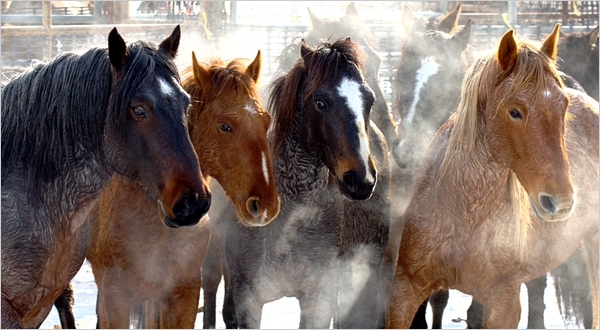
Horseback Magazine repeatedly asked for the name of the landowner, Greg Foster, who is cooperating with BLM on the gather. The agency claims the wild horses it is stampeding with a low flying helicopter are in mountainous terrain. Spokesmen say that the bureau is only setting up a holding pen and storing equipment on Foster’s property. Since press and public have been barred from witnessing the “gather” except in tightly controlled “media days,” there is no way to independently determine if the BLM is herding wild horses found on the landowner’s property.
The agency claims the horses are driven from the Nevada highlands into the pen set up on Foster’s property.
The BLM has refused to release any more information about the landowner other than his name. A search has produced numerous Nevadans named Greg Foster. An agency spokeswoman claimed the information is protected by the federal privacy act, however, details regarding federal contractors who are not engaged in national security work are generally readily available as public record. Horseback has asked for the information under the federal Freedom of Information Act. Horseback has also asked if Foster is reimbursing the federal government for removing horses from his property.
The roundup was ordered by Nevada BLM officials with the approval of Director Bob Abbey. It has sparked protests and demonstrations nationwide. It has also prompted celebrities such as Willie Nelson, the Barbie Twins, Cheryl Crow, and comedian Bill Maher to call on President Obama to call off the capture.
One horse has reportedly died in the roundup.
In 2008, 45 percent of the roundups resulted in at least one fatality, and on another roundup in Nevada, 27 horses died. The total number of deaths through injury or for other reasons totaled 126 animals last year.
The percentage of dead horses on BLM roundups this year is slightly worse at 46 percent resulting in at least one horse death. In July, a Wyoming gather proved fatal to 11 horses. Through September of this year, 79 horses have died as the agency rushes to clear wild horses from the West.
Over the last two years a total of 205 horses have died at the agency’s hands during its “gathers” to thin the herds despite the almost 260 million acres of vacant land managed by BLM.
Wild horse advocates claim the BLM roundups are genetically bankrupting the herds to the point of extinction.
The horse habitat set aside by the 1971 Free Roaming Wild Horse and Burro Act is coveted by ranchers for grazing land who sign leases at fire sale prices of $1.35 per cow per month.

Terror in Nevada: A BLM Wild Horse Roundup Goes Tragically Wrong

Straight from the Horse's Heart

by R.T. Fitch, author of “Straight from the Horse’s Heart“


Terrorized and Frozen, the Horses of the Calico Roundup - Photo by Kurt Golgart/Bureau of Land Management
HOUSTON (SFHH) – If ever there were a case of “a picture is worth a thousand words” then this is surely the premier example.
Sheer terror in their eyes, steam coming from not only their breath but from their soaked coats in the freezing temperatures and what has not dissipated into the frigid air has frozen solid to their winter coats.  This is a Department of Interior “approved for release photograph” documenting the cruel and inhumane roundup going on in Northern Nevada at this very moment…and just in, at least one horse is now dead, one that we know of.

Plagued by controversy and bad press BLM Director Bob Abby decided to ignore the advice of a Federal Judge and proceed with a wintertime roundup of epic, disastrous proportions.  Tens of thousands of American citizens have spoken out and demanded that the Obama administration stop this dangerous operation but to date the new President has elected to remain silent on the topic.
Warned by equine professionals that the chasing of wild horses down snow covered mountains with helicopters would not only prove dangerous and deadly but also destroy the health and well being of the native wild animals; again, the BLM pressed forward but this time on private land so that neither the press or the public could view or monitor the deadly operation.
Many questions have been raised by this clandestine operation that will cost the U.S. tax payers close to $2,000,000.00.
If the horses are being removed because there is, allegedly, little grass on which they can feed, why then did the BLM increase the grazing permits for private cattle by 300% last year, for the exact same public land?
Are the ranchers who own the private land paying and reimbursing the BLM (and US tax payers) for the removal?
Who is allowing the BLM to set up shop on their private land?
Why is the operation done in secret after program manager Don Glenn assured everyone it would be public?
Why is the current Administration, a proposed Administration of “change”, turning a deaf ear to thousands of phone calls, tens of thousands of emails and multiple demonstrations across the country?
Last year the BLM wanted to destroy the 33,000+ wild horses it allegedly has in long term incarceration because it could not afford to feed them; why do they plan on ripping 12,000 more from their rightful land in fiscal 2010?  Does that makes sense?
No, of course it does not make sense, nothing about the random acts of violence the BLM commits makes sense.
The questions are limitless and the answers are obvious to the public but remain unanswered by an agency than has gone full-blown amuck.
As we speak, our young men and women are fighting and losing their lives while battling terror and tyranny that rips apart families, steals their land, kills tribal members and incarcerates the innocent.  Yet here, within the U.S. Government, we have an agency that is doing the exact same thing; ripping apart families; stealing the very land that the U.S. Congress gave to the horses, killing many while they run the remainder into traps where the horses will live in prison for the rest of their lives.

Author/Editor Steven Long documented a recent interview with a BLM official who’s total lack of engagement with the facts should be grounds for immediate dismissal.
Likewise, Mr. Long in yet another in-depth article got to the root of the problem when finding out who was responsible for defying a Federal Judge’s recommendation and proceeded with the roundup with full knowledge that holding said horses, long term, could be illegal.  BLM Director Bob Abby admitted himself into the voting public’s “Hall of Shame” for his disrespectful and cowardice act of pulling the trigger on the wild ones.  Secretary of the Interior, Cattleman Ken Salazar, wins the runner up award for blatant corruption and collusion, but he is pressing hard for first.
The picture tells it all, it speaks volumes and should be sent to the President, himself, with the plea to call a halt to this madness and let the professionals assess the situation prior to mounting anymore dangerous and unwarranted wild horse roundups.
Write, call and make your voice heard.  Let the Administration know that you want a moratorium on the roundups.  You can make a difference, you can save a life and in so doing leave the last final legacy of our frontier roots to live out their lives as intended so that your grandchildren can share in their beauty.

Fact Sheet and Overview from The Cloud Foundation Click here for Fact Sheet
Frequently Asked Questions from The Mustang Coalition FAQ About Wild Horses_12_09
Myths About Wild Horses and Burros from Animal Welfare Institute wild-horse-and-burro-facts-and-myths
Words to Save Them from the Animal Welfare Institute Words to Keep Them Wild and Free


Bookmark and Share

Let's Make 2010 A Better Year for Wild Herds


This is the last 12 hours to give a donation for 2009 online,
just 
click here or send in a donation today
Happy New Year
Protests Take Place Nationwide- More Planned for coming week as Calico Roundup Continues 


Dear Friends & Supporters,

This has been a year full of a lot of tragedy for a our wild horses and burros but also a lot of hope. Let's not tire in our work to protect our wild herds in the west as 2010 begins. Yesterday we were inspired by those who stood up for the wild horses and burros in Chicago, Colorado, Idaho and San Francisco, gaining international press coverage and a lot of awareness for what is going on right now in Calico. 


We are helping to plan more protests in Denver , Los Angeles , Las Vegas , New York City, and London next week with repeat protests expected from yesterday's cities. Details on all these events will be on our events page soon. We've posted photos and links to the stories that came out on these protests at The Cloud Foundation blog, here. We will be posting more information on starting your own protest, rally or vigil for our wild horses. Even the little heros for our wild herds were out in force in San Francisco yesterday (kids too, pictured above!)

Figaro & Fluffy protest- photo @ left from the San Francisco Chronicle
While the BLM, under the auspices of Secretary Salazar, is running away with our wild herds, please don't forget that we can stop this. These are our wild horses on our public lands! This is both an honor and a huge responsibility and until we get the train back on the tracks we will push on. About 40 years ago Wild Horse Annie said "I am fighting for their memory" and until we can institute a moratorium on these unnecessary and cruel roundups, we will continue to work. 
Please support the Cloud Foundation as you can, with your action and support. As we wish you a new year I am standing on Sykes Ridge watching wild horses forage and lay in the sun, conserving as much energy as possible- the antithesis of what is going on in Nevada right now.
What an exciting and beautiful thing that we are fighting for! Don't give up and please feel supported as advocates from around the world are coming together to battle one rogue government  agency that happens to hold a real jewel in its hand, our wild horses and burros.


Thank you for your support.
Best wishes for the new year,
Ginger, Makendra & the entire Cloud Foundation Team of inspiring Volunteers


Please watch the new PSA with Sheryl Crow & Viggo Mortensen from Moving Cloud Productions, share it and then take action.
Call your Senators: 202-224-3121, again, and ask that they work with you to stop the Calico roundup and reform the BLM.

The photo above & the photo below were taken by a witness to the disastrous Dec. 2007 BLM Roundup of 1000+ mustangs from the Antelope & Antelope Valley herds in Nevada . We thank her for being there.
The same thing is happening today in Calico. More photos of this roundup & Calico coming soon

The Cloud Foundation is a 501(c)3 non-profit named in honor of Cloud, a wild horse stallion who has become an ambassador for a movement to save all our wild horses living in their wild homes with their families.
This is the last 12 hours to give a donation online for 2009, just click here or send in a donation today
Signed books, DVDs, Calendars & more are sold to support TCF as well, visit our online store or call 719-633-3842 to order.
Photo of rescued Pryor horses now on a Montana ranch by Mike Penfold; photo of Cloud's and Morning Star's bands running by supporter Tony Wengert