
Friday, June 3, 2011


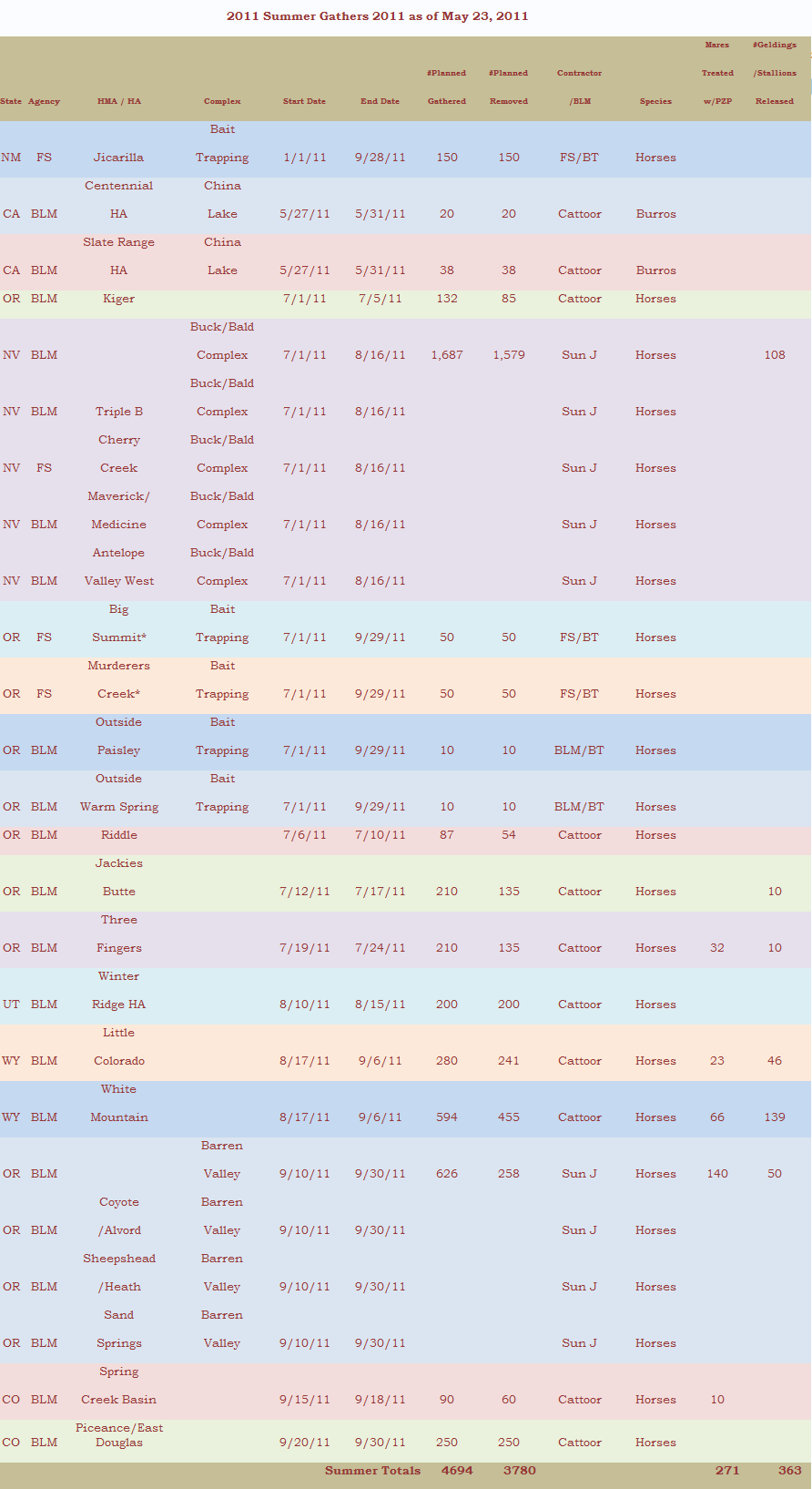
http://rtfitch.wordpress.com/2011/06/03/blm-wild-horse-stampede-schedule-for-2011/
Straight from the Horse's Heart

“Let the Cruelty Begin”
Documented inhumane contractors will be spending hundreds of thousands of your dollars to cruelly chase federally protected horses across our public lands. Heat of the Summer, still into foaling season, the only thing left to do will be to count the bodies, just like last year…a broken system lumbering forward leaving only bones and broken families behind, it is a travesty.
Related articles
- Fight Continues to Expose Obama’s BLM Lies to the American Public (rtfitch.wordpress.com)
- Scientists Demand Obama’s BLM Cease Stampeding Wild Horse Foals and Mares (rtfitch.wordpress.com)
- Stop Obama’s Wild Horse Harvesting Machine: aka the BLM (rtfitch.wordpress.com)
- Obama’s BLM Flips Off Wild Horse Advocates with New Board Appointees (rtfitch.wordpress.com)
Thursday, June 2, 2011
Upsetting News About Havasupai
Dear Animal advocates,
Please read the comment I got on the blog below:
"I have just returned from a trip to the Havasupai. The beauty of the area was maligned by the condition of animals and the pollution of the land. I can only fight so many battles so the the plight of the horses has taken the front step. Upon arrival at the trailhead I found 2 starved horses; one older, clearly hours from death and a yearling, not quite as bad. Both evidently, without food or water for days. I gave them gave all the water I could spare. The trailhead guard expressed sympathy and said to turn them loose. I did. Upon arrival in the canyon I found animals thin, but nothing as drastic. I observed pack animals through the days. I came to the conclusion that there were very experienced and humane packers who clearly took care of their animals and there were packers without conscience or consideration. Being a horse owner, I feel I have to speak up for the dire situation. I have never been as deeply affected by wrongful situations as I have witnessed in the Havasupai. I will never return. I will never recommend trips, only give testimony to the degradation. I am saddened. What can I do to help?"
I replied there at the blog post.
http://arizona1-aahsbloggingupdates.blogspot.com/2009/09/urgent-horse-situation-in-havasupai.html#comment-216860350
We need to follow up on this. It was first reported to me two years ago.
I welcome ANY suggestions, actions we should take. This is deplorable and unacceptable.
Thanks. Please share everywhere.
Please read the comment I got on the blog below:
"I have just returned from a trip to the Havasupai. The beauty of the area was maligned by the condition of animals and the pollution of the land. I can only fight so many battles so the the plight of the horses has taken the front step. Upon arrival at the trailhead I found 2 starved horses; one older, clearly hours from death and a yearling, not quite as bad. Both evidently, without food or water for days. I gave them gave all the water I could spare. The trailhead guard expressed sympathy and said to turn them loose. I did. Upon arrival in the canyon I found animals thin, but nothing as drastic. I observed pack animals through the days. I came to the conclusion that there were very experienced and humane packers who clearly took care of their animals and there were packers without conscience or consideration. Being a horse owner, I feel I have to speak up for the dire situation. I have never been as deeply affected by wrongful situations as I have witnessed in the Havasupai. I will never return. I will never recommend trips, only give testimony to the degradation. I am saddened. What can I do to help?"
I replied there at the blog post.
http://arizona1-aahsbloggingupdates.blogspot.com/2009/09/urgent-horse-situation-in-havasupai.html#comment-216860350
We need to follow up on this. It was first reported to me two years ago.
I welcome ANY suggestions, actions we should take. This is deplorable and unacceptable.
Thanks. Please share everywhere.
Federal EHV-1 update: our latest state wrap | Horsetalk.co.nz - International horse news
Federal EHV-1 update: our latest state wrap | Horsetalk.co.nz - International horse news
There remain 73 cases considered suspect and, in total, 244 properties across 10 states have horses that have been exposed.
June 3, 2011
By Laurie Dixon
» EHV Q&A
Federal authorities in the US have today released their weekly Equine Herpesvirus-1 update, reporting one additional death and nine extra confirmed cases.
» Got an update? Contact us.
|
Our state by state wrap of EHV-1 across western states reflects today's report from the Animal and Plant Health Inspection Service (APHIS) of the US Department of Agriculture.
The agency is collating all state information and is publishing it only when the data is verified.
Information below from individual states is included where it advances the details provided by APHIS.
EHV-1 is capable of causing severe neurological symptoms in horses, which can prove fatal. However, not all horses that are infected will show neurological signs. ...
Arizona
Thirty-three horses were exposed at the Ogden, Utah, cutting horse event at the centre of the outbreak. There are two confirmed cases of EHV-1 infection and one confirmed cases of the neurological form, EHM. One has been euthanized. The state has four suspected cases of EHV-1
Horse Eating Wyoming Politician Spews More Hatred
Straight from the Horse's Heart
(In My Most Outraged Opinion) by R.T. Fitch ~ Author/Director of HfH Advisory Council
 A great victory for the American horse occurred this week when the House Appropriations Committee voted on an amendment to reinstate formerly existing language in a bill that prohibited wasting tax payer’s hard earned dollars on funding inspections of horse slaughter plants (5 million dollars worth). That language was voted on and inserted in 2006 representing the opinion of over two thirds of the American public who stand firmly against the inhumane practice of horse slaughter in this country. The only reason that Rep. Moran of Virginia, an enlightened horse supporting state that makes money off from equine development, was forced to add the amendment was due to the back room, special interest finagling of Rep. Lummis and her off the wall cohort “Slaughterhouse” Sue Wallis a lowly and third rate state representative from Wyoming. (IMHO)
On Tuesday, the day of the vote, sane and intelligent Americans phoned and faxed Washington to insist that the language be returned to the bill and the amendment passed by a vote of 24-21. These Americans were not activists, radicals or urban, tree hugging vegans (to use the oppositions’ words) but mothers, aunts, grand fathers and the little girl next door; NORMAL people who see the horse as an elegant creature that deserves not only to be treated humanely during its life but even more so upon its death. Respect, dignity and a strong sense of morality drove these fine people to make a difference and prove to, not only themselves, but to their elected officials that the American public still has a heart and cares deeply about doing the “right thing”.
But that goodness and honesty rankles the greed of the soulless and unclean as they are now pummeling the internet with more lies, unsubstantiated facts and outright temper tantrums. (Sue Wallis was so very much looking forward to her rare and bloody “Filly Fillet.)
On Wednesday the lost and pathetic politician, Wallis of course, posted on her failed FaceBook page, from a long forgotten horse eater convention, a link to her latest tirade against the evil HSUS and we highly paid and uninformed followers. With each post she slips further and further from the grasp of reality and sinks ever deeper in her swirling cesspool of equine entrails.
Maybe it is her lack of followers, support, failed newspaper, investigations, law suits, dubious financial dealings, switching and manipulating “non-profit” organizations and the lack of interest, overall, of eating a non-food animal and friend to mankind. Who knows as her demons are many.
 You can read her latest meltdown by clicking (HERE) but the evil queen of deception rants in such a way that it is obvious the padded room is long overdue. We have taken the liberty to highlight her most outlandish and undocumented lies but I neither have the time nor the patience to address each and every one; this blog is full of the facts, links and the documentation which proves that she is just pissing in the wind and grasping at straws.
But for the sake of the horses, here are a few highlights that bear addressing:
“… captive bolts provide instantaneous insensibility… Lethal drugs can cause many long minutes of suffering before the animal finally succumbs, a horse in a processing plant dies instantaneously with a minimum of pain or stress and their meat is welcomed by a thriving worldwide market”…WRONG
Dr. Lester Friedlander, DVM & former Chief USDA Inspector, told Congress in 2008, “The captive bolt is not a proper instrument for the slaughter of equids, these animals regain consciousness 30 seconds after being struck, they are fully aware they are being vivisected.” (In normal people language that means that they are alive as they are skinned and their insides are ripped out.)
“…being abandoned to fend for themselves where they inevitably die an agonizing death of starvation where they all too often become the victim of predators and have their guts and their butts eaten by wolves or coyotes while they are still alive” WRONG
The twisted politician has a way with words, doesn’t she? Now if she were to donate her ample, ugh, backside to the wolves it would keep them in high cotton until the beginning of 2012 and this case would be closed but come on…how do you then explain, in another one of her lies, the “exploding” wild horse population. If predators were such a threat then she would not be climbing into a very large bed with the BLM in an effort to sell our wild national icons off into slaughter now would she? This is pure political double talk at its most despicable finest.
“…a 30% to 80% drop in value of horses nationwide with the commensurate loss of income and assets to our U.S. horse owners.“ WRONG
If this lard ass of a failed politician would have been doing her job, over the past several years, she would at least be mildly aware of the fact that the economy is in the toilet. Sales of homes, cars, manufactured products, goods and commodities have tanked as the jobs have disappeared and any change, not 30%-80% you lying wench, to the horse market would equally be affected. The Eastern states are doing well with the equine market with the exception of breeders and being that most of them have at least completed high school they don’t blame the down turn on the demise of 3 little, foreign owned slaughter plants but on an increased interest and market for European horses. They actually have business plans and THINK you dumbass.
“…To say that all horses are full of toxic drugs is an exaggeration so outrageous as to be beyond belief–number one, the vast majority of horses who are not performance or sport horses ever receive any kind of veterinary medicine in their entire lives” WRONG
That one must have all of you horse people rolling on the floor laughing. I, for one, do not own performance or sport horses but the ones that do grace our pastures certainly ensure that we spend a lot of money with the vet. As our pampered ponies age the cabinet in the tack room looks more like a pharmacy than a hardware store and Bute for the off the track TBs is often a must. So blow it out your backside you perpetrator of lies and deceit we all know that you are full it.
“…It strikes us as a bit ingenuous that people so opposed to eating horse meat are raising food safety issues as their argument against it.” WRONG
Oh gawd, I am out of breath, I can’t go on as we have gone from being just plain stupid to totally maniacal; my fun meter is pegged at zero and the tolerance factor has long since left the house.
I am sorry, this is as far as I can go; I leave the end of this story to you fine people. Spread the word, support the horses and continue to make those calls as the equines are going to need all of the support that they can get in light of this foul sickness.
So God Speed my friends; let’s kick Sue Wallis and all three of her followers in the ass and save some horses. Our efforts will not only help the equines but, perhaps, save the lives of acres of cotton plants that are required to sacrifice themselves just to make one pair of jeans for the bloated likes of “Slaughterhouse” Sue.
Let’s dance, Sue baby…you ready?
(In My Most Outraged Opinion) by R.T. Fitch ~ Author/Director of HfH Advisory Council
“Slaughterhouse” Sue Proudly Shows Her Ass

The Bloody Vision of Wyoming's Sue Wallis ~ photo courtesy of Canadian Horse Defense Coalition
On Tuesday, the day of the vote, sane and intelligent Americans phoned and faxed Washington to insist that the language be returned to the bill and the amendment passed by a vote of 24-21. These Americans were not activists, radicals or urban, tree hugging vegans (to use the oppositions’ words) but mothers, aunts, grand fathers and the little girl next door; NORMAL people who see the horse as an elegant creature that deserves not only to be treated humanely during its life but even more so upon its death. Respect, dignity and a strong sense of morality drove these fine people to make a difference and prove to, not only themselves, but to their elected officials that the American public still has a heart and cares deeply about doing the “right thing”.
But that goodness and honesty rankles the greed of the soulless and unclean as they are now pummeling the internet with more lies, unsubstantiated facts and outright temper tantrums. (Sue Wallis was so very much looking forward to her rare and bloody “Filly Fillet.)
On Wednesday the lost and pathetic politician, Wallis of course, posted on her failed FaceBook page, from a long forgotten horse eater convention, a link to her latest tirade against the evil HSUS and we highly paid and uninformed followers. With each post she slips further and further from the grasp of reality and sinks ever deeper in her swirling cesspool of equine entrails.
Maybe it is her lack of followers, support, failed newspaper, investigations, law suits, dubious financial dealings, switching and manipulating “non-profit” organizations and the lack of interest, overall, of eating a non-food animal and friend to mankind. Who knows as her demons are many.

This is the latest tourist attraction that Sue Wallis wants for Wyoming, a horse organ dump ~ photo of dump outside of Canadian Horse Slaughter Plant courtesy of John Hlland
But for the sake of the horses, here are a few highlights that bear addressing:
“… captive bolts provide instantaneous insensibility… Lethal drugs can cause many long minutes of suffering before the animal finally succumbs, a horse in a processing plant dies instantaneously with a minimum of pain or stress and their meat is welcomed by a thriving worldwide market”…WRONG
Dr. Lester Friedlander, DVM & former Chief USDA Inspector, told Congress in 2008, “The captive bolt is not a proper instrument for the slaughter of equids, these animals regain consciousness 30 seconds after being struck, they are fully aware they are being vivisected.” (In normal people language that means that they are alive as they are skinned and their insides are ripped out.)
“…being abandoned to fend for themselves where they inevitably die an agonizing death of starvation where they all too often become the victim of predators and have their guts and their butts eaten by wolves or coyotes while they are still alive” WRONG
The twisted politician has a way with words, doesn’t she? Now if she were to donate her ample, ugh, backside to the wolves it would keep them in high cotton until the beginning of 2012 and this case would be closed but come on…how do you then explain, in another one of her lies, the “exploding” wild horse population. If predators were such a threat then she would not be climbing into a very large bed with the BLM in an effort to sell our wild national icons off into slaughter now would she? This is pure political double talk at its most despicable finest.
“…a 30% to 80% drop in value of horses nationwide with the commensurate loss of income and assets to our U.S. horse owners.“ WRONG
If this lard ass of a failed politician would have been doing her job, over the past several years, she would at least be mildly aware of the fact that the economy is in the toilet. Sales of homes, cars, manufactured products, goods and commodities have tanked as the jobs have disappeared and any change, not 30%-80% you lying wench, to the horse market would equally be affected. The Eastern states are doing well with the equine market with the exception of breeders and being that most of them have at least completed high school they don’t blame the down turn on the demise of 3 little, foreign owned slaughter plants but on an increased interest and market for European horses. They actually have business plans and THINK you dumbass.
“…To say that all horses are full of toxic drugs is an exaggeration so outrageous as to be beyond belief–number one, the vast majority of horses who are not performance or sport horses ever receive any kind of veterinary medicine in their entire lives” WRONG
That one must have all of you horse people rolling on the floor laughing. I, for one, do not own performance or sport horses but the ones that do grace our pastures certainly ensure that we spend a lot of money with the vet. As our pampered ponies age the cabinet in the tack room looks more like a pharmacy than a hardware store and Bute for the off the track TBs is often a must. So blow it out your backside you perpetrator of lies and deceit we all know that you are full it.
“…It strikes us as a bit ingenuous that people so opposed to eating horse meat are raising food safety issues as their argument against it.” WRONG
Oh gawd, I am out of breath, I can’t go on as we have gone from being just plain stupid to totally maniacal; my fun meter is pegged at zero and the tolerance factor has long since left the house.
I am sorry, this is as far as I can go; I leave the end of this story to you fine people. Spread the word, support the horses and continue to make those calls as the equines are going to need all of the support that they can get in light of this foul sickness.
So God Speed my friends; let’s kick Sue Wallis and all three of her followers in the ass and save some horses. Our efforts will not only help the equines but, perhaps, save the lives of acres of cotton plants that are required to sacrifice themselves just to make one pair of jeans for the bloated likes of “Slaughterhouse” Sue.
Let’s dance, Sue baby…you ready?
Related articles
- The High Price of Horse Slaughter (rtfitch.wordpress.com)
- Wyoming Horse Slaughter Politician Sued for Alleged Assualt and Battery (rtfitch.wordpress.com)
- Interview: Reporter Scoops Story on Wyoming Horse Slaughter Politician (rtfitch.wordpress.com)
Wednesday, June 1, 2011
The High Price of Horse Slaughter
Straight from the Horse's Heart
 Chicago (EWA) – The Equine Welfare Alliance and Animal Law Coalition applaud Rep. Jim Moran and House of Representatives Appropriations Committee members who stood up for the horses this week. Rep. Moran introduced an amendment to the proposed agriculture appropriations bill to make sure commercial horse slaughter in the U.S. remains illegal.
The amendment was accepted by the Committee on a vote of 24 to 21 and it’s now on to a vote by the full House on the agriculture appropriations bill on June 15.
The amendment de-funds (prohibits funds from being spent on) ante-mortem inspections of horses to be slaughtered for human consumption. Without these inspections required by federal law, horses cannot be commercially slaughtered for human consumption in the U.S. The inspections have been de-funded since 2006. http://www.animallawcoalition.com/horse-slaughter/article/1809
The next step must be a ban on exports of U.S. horses for slaughter for human consumption. More than two thirds of Americans support a ban on horse slaughter. Proponents have avoided discussing what is clear to most Americans – the inherent cruelty of horse slaughter. As Dr. Lester Friedlander, DVM & former Chief USDA Inspector, told Congress in 2008, “The captive bolt is not a proper instrument for the slaughter of equids, these animals regain consciousness 30 seconds after being struck, they are fully aware they are being vivisected.”
There is virtually no market in the U.S. for horsemeat and U.S. horses are not raised under the regulations required for food animals. Indeed, horses are given a wide variety of drugs that are not tracked. Phenylbutazone (bute), for example, is given to horses like aspirin. Bute is a known carcinogen and causes liver failure, aplastic anemia and other blood diseases. It is banned by the FDA for use in food animals. Yet, we continue to allow horses full of drugs to be sent for slaughter for consumption as a pricey delicacy by people in other countries.
Slaughter is also not a “service” for so-called excess or “unwanted”, abandoned, neglected or infirm horses. If it were, we would have no horses in need because slaughter is still available for American horses in other countries. But a study for USDA confirms more than 92% of horses sent for slaughter are healthy. Kill buyers want the healthiest horses, not old, sick or infirm horses. Slaughter is driven by a demand for horsemeat in other countries.
Slaughter proponents claim that horse slaughter is necessary because there are too many horses, but the irony is that the availability of slaughter creates a “salvage market” that encourages excess breeding and poor breeding practices. In a market where supply is so easily increased, it will simply follow demand.
Among other observations, Rep. Moran made the point that the $5 million dollars of funding in question would merely prop up a foreign owned industry at US taxpayer expense. In the current fiscal environment, this argument resonated across party lines.
Slaughter represents less than 3 cents for every $100 of revenue in the horse industry. It has nothing to do with the health of the horse industry. All slaughter has ever brought to U.S. communities besides animal cruelty is environmental and economic devastation. The jobs are few and very poor; the profits along with the “product” are shipped off to foreign owners of slaughter facilities. As Paula Bacon, mayor of Kaufman, Texas when a horse slaughter facility operated there, said, “Our community did not benefit. We paid”.
It is time Americans and their horses stopped paying the awful price of horse slaughter. Call on your U.S. representative to retain the de-funding of horse inspections in the Agriculture Appropriations bill.
Equine Welfare Alliance and Animal Law Coalition
 Chicago (EWA) – The Equine Welfare Alliance and Animal Law Coalition applaud Rep. Jim Moran and House of Representatives Appropriations Committee members who stood up for the horses this week. Rep. Moran introduced an amendment to the proposed agriculture appropriations bill to make sure commercial horse slaughter in the U.S. remains illegal.
The amendment was accepted by the Committee on a vote of 24 to 21 and it’s now on to a vote by the full House on the agriculture appropriations bill on June 15.
The amendment de-funds (prohibits funds from being spent on) ante-mortem inspections of horses to be slaughtered for human consumption. Without these inspections required by federal law, horses cannot be commercially slaughtered for human consumption in the U.S. The inspections have been de-funded since 2006. http://www.animallawcoalition.com/horse-slaughter/article/1809
The next step must be a ban on exports of U.S. horses for slaughter for human consumption. More than two thirds of Americans support a ban on horse slaughter. Proponents have avoided discussing what is clear to most Americans – the inherent cruelty of horse slaughter. As Dr. Lester Friedlander, DVM & former Chief USDA Inspector, told Congress in 2008, “The captive bolt is not a proper instrument for the slaughter of equids, these animals regain consciousness 30 seconds after being struck, they are fully aware they are being vivisected.”
There is virtually no market in the U.S. for horsemeat and U.S. horses are not raised under the regulations required for food animals. Indeed, horses are given a wide variety of drugs that are not tracked. Phenylbutazone (bute), for example, is given to horses like aspirin. Bute is a known carcinogen and causes liver failure, aplastic anemia and other blood diseases. It is banned by the FDA for use in food animals. Yet, we continue to allow horses full of drugs to be sent for slaughter for consumption as a pricey delicacy by people in other countries.
Slaughter is also not a “service” for so-called excess or “unwanted”, abandoned, neglected or infirm horses. If it were, we would have no horses in need because slaughter is still available for American horses in other countries. But a study for USDA confirms more than 92% of horses sent for slaughter are healthy. Kill buyers want the healthiest horses, not old, sick or infirm horses. Slaughter is driven by a demand for horsemeat in other countries.
Slaughter proponents claim that horse slaughter is necessary because there are too many horses, but the irony is that the availability of slaughter creates a “salvage market” that encourages excess breeding and poor breeding practices. In a market where supply is so easily increased, it will simply follow demand.
Among other observations, Rep. Moran made the point that the $5 million dollars of funding in question would merely prop up a foreign owned industry at US taxpayer expense. In the current fiscal environment, this argument resonated across party lines.
Slaughter represents less than 3 cents for every $100 of revenue in the horse industry. It has nothing to do with the health of the horse industry. All slaughter has ever brought to U.S. communities besides animal cruelty is environmental and economic devastation. The jobs are few and very poor; the profits along with the “product” are shipped off to foreign owners of slaughter facilities. As Paula Bacon, mayor of Kaufman, Texas when a horse slaughter facility operated there, said, “Our community did not benefit. We paid”.
It is time Americans and their horses stopped paying the awful price of horse slaughter. Call on your U.S. representative to retain the de-funding of horse inspections in the Agriculture Appropriations bill.
The Equine Welfare Alliance is a dues free, umbrella organization with 155 member organizations and hundreds of individuals worldwide. The organization focuses its efforts on the welfare of all equines and the preservation of wild equids. www.equinewelfarealliance.org
The Animal Law Coalition is a coalition of pet owners and rescuers, advocates, attorneys, law students, veterinarians, shelter workers, decision makers, and other citizens, that advocates for the rights of animals to live and live free of cruelty and neglect. www.animallawcoalition.com
Related articles
- Horse Slaughter Defunding Language Remains Intact!! (rtfitch.wordpress.com)
- Wyoming Horse Slaughter Politician Sued for Alleged Assualt and Battery (rtfitch.wordpress.com)
- Interview: Reporter Scoops Story on Wyoming Horse Slaughter Politician (rtfitch.wordpress.com)
Allure of wild horses draw tourists on a global scale
RGJ.com
Ecotourism isn't a word one hears often in reference to Lyon County, but a significant number of people are willing to travel thousands of miles to visit the area in search of wild horses. Read MORE...
Ecotourism isn't a word one hears often in reference to Lyon County, but a significant number of people are willing to travel thousands of miles to visit the area in search of wild horses. Read MORE...
After Loss, Slaughter Leader Issues Manifesto
Horseback Magazine
June 1, 2011
Ag Appropriations Report and our Initial Response
By Sue Wallis,
 WASHINGTON, (United Organizations of the Horse) – Last night the Ag Appropriations Committee voted 24-21 to adopt Rep. Moran, Virginia, amendment to reinstate the prohibition on inspection of horse meat. This in spite of Rep. Lummis’ knowledgeable and articulate testimony and over the objection of Subcommittee Chairman Kingston.
This is just the opening round, however, and we still have multiple opportunities to fix the bill before the 2012 appropriations process is complete. Our next chance will be when the committee bill comes to a full vote of the House on June 15th. Then it will go to the Senate and goes through the complete process over there. Needless to say we are circling the wagons with our coalition partners and will do our best to keep you apprised as we move along. We will be asking for your help throughout, and really appreciate your willingness to step up on behalf of our industry.
Moran is well known for his support of HSUS causes, so that it is not surprising that he would bring forward the amendment-what was disappointing to so many of us is that the Committee did not honor our request to not inflict any more damage on the horse industry until after they have had a chance to review the findings of the GAO Report on the welfare of horses and the effect on the equine economy of the plants closing.
That long anticipated report is done. It was delivered to USDA last Friday, and is due to Congress within two weeks of that date.
Our message remains the same. There is no disagreement in that we all expect horses to be well cared for and not abused from birth to death. The only disagreement boils down to a private property rights issue. The veterinarians agree that there are three humane ways to end a horse’s life, by bullet, by captive bolt, by lethal drug. Bullets and captive bolts provide instantaneous insensibility. Lethal drugs can cause many long minutes of suffering before the animal finally succumbs, which many of us have witnessed with our own eyes, and results in a large, expensive, toxic drug ridden carcass that cannot be buried for fear of leaching into water tables, cannot be left above ground for fear of other animals feeding on the carcass and dying, cannot even be rendered where that is available because the drugs survive the rendering process-basically results in a thousand pounds of toxic waste.
On the other hand, a horse in a processing plant dies instantaneously with a minimum of pain or stress and their meat is welcomed by a thriving worldwide market providing the horse owner who chooses to receive some return on their investment a decent price. From a humanitarian viewpoint the result is the same, the horse has been dealt with in the best possible way. The only difference is whether the carcass is used or disposed of-for some that means a burial for an old friend, for others it is a bit of income that can be reinvested in better or more useful animals to support their livelihood. No one should have the right to dictate to someone else whether or not they respect their horse’s life by making sure it is not wasted, or dictate how that carcass should be disposed of-only the owner of the horse should determine that.
Secondly there is the issue of Congress once again issuing edicts that prevent states from developing their own economies. Strongly worded resolutions from the National Conference of State Legislatures, the National Association of Counties, the National Congress of American Indians and other such organizations reflect the position of state, local, and tribal governments and have called on Congress not to pass such measures.
The fact is that the well developed projects in Wyoming, North Dakota, Oregon, Montana, Missouri and elsewhere would create over a Thousand good paying jobs almost overnight with the ability to access the export market. It is ironic that the Ag Appropriations process funds millions of dollars of government inspected beef, pork, lamb, and chicken FOR EXPORT, but one of Rep. Moran’s main arguments was that the USDA shouldn’t inspect meat only meant for export!
Instead our excess, unusable, unwanted horses must endure the sorry choice of being killed, albeit humanely, but totally wasted; or trucked for thousands of miles to other countries to be processed where we have no control over how that is done (not to mention their economy gets enhanced, not ours, we’re now importing millions of tons of horse meat for zoo diet and ethnic markets); or being abandoned to fend for themselves where they inevitably die an agonizing death of starvation where they all too often become the victim of predators and have their guts and their butts eaten by wolves or coyotes while they are still alive (google the recent wolf kill of a prized horse in Darby, Montana to see what wolves do to horses). Look up A Million Horses.com – 400% increase in reports of abandoned, neglected horses every year since the plants closed. That is abuse!
Many aspects of Rep. Moran’s testimony were disturbing, misleading, and false. The fact is that allowing horse plants to pay for their own processing fees would add zero cost, and require zero appropriation, not the $5 million that he claimed.
To say that the only benefactors of horse processing are foreign countries is almost beyond belief when the secondary market for an entire sector of animal agriculture is eliminated-a 30% to 80% drop in value of horses nationwide with the commensurate loss of income and assets to our U.S. horse owners.
To say that Americans do not use horse meat is crazy when three quarters of the world does, and we have a long and honorable history in this country of using and enjoying a meat that is so healthy and nutritious-twice the protein, half the fat, high in iron and other beneficial nutrients with, for instance, eighteen times the omega three fatty acids.
To say that all horses are full of toxic drugs is an exaggeration so outrageous as to be beyond belief-number one, the vast majority of horses who are not performance or sport horses ever receive any kind of veterinary medicine in their entire lives, those that are can be held for an appropriate withdrawal period before processing depending on the drug, and there are tests for both live animals before processing and for carcasses afterwards that can detect any drug residue down to the parts per trillion-combine that with the fact that EU has NEVER found any significant drug residue in any carcass in any horse plant in the United States, Canada, or Mexico, EVER. It strikes us as a bit ingenuous that people so opposed to eating horse meat are raising food safety issues as their argument against it.
The brutal truth is that the entire United States equine industry is in the process of liquidating and downsizing. Until we see the GAO Report no one has any accurate accounting of how many jobs and livelihoods have already been lost. It is no exaggeration to note that without a responsible and regulated option for processing to deal with excess otherwise unusable and unwanted horses that we will inevitable lose another 200,000 to 300,000 jobs. Without a secondary outlet, the whole market has plummeted, breeding has essentially stopped.
Fewer horses means fewer jobs means fewer horse shows, fewer rodeos, fewer horse trailers, fewer training dollars, fewer veterinary needs, fewer saddles, bridles, less need for feed-that all amounts to a devastating economic contraction that is destroying our prized American horseback culture.
Our efforts to restore the private property rights of horse owners, to rejuvenate an entire sector of animal agriculture, to create jobs and opportunity, and to preserve our cultures and livelihoods will continue.
June 1, 2011
Ag Appropriations Report and our Initial Response
By Sue Wallis,
 WASHINGTON, (United Organizations of the Horse) – Last night the Ag Appropriations Committee voted 24-21 to adopt Rep. Moran, Virginia, amendment to reinstate the prohibition on inspection of horse meat. This in spite of Rep. Lummis’ knowledgeable and articulate testimony and over the objection of Subcommittee Chairman Kingston.
This is just the opening round, however, and we still have multiple opportunities to fix the bill before the 2012 appropriations process is complete. Our next chance will be when the committee bill comes to a full vote of the House on June 15th. Then it will go to the Senate and goes through the complete process over there. Needless to say we are circling the wagons with our coalition partners and will do our best to keep you apprised as we move along. We will be asking for your help throughout, and really appreciate your willingness to step up on behalf of our industry.
Moran is well known for his support of HSUS causes, so that it is not surprising that he would bring forward the amendment-what was disappointing to so many of us is that the Committee did not honor our request to not inflict any more damage on the horse industry until after they have had a chance to review the findings of the GAO Report on the welfare of horses and the effect on the equine economy of the plants closing.
That long anticipated report is done. It was delivered to USDA last Friday, and is due to Congress within two weeks of that date.
Our message remains the same. There is no disagreement in that we all expect horses to be well cared for and not abused from birth to death. The only disagreement boils down to a private property rights issue. The veterinarians agree that there are three humane ways to end a horse’s life, by bullet, by captive bolt, by lethal drug. Bullets and captive bolts provide instantaneous insensibility. Lethal drugs can cause many long minutes of suffering before the animal finally succumbs, which many of us have witnessed with our own eyes, and results in a large, expensive, toxic drug ridden carcass that cannot be buried for fear of leaching into water tables, cannot be left above ground for fear of other animals feeding on the carcass and dying, cannot even be rendered where that is available because the drugs survive the rendering process-basically results in a thousand pounds of toxic waste.
On the other hand, a horse in a processing plant dies instantaneously with a minimum of pain or stress and their meat is welcomed by a thriving worldwide market providing the horse owner who chooses to receive some return on their investment a decent price. From a humanitarian viewpoint the result is the same, the horse has been dealt with in the best possible way. The only difference is whether the carcass is used or disposed of-for some that means a burial for an old friend, for others it is a bit of income that can be reinvested in better or more useful animals to support their livelihood. No one should have the right to dictate to someone else whether or not they respect their horse’s life by making sure it is not wasted, or dictate how that carcass should be disposed of-only the owner of the horse should determine that.
Secondly there is the issue of Congress once again issuing edicts that prevent states from developing their own economies. Strongly worded resolutions from the National Conference of State Legislatures, the National Association of Counties, the National Congress of American Indians and other such organizations reflect the position of state, local, and tribal governments and have called on Congress not to pass such measures.
The fact is that the well developed projects in Wyoming, North Dakota, Oregon, Montana, Missouri and elsewhere would create over a Thousand good paying jobs almost overnight with the ability to access the export market. It is ironic that the Ag Appropriations process funds millions of dollars of government inspected beef, pork, lamb, and chicken FOR EXPORT, but one of Rep. Moran’s main arguments was that the USDA shouldn’t inspect meat only meant for export!
Instead our excess, unusable, unwanted horses must endure the sorry choice of being killed, albeit humanely, but totally wasted; or trucked for thousands of miles to other countries to be processed where we have no control over how that is done (not to mention their economy gets enhanced, not ours, we’re now importing millions of tons of horse meat for zoo diet and ethnic markets); or being abandoned to fend for themselves where they inevitably die an agonizing death of starvation where they all too often become the victim of predators and have their guts and their butts eaten by wolves or coyotes while they are still alive (google the recent wolf kill of a prized horse in Darby, Montana to see what wolves do to horses). Look up A Million Horses.com – 400% increase in reports of abandoned, neglected horses every year since the plants closed. That is abuse!
Many aspects of Rep. Moran’s testimony were disturbing, misleading, and false. The fact is that allowing horse plants to pay for their own processing fees would add zero cost, and require zero appropriation, not the $5 million that he claimed.
To say that the only benefactors of horse processing are foreign countries is almost beyond belief when the secondary market for an entire sector of animal agriculture is eliminated-a 30% to 80% drop in value of horses nationwide with the commensurate loss of income and assets to our U.S. horse owners.
To say that Americans do not use horse meat is crazy when three quarters of the world does, and we have a long and honorable history in this country of using and enjoying a meat that is so healthy and nutritious-twice the protein, half the fat, high in iron and other beneficial nutrients with, for instance, eighteen times the omega three fatty acids.
To say that all horses are full of toxic drugs is an exaggeration so outrageous as to be beyond belief-number one, the vast majority of horses who are not performance or sport horses ever receive any kind of veterinary medicine in their entire lives, those that are can be held for an appropriate withdrawal period before processing depending on the drug, and there are tests for both live animals before processing and for carcasses afterwards that can detect any drug residue down to the parts per trillion-combine that with the fact that EU has NEVER found any significant drug residue in any carcass in any horse plant in the United States, Canada, or Mexico, EVER. It strikes us as a bit ingenuous that people so opposed to eating horse meat are raising food safety issues as their argument against it.
The brutal truth is that the entire United States equine industry is in the process of liquidating and downsizing. Until we see the GAO Report no one has any accurate accounting of how many jobs and livelihoods have already been lost. It is no exaggeration to note that without a responsible and regulated option for processing to deal with excess otherwise unusable and unwanted horses that we will inevitable lose another 200,000 to 300,000 jobs. Without a secondary outlet, the whole market has plummeted, breeding has essentially stopped.
Fewer horses means fewer jobs means fewer horse shows, fewer rodeos, fewer horse trailers, fewer training dollars, fewer veterinary needs, fewer saddles, bridles, less need for feed-that all amounts to a devastating economic contraction that is destroying our prized American horseback culture.
Our efforts to restore the private property rights of horse owners, to rejuvenate an entire sector of animal agriculture, to create jobs and opportunity, and to preserve our cultures and livelihoods will continue.
Congressman Moran's press release on passage of the anti-horse slaughter amendment to the Agriculture
Congressman Jim Moran's website
PRESS RELEASE
PRINT
For Immediate Release:
May 31, 2011
Contact: Anne Hughes
202-225-4376
Moran Amendment to Ban Horse Slaughter Attached to Agricultural Appropriations Bill
Language to halt USDA inspections, certification of slaughter facilities
Washington, DC – Congressman Jim Moran, Northern Virginia Democrat, successfully included an amendment to the Fiscal Year ’12 Agricultural Appropriations Act to eliminate funding for USDA inspection of horsemeat. By defunding federal inspections, the amendment will prevent the cruel practice of horse slaughter in the United States.
“Industrial slaughter of horses should not be condoned by the United States Government,” said Rep. Moran. “We have to put an end once and for all to this practice. These animals are a proud symbol of the American West, treasured by all for their beauty and majesty. They deserve to be cared for, not killed for foreign consumption.”
Identical language was overwhelmingly approved in 2006 and has been included in the Agricultural Appropriations bill every year when introduced in subcommittee. This year the language had been stripped out and the Moran amendment sought to reinstate it.
A ban on USDA inspections halts the issuance of certifications for horsemeat exports, which has stopped operations at horse slaughter facilities and prevented new facilities from opening. In addition to improving U.S. animal welfare, the Moran amendment will reduce federal spending by $5 million each year. The FY’12 Appropriations Act now heads to the floor for a full vote by the House of Representatives.
The amendment has received the support of the Animal Welfare Institute and the Humane Society of the United States.
“Adding millions of dollars to the federal budget to inspect foreign-owned horse slaughter plants would have been a step backwards for America’s iconic horses and a waste of tax dollars,” said Wayne Pacelle, president and CEO of The Humane Society of the United States. “We are grateful to Congressman Jim Moran for leading the charge to restore this critical horse protection provision, and to the House Appropriations Committee for reining in this multi-million-dollar subsidy that would paved the way for the needless killing of American horses for foreign gourmands.”
Moran has a long history of animal protection advocacy. He currently serves as the co-chair of the bipartisan Congressional Animal Protection Caucus. Moran received the Humane Society’s highest award in 2010 for championing the Truth in Fur Labeling Act, enacted in February 2011, which requires accurate labeling on all fur garments. During his time in Congress, Representative Moran has led the charge on a number of issues related to the protection of animals, including the successful passage of the Prevention of Interstate Commerce in Animal Crush Videos Act of 2010.
To read more on Rep. Moran’s efforts to protect animal welfare, please visit: http://moran.house.gov/issues_animal.shtml
PRESS RELEASE
For Immediate Release:
May 31, 2011
Contact: Anne Hughes
202-225-4376
Moran Amendment to Ban Horse Slaughter Attached to Agricultural Appropriations Bill
Language to halt USDA inspections, certification of slaughter facilities
Washington, DC – Congressman Jim Moran, Northern Virginia Democrat, successfully included an amendment to the Fiscal Year ’12 Agricultural Appropriations Act to eliminate funding for USDA inspection of horsemeat. By defunding federal inspections, the amendment will prevent the cruel practice of horse slaughter in the United States.
“Industrial slaughter of horses should not be condoned by the United States Government,” said Rep. Moran. “We have to put an end once and for all to this practice. These animals are a proud symbol of the American West, treasured by all for their beauty and majesty. They deserve to be cared for, not killed for foreign consumption.”
Identical language was overwhelmingly approved in 2006 and has been included in the Agricultural Appropriations bill every year when introduced in subcommittee. This year the language had been stripped out and the Moran amendment sought to reinstate it.
A ban on USDA inspections halts the issuance of certifications for horsemeat exports, which has stopped operations at horse slaughter facilities and prevented new facilities from opening. In addition to improving U.S. animal welfare, the Moran amendment will reduce federal spending by $5 million each year. The FY’12 Appropriations Act now heads to the floor for a full vote by the House of Representatives.
The amendment has received the support of the Animal Welfare Institute and the Humane Society of the United States.
“Adding millions of dollars to the federal budget to inspect foreign-owned horse slaughter plants would have been a step backwards for America’s iconic horses and a waste of tax dollars,” said Wayne Pacelle, president and CEO of The Humane Society of the United States. “We are grateful to Congressman Jim Moran for leading the charge to restore this critical horse protection provision, and to the House Appropriations Committee for reining in this multi-million-dollar subsidy that would paved the way for the needless killing of American horses for foreign gourmands.”
Moran has a long history of animal protection advocacy. He currently serves as the co-chair of the bipartisan Congressional Animal Protection Caucus. Moran received the Humane Society’s highest award in 2010 for championing the Truth in Fur Labeling Act, enacted in February 2011, which requires accurate labeling on all fur garments. During his time in Congress, Representative Moran has led the charge on a number of issues related to the protection of animals, including the successful passage of the Prevention of Interstate Commerce in Animal Crush Videos Act of 2010.
To read more on Rep. Moran’s efforts to protect animal welfare, please visit: http://moran.house.gov/issues_animal.shtml
Subscribe to:
Posts (Atom)


