Showing posts with label BLM. Show all posts

Saturday, October 6, 2012

Judge Dismisses Wild Horse Suit

Straight from the Horse's Heart


Posted: October 6, 2012 by R.T. Fitch
By  on Sat, Oct 6, 2012
“BLM has  said the horses don’t fall under the protections of the Wild Horse and Burro Act…”
A federal judge has dismissed a case filed by a group of Placitas wild horse enthusiasts against Secretary of the Interior Ken Salazar, the Bureau of Land Management and an Algodones man the suit claimed was working with the BLM to round up the horses.
Members of the Wild Horse Observers Association filed the lawsuit last year, claiming Salazar and the BLM violated a 1971 federal law designed to protect wild horses because they have never recognized horses that roam around Placitas as wild.
The group later amended the lawsuit to seek an injunction preventing the BLM and Al Baca from capturing, transporting or allowing the sale of the horses except as permitted by the Wild Horse and Burro Act. It claimed Baca was working with the BLM and planning to capture and sell the roaming Placitas horses.
Late last month, U.S. District Court Judge Christina Armijo denied the association’s request to further amend its case and granted Baca’s request to dismiss the lawsuit with prejudice, meaning that it cannot be refiled.
In her order, Armijo granted Baca’s request because the Wild Horse Act does not provide for an action filed by a private group or individual. It also said the law the association sought relief under did not apply to a “non-governmental defendant.”
Wild Horse Observers Association is a nonprofit organization whose mission is to protect and preserve horses that roam freely in Placitas and their habitat.
The lawsuit claimed removal of the horses would harm association members who enjoy observing, photographing and writing about the horses.
BLM representatives have said the horses don’t fall under the protections of the Wild Horse and Burro Act because they belong to San Felipe Pueblo and were not therefore classified as wild.
The lawsuit disputed that position, saying the pueblo has never made efforts to claim the horses and the BLM is breaking the law by not recognizing them as wild and protecting them.
San Felipe Gov. Anthony Ortiz recently disagreed with the BLM position in a letter to Association members and its President Patience O’Dowd.
“Contrary to statements made by others, neither San Felipe nor any of its members claims the wild horses as private property or views them as livestock,” the Sept. 5 letter stated.

Tuesday, January 10, 2012

Feds Defend Press Limits to Wild Horse Roundup

Straight from the Horse's Heart

Story by DAVE TARTRE of the Courthouse News Service

BLM Argues for Covert Wild Horse Operations

Recent BLM attack upon the wild horses of the Calico Complex ~ photo by Laura Leigh
SAN FRANCISCO (CN) – A photographer appeared before the 9th Circuit on Monday to defend press freedoms against the federal agency that barred her from attending a roundup of wild horses in Nevada.
Laura Leigh sued in September 2010 for a temporary restraining order that would stop the Bureau of Land Management from conducting a wild horse roundup in the Silver King Herd Management Area, which is about 150 miles north of Las Vegas in Lincoln County.
Leigh wanted to get close enough to take pictures of what is also called a horse gather, which the bureau organized under the Wild and Free-Roaming Horses and Burros Act of 1971, which put the federal government in charge of the herds of wild horses that have roamed the west since they were brought centuries ago by Spanish conquistadors.
As the bureau refused to let Leigh access the roundup, citing public safety concerns, she claimed that the bar would prevent her from closely monitoring the bureau’s methods. She also sought to prevent the use of helicopters to chase down stray horses.
After the roundup occurred, U.S. District Judge Larry Hicks ruled that Leigh failed to show that she had been treated worse than other members of the media or “that the BLM has placed any specific barriers to her access to or observation of these specific gather activities.”
A three-judge panel of the 9th Circuit seemed reluctant Monday to consider Leigh’s First Amendment arguments.
“Why is this case not moot in light of the fact that the Silver King horse gathering is already complete?” Judge Milan Smith Jr. asked Leigh’s attorney, Gordon Cowan of Reno, Nev.
Cowan replied that restrictions on access to government activities, such as the roundup on public land, are capable of repetition.
“This same conduct, denying the press or public access, happened before Silver King, during Silver King, and it happened after Silver King,” Cowan said.
Leigh’s appellate brief states that the bureau had prevented Leigh from observing public resources in a public place in retaliation for stories and pictures Leigh had published on the Internet that showed the agency in a bad light.
“Because the published material is controversial and portrays the government in an unfavorable light, the government’s effective preclusion amounts to content-based censorship,” Cowan wrote.
Justice Department attorney Nicholas DiMascio defended the trial court’s finding, emphasizing that Leigh had the same access to the roundup as any member of the public. Such access was justly restricted because horses that are unaccustomed to people pose a significant dangers to onlookers, he added.
His brief also states that it might have hampered the government’s goals to grant press access to the temporary corrals, since they might spook the horses and make them bolt before the roundup.
The Wild and Free-Roaming Horses and Burros Act protects wild horses on public land, but the horses reproduce at a rate that outpaces the land’s ability to support them. Each year, the bureau uses cowboys, helicopters and portable corrals to capture some of the estimated 30,000 or more feral horses believed to range in Nevada and other western states. Then they are placed on trucks headed to ranches in Oklahoma and other points east where they are warehoused for life.
In a separate lawsuit Leigh filed in 2009, she noted that she has spent “countless time” researching the wild horses for a children’s book.


Federal Court of Appeals To Decide Issue of Press Access To Controversial Seizures of Wild Horses

Straight from the Horse's Heart

Information made available by the Wild Horse Freedom Federation

Wild Horses and Burros Get a Day in Court


WHFF Legal Team, Attorney Bruce Wagman, Plaintiff Laura Leigh, Attorney Gordon Cowan
SAN FRANCISCO (Jan. 10, 2012) – Lawyers for plaintiff Laura Leigh, supported by the Wild Horse Freedom Federation, argued before the federal Ninth Circuit Court of Appeals yesterday, in a case that strikes at the heart of the press’ access to Bureau of Land Management (BLM) conduct which Leigh has alleged is both illegal and inhumane, and in violation of the federal law intended to protect wild horses on public lands.  A federal judge in a different case had earlier ruled that the BLM’s exclusion of Leigh was a violation of her First Amendment newsgathering rights, but the issue continues to arise each time Leigh tries to document the BLM’s activity.  The appellate court yesterday seemed interested in considering a new standard to gauge press access to such situations.  If the court adopts a new rule, it may enable the press — and the public, which relies on it — to properly observe the tragic elimination of the wild horse from the range, as well as the horses’ ultimate disposition: adoption, sale or death.
The BLM has seized over 130,000 wild horses in its campaign to clear the public lands of these symbols of the American spirit and instead sell grazing and oil and gas rights to commercial interests to use the land which is the wild horses’ historic homeland.  The BLM claims its right under the Wild Free-Roaming Horses and Burros Act, and Leigh seeks to document its actions so that all Americans can see what is happening to these living icons of freedom.  Because of the BLM’s restrictions on her ability to document and observe roundups, the conditions of horses in long-term holding, and the records of bulk sales that might land horses in the slaughter pipeline, Leigh brought this suit.
“It’s plain and simple,” said Leigh.  “The BLM is operating in a manner that the public finds unacceptable, and it is not okay to hide it.  This is an area of extreme public interest and the public has a right to the information so that it can reach its own opinion.”
Leigh’s suit has attracted national attention from press and First Amendment groups who have actively supported her position and filed briefs with the court urging that she be given full access to document the removal of the wild horses.
“The bottom line is the BLM obviously has something to hide, because as soon as Ms. Leigh’s first photographs were broadcast to the nation, she was severely restricted in her further ability to document the roundups,” said R.T. Fitch, President of the Wild Horse Freedom Federation, of which Ms. Leigh is Vice President.  “This is a government program, affecting our greatest symbol of American history, and the BLM wants to be able to eliminate and terrorize them under the cover of darkness.  BLM’s conduct flouts the right of the press under the First Amendment, and the right of these horses to be protected.”
The BLM now holds over 45,000+ captured wild horses in long-term holding corrals, and sells others who may end up in rendering plants or slaughtered for human consumption abroad.  Leigh’s suit seeks to establish her ability as a member of the press corps to expose the inherent cruelty and instances of illegality in this federal program.
The suit is Laura Leigh v. Ken Salazar, No. 11-16088


Saturday, July 30, 2011

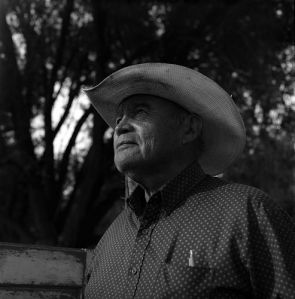
Nevada Tribal Leader, 81, Sues BLM for $30 million

Straight from the Horse's Heart

Article by Scott Sonner as it appears in RGJ.com
“The perversity the permeates Obama’s BLM runs deeper than just massacring the last of our native wild horses and burros, they target our Native American brothers, as well!” ~ R.T.

Violating Constitutional Rights is the Core of BLM’s Business Plan

photo courtesy of Danny Brady
The federal government seized Raymond Yowell’s cattle — all 132 head — and hauled them across the state and sold them at auction.
Then the U.S. Bureau of Land Management sent Yowell a bill for $180,000 for back grazing fees and penalties, and later garnished part of his Social Security benefits.
Now, nearly a decade later, the 81-year-old former chief of the Western Shoshone National Council is fighting back. He’s suing the U.S. Bureau of Land Management, the Treasury Department and others for $30 million. Yowell claims the government violated his constitutional rights, broke an 1863 treaty and saddled him with a debt that he doesn’t owe.
“There’s no other way,” said Yowell, a member of the Te-Moak Band of Western Shoshone, who still works a small cattle ranch with his son in northeast Nevada’s high desert.
“I kept writing letters to them saying I didn’t have a debt with them, that I never signed a contract,” he told The Associated Press. “But they just ignored it. There’s no use talking to them.”
Yowell said in the lawsuit filed earlier this month he was exercising his “treaty guaranteed vested rights” to be a herdsman when he turned his cattle out in May 2002 to graze on the historic ranges of the South Fork Indian Reservation.
BLM officials said the tribe’s Te-Moak Livestock Association held a federal permit to graze cattle on the public land in northeast Nevada from 1940 to 1984, but had quit paying the fees to the BLM in 1984, claiming the tribe held title to the land.
Despite earlier federal and U.S. Supreme Court decisions against them, the Indian leaders asserted then — as Yowell does today — that the land is still theirs as dictated by the Treaty of Ruby Valley of 1863.
Under the treaty, the United States formally recognized Western Shoshone rights to some 60 million acres stretching across Nevada, Idaho, Utah and California. But the Supreme Court’s 1979 ruling determined the treaty gave the U.S. government trusteeship over tribal lands, and that it could claim them as “public” or federal lands.

Click (HERE) to read the story in it’s entirety

Friday, July 29, 2011

Wild Horses Are (Again) Losing Their Home On The Range

Straight from the Horse's Heart

article by Andrew Cohen from the pages of the Atlantic
America’s wild horses are in trouble, and the federal government isn’t helping
An excellent must read for all!” ~ R.T.
Why did this animal that had prospered so in the Colorado desert leave his amiable homeland for Siberia? There is no answer. We know that when the horse negotiated the land bridge… he found on the other end an opportunity for varied development that is one of the bright aspects of animal history. He wandered into France and became the mighty Percheron, and into Arabia, where he developed into a lovely poem of a horse, and into Africa where he became the brilliant zebra, and into Scotland, where he bred selectively to form the massive Clydesdale. He would also journey into Spain, where his very name would become the designation for gentleman, a caballero, a man of the horse. There he would flourish mightily and serve the armies that would conquer much of the known world.

– James Michener
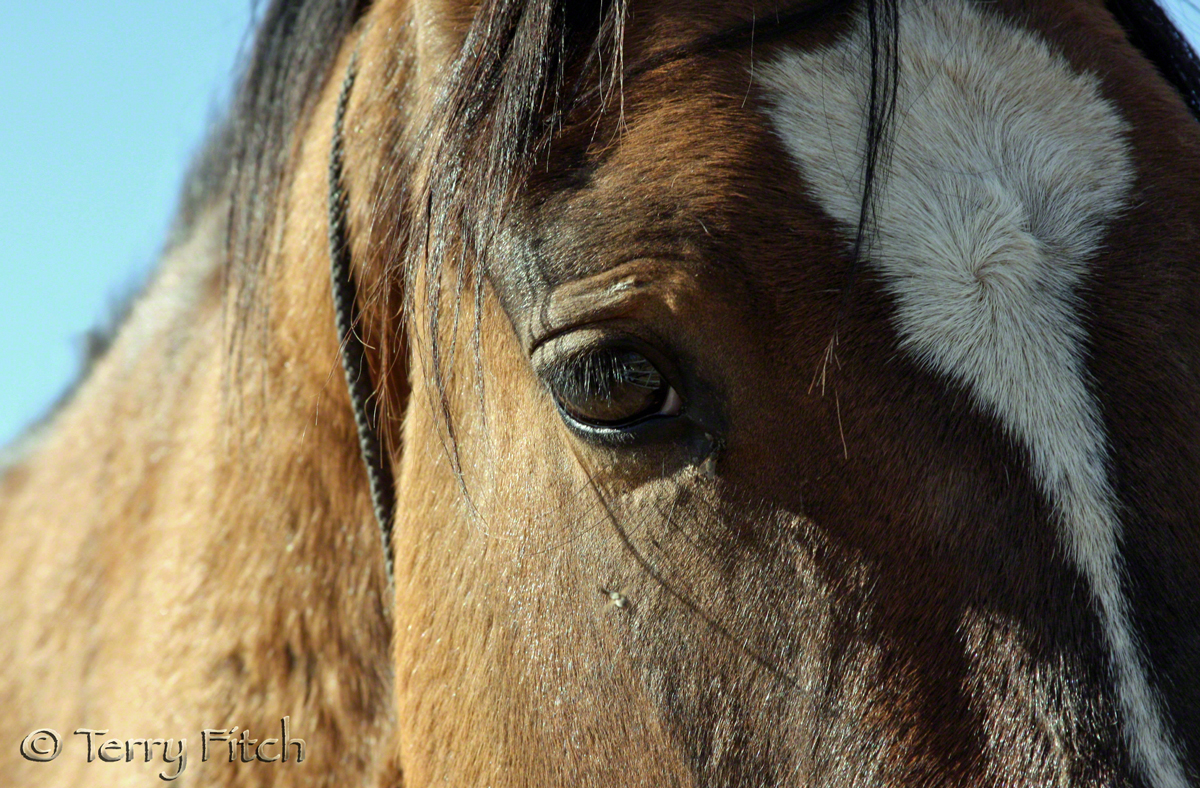
Photo by Terry Fitch
It’s been a hot, stormy summer on the Red Desert range in southern Wyoming, around Rock Springs and the state’s southern boundary with Colorado, where Interstate 80 takes long-haul truckers and tourists through one of America’s least hospitable landscapes. The desolate land even includes Sweetwater County, one of those romantic cowboyesque names that mockingly crop up from place to place in the Rocky Mountain West, more an aspiration than a reality when you consider that there isn’t much water there and what there is isn’t so sweet.
In this forlorn place are two “herd management areas” called “White Mountain” and “Little Colorado,” places were some of America’s wild horses roam free pursuant to federal rule and regulation. According to Bureau of Land Management statistics, the federal government owns or controls 849,033 acres of land in the area, Wyoming owns another 15,877 acres, and private entities own 149,647 more. BLM officials estimate that, after the 2011 foaling season, there are approximately 970 wild horses on White Mountain and Little Colorado lands.
If you do the math, based only upon the federal land figure, it comes to 875.29 acres per horse. Do a little more math and you learn that 875 acres equals approximately 1.37 square miles. Ask any horse owner you know if she could get by on that horse-to-land ratio and the answer is an immediate and emphatic “Yes!” At first glance, it seems like a perfectly harmonic arrangement; our nation’s wild horses peaceably tending to our nation’s less desirable lands out of the way of most human traffic. The symbol of our nation’s history and growth simply left alone to graze land most of us would never see if we were to live a hundred lifetimes.
But alas it’s a lot more complicated than that. Intertwined private ownership of lands within the management areas, differing land-use priorities, a lack of bureaucratic courage and creativity, and a 30-year-old deal between ranchers and a long-gone horse group, all have eliminated the possibility of simply working the acreage numbers for the benefit of the horses. The herd areas themselves are part of a “checkerboard” pattern of public and private land (the ratio is close to 50-50, say ranchers) and the horses themselves haven’t helped their own cause. During the winter, they often migrate from public land onto private land, where they are considered a nuisance to some property owners.
This natural pattern has persisted for generations and it’s been closely monitored by the feds for at least the past 30 years. With this history, geography, and horse biology in mind, the BLM announced last month that there were, again, too many wild horses on the two Wyoming ranges. Wildlife officials now plan in mid-August to begin to cull roughly 70 percent of the herds out of Little Colorado and White Mountain in a particularly controversial way. And, in response, wild horse advocacy groups and others filed a federal lawsuit Monday in Washington, D.C. seeking a restraining order that would halt the roundup.
All the time and all over the West, horse advocacy groups battle the federal government over the fate of wild horses. The story is almost always the same. The “horse lobby” cannot compete politically (i.e. financially) with the cattle or ranching industries. Invariably, it’s the wild horses which lose out to the cattle or to the sheep or to other business interests. And invariably, its the federal government, acting through regulators who are captive to the industries they are supposed to regulate, which helps ensure that this occurs. In this case, for example, we see the federal agency responsible for protecting wild horses struggling to justify a decision that undoubtedly will harm a great many of those horses and, indeed, the future of those herds.
Sell the cow, buy the sheep, but never be without the horse. — Irish Proverb  
On June 14th, the BLM announced a plan to remove all of the wild horses on Little Colorado and White Mountain and to then return a small number of castrated or spayed horses to the range. Here is how the Bureau describes how the roundup occurs:
Multiple capture sites (traps) would be used to capture wild horses within the White Mountain and Little Colorado HMAs… Capture techniques would include the helicopter-drive trapping method and/or helicopter-roping from horseback. Bait trapping may also be utilized on a limited basis, as needed.
(These roundups can be so disturbing that they warrant their own treatment in a future article. I will try to get to it later this summer). Just one week later, however, under heavy fire from mortified advocacy groups, the Bureau partially changed its tune. It increased the number of horses that would be returned to the lands and decided not to spay the mares. Still, nearly 700 of 970 or so horses now on the Little Colorado and White Mountain range will soon be gone if the BLM gets its way. Here’s how Interior Department officials described their new plan:
This modified decision returns about 177 geldings to the two HMAs to reach appropriate management level (AML). AML is the point at which the herd’s population is consistent with the land’s capacity to support wild horses in balance with other public rangeland uses and resources. The projected wild horse population remaining on the range following the gather would be about 205 in the White Mountain HMA and about 69 in the Little Colorado HMA.
There is no evidence that the horses are harming each other. And no factual detail about how their population has created an “imbalance” upon the vast range lands. Instead, Lance Porter, Field Manager at the Rock Springs office of the BLM, justified the “modified” decision” by writing that he had “concluded that gathering the excess horses is necessary to preserve and maintain a thriving ecological balance and multiple-use relationship” on the land. By bringing back only castrated stallions to the two Wyoming herds, Porter’s plan was meant to “prevent the necessity to gather more frequently due to lower population increases over time.”
Going forward, the two herds will be genetically limited in ways the government has not yet fully evaluated. This is perhaps the most significant part of the new BLM plan. It doesn’t just purport to addres the current “overcrowding” it sees on these ranges. It seeks to impact the ability of these herds in the future to breed the way wild horses have bred for thousands of years. It’s a sort of genetic engineering which horse advocate groups say needs a lot more scientific review before it can be implemented in the wild.
Among the many options that were considered and rejected by the BLM was the concept of revising the existing “management level” so that more than 205-300 horses would be considered an “appropriate” number to graze on the hundreds of thousands of empty acres. Those figures (205-300) arose in 1981 as part of a settlement in a federal lawsuit over the fate of the horses. The party that sought (and obtained) the drastic limitation on the number of wild horses on the lands is an organization known as the Rock Springs Grazing Association. In 2007, according to the Wyoming Business Report, the Association celebrated “100 years of unity.”
Here’s what else the business paper had to say about the group:

Click (HERE) to read this article in it’s Entirety
Thursday, July 28, 2011

Wild Horse Deaths Mount at Contested BLM Helicopter Stampede July 28, 2011

Straight from the Horse's Heart

Eyewitness report by Laura Leigh, VP of Wild Horse Freedom Federation

Day Four of Bloody BLM Triple B Stampede

 This is the last video that will be posted for a bit. Editing video takes an incredible amount of time. I will go back to archiving the video in case the documentation is required and posting still images. But I think this series of three days gives you an idea how frustrating this is. It will not give you a clear picture of the wear and tear on your vehicle, the damage done to your equipment or the toll it takes on your face.

Day 4 began at holding and the lame excuses about the medical treatment of these foals (that were now euthanized) set the tone. Sometimes my hands will shake from the stupidity. It is like being a teacher in Kindergarten… but the Kindergartners make the rules.
Yes, the tone of this report is terse. But being with this contractor every day but two during Antelope, and now watching this at Triple B, is like chewing on tin foil.
I am usually very patient and quiet. I do my observations and reports.This time I am trying very hard not to allow the frustration to drive me.
On another front there may be some good news soon, but that will have to wait for another day. So pray that sanity can begin to take root somewhere.
Day 4 brought with it frustration after frustration.
It began with the excuses about water and food, with no indication that anything would change. It continued with the absurd assertions about the injured foals.
At the trap the radio was again left so I could not hear anything until one time Heather Emmons left it loud enough that I could pick up a call. It was the pilot asking Alan Shepherd to glass a horse that could not keep up. I was given no further information as to the age or reason the horse could not keep up… and of course I was held to a position that did not allow me any observation.
The horses the pilot drove into the trap came in two groups.
Then 4 runners went out and the pilot. The pilot asked Shepherd the location and was told it should be “right under you.” It was apparently a bush.
I asked if I could go to the rise and look. I said that all eyes should be utilized. I was not granted permission, nor was it denied. I stayed behind the tape. It is my belief that this agency attempts to push the limits of control until we are tempted to break them… only to utilize the unreasonable restraints against us.
After almost an hour of no information, BLM personnel reading newspapers, I asked to go give my dog water and check on him. That permission was granted. I hung out in the vehicle with the dog, as it is much cooler there. I saw two runners beating it back to the trap so I went back to the observation area only to find out that the runners were coming back… not because they had found anything… but because the pilot was driving horses to the trap.
Shepherd had given the authorization for resources to abandon the search and begin operations. The other two runners also returned to the trap. I expressed my outrage in no uncertain terms. I informed personnel that I had called people from my vehicle and the public knew they had stopped looking. I informed them I was not leaving until the horse was located.
After the drive Heather was called down to speak with Alan.
Miraculously the horse that had now been missing for over an hour and a half had been found. It had “run back home” and hooked up with a stud. A trailer went down the road and in less than ten minutes came back… with a load that looked much like it did when it left.
As I am not permitted to travel the same road as the trailer it would take me about an hour longer to reach holding. I would not see this animal unload.
The animal was allegedly a 4 month old that was so deformed it couldn’t run correctly and was euthanized. The same animal that ran almost to the trap and back again… I can not confirm that there was an animal even picked up off that range.
Have you pulled out all your hair yet? Have you gritted your teeth so badly that you have broken molars? Have you bitten your lip so hard it bleeds? Have you vowed to god you will not allow this “spoiled child agency” to continue without challenge… no matter what it takes?
If you can help me with expenses please donate to http://wildhorseeducation.org


Tuesday, July 26, 2011

Wild Horse Babies Killed by BLM at Triple B Roundup

Straight from the Horse's Heart

Report from Laura Leigh ~ VP of Wild Horse Freedom Federation

The Injured Babies in this Report were later Killed by the BLM

At the roundup we had runners go off with no explanation. We had a baby come in that I could see was injured.
So I added an extra two hours of driving to my day and headed to holding.
There I saw three youngsters treated for injury. I do not know how many were treated prior to my arrival. (note: it is interesting that I asked about the injuries and am only given information on the treatment I actually saw, with no other information offered. It always seems like “If they don’t see it, it didn’t happen”).
A big bay stud and his band have really hit me hard. He was in the last group (or at least the last group I knew of). One of his foals (the only one that came in with his band) was injured. They put his mare and injured foal in the pen next to him. He kept all the other horses from the fence line. He called to them non-stop while I was there. He was there at the fence line when I arrived in the morning. I was pretty upset by some comments Alan Shepherd made so I got a few quick takes and did not get one of his calls as they began to load that am.
I quickly headed to the roundup site instead as the day before they had already captured 40 horses before my arrival. Leaving holding early didn’t change anything, they still had about 40 prior to my arrival on Day 4. Keep in mind we leave our “meeting” spot at 4:30 am, that’s how much driving is involved.
The comments from Shepherd that were so distressing go like this:  ”The palomino foal had weak tendons. The little chestnut has a bad mom. The other foal that was treated has a laceration to a leg, but it’s pre-existing. The animals drain the water and it needs to be refilled a couple times.”
Did that hit you like it hit me from the State Lead for Nevada’s Wild Horse and Burro program, Alan Shepherd? Did that hit you like it hit me from the man that constantly blames the animal for it’s situation? (Old Mare at Antelope) Did that hit you like it hit me from the man that took part in several “Final solution” conversations for our wild horses? (2009 Article animal Law Coalition) Did that hit you like it hit me from the man that answered in Federal Court that there were “no fences, no cows, no water” in the Owyhee HMA? (Gorey’s explanation to Horseback)
At the Antelope Complex Roundup this past winter there was the exact same situation with this contractor, Sun-J (it is a pattern). When I pointed out the deficiency Ben Noyes, the WH&B specialist in Ely, simply grabbed more tubs for water and placed them in the pens. He directed the contractor to appropriately distribute feed. He made no excuse.
Perhaps a man like Ben Noyes, that is able to admit a deficit and comprehends that the equation for the amount of horses translates into water consumption, should be the state lead and Mr. Shepherd should go muck at the Burns Corral until he comprehends what horses are?
I was told the runners went out to get the two injured foals. We already know that is also not the truth.
This IS foaling season. ALL foals have weak legs, that is why you don’t run a foal. It IS over 90 degrees during the day and horses need water. The fact that this conversation has to occur at all with an agency tasked for the last 40 YEARS with the humane treatment and management of our wild herds is OBSCENE.
note: and the more I review my tapes the more I believe that the roan is NOT that little chestnuts mom. The chestnut mare at the trap is most likely his mom. They even look alike. A bay dad and a roan mom will most likely not produce a chestnut baby. That baby was leaning against ANY family member he could because he could NOT stand. I’ll bet that’s why she was so agitated. I wonder where her baby is? I wonder so much about the ability to actually OBSERVE and not just process inventory in this agency. I need to see that chestnut foal.


Week 1: Triple B Complex Roundup

American Wild Horse Preservation Campaign

The Massive Removal Begins


Photo by Laura Leigh
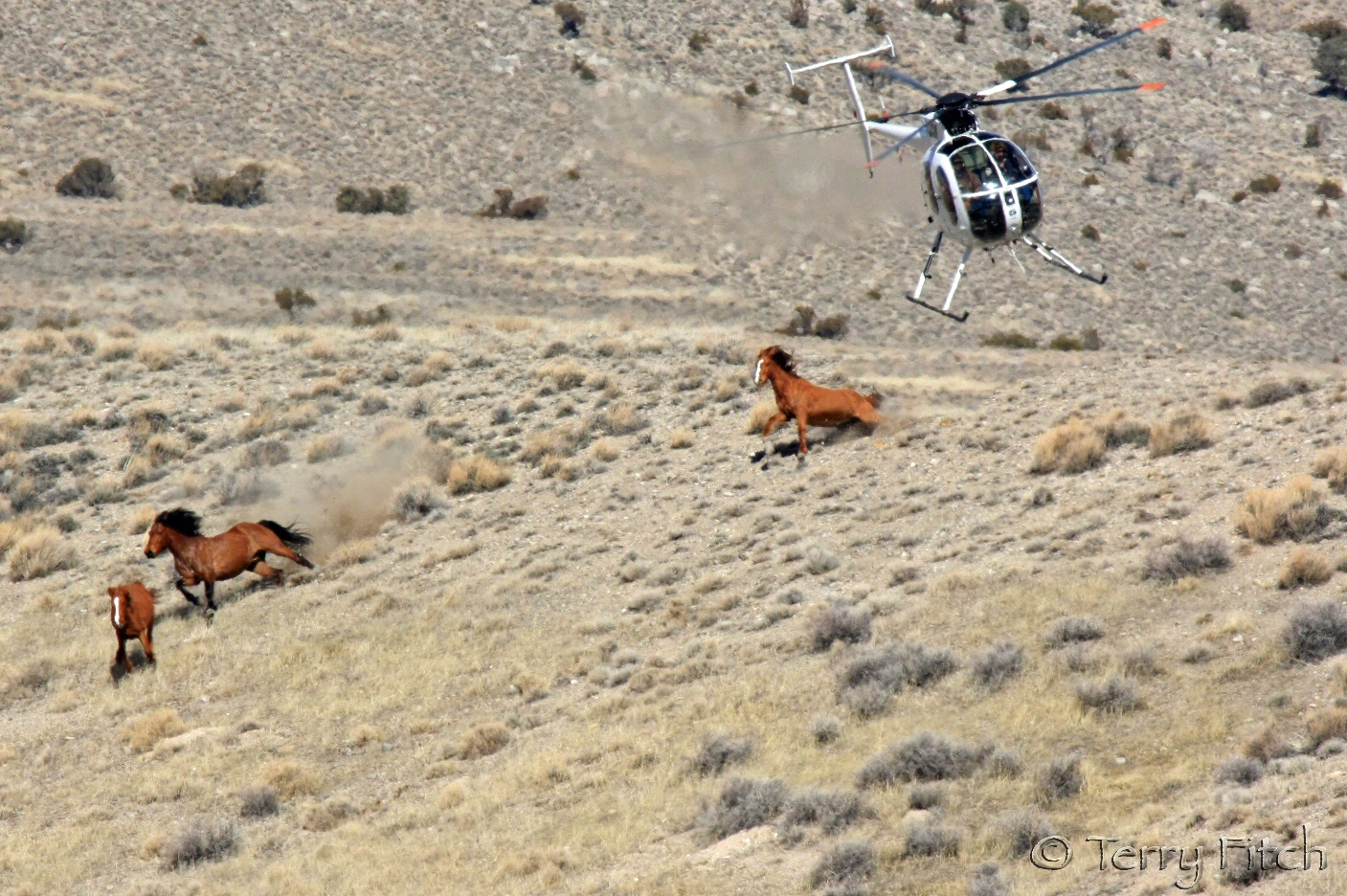
After legal efforts to block the roundup did not meet with success (information on the lawsuit available here), the Bureau of Land Management is began the Triple B roundup on July 20, 2011. The action will permanently remove 1,700 wild horses from their families and homes on public lands in Northeastern Nevada. Due to the timing of the roundup, very young foals will be stampeded in the helicopter drive. Horses will be run for miles in the middle of the hot desert summer. In addition, the horses have adapted to and are operating on low water resources, meaning they are prone to dehydration after being subjected to miles long helicopter chases.
Reports from the front lines of this mass capture operation follow.  READ MORE.

Triple B Wild Horse Roundup: Day 2 

Follow   on Youtube. 

Friday, July 15, 2011

Breaking News: Federal Judge Rules Against Wild Horses and American Public

Straight from the Horse's Heart

Unedited Press Release from BLM Propaganda Central
Judge McKibben Rules in Favor of BLM Triple B Wild Horse Stampede
The Horses Lose AGAIN!!!
Reno, Nev. — Today U.S. District Court Judge Howard McKibben issued a decision in favor of the Bureau of Land Management (BLM) which allows the BLM to proceed with the Triple B gather to remove excess wild horses on Saturday, July 16.
“The BLM is pleased with the decision of the court that allows us to move forward with the Triple B gather, where the wild horse population is five times over the minimum appropriate management level,” said Amy Lueders, BLM Nevada Acting State Director.
The BLM will gather and remove approximately 1,726 excess wild horses from in and around the Triple B, Maverick-Medicine and Antelope Valley herd management areas (HMA) and the Cherry Springs Wild Horse Territory located approximately 30 miles northwest of Ely and 70 miles southeast of Elko, Nev.  Removal of the excess wild horses is necessary to prevent degradation of rangeland resources and to ensure sufficient forage and water is available for the wild horse population.
The estimated population for the entire gather area is 2,198.  The appropriate management level (AML) for the entire area is 472-889 animals. Any horses gathered above targeted removal numbers will be released back to the range so that the remaining population is within AML.
Any gathered mares released back to the range will be vaccinated with the PZP-22 (Porcine Zona Pellucida) fertility control vaccine.  Additionally, sex ratios of gathered animals to be returned to the HMAs may be adjusted to achieve an approximately 60 percent male/40 percent female ratio.
The gathered animals will be transported to the National Wild Horse and Burro Center at Palomino Valley (PVC), in Reno, Nev., Gunnison Correctional Facility in Gunnison, Utah, and the Delta Wild Horse Corrals in Delta City, Utah.  The animals will be prepared for the BLM adoption program or for long-term holding.
The Cloud Foundation, Craig Downer and Lorna Moffat filed a lawsuit on Wednesday, June 29, 2011, and moved to enjoin the Triple B gather. Judge McKibben held a hearing Thursday morning and denied the motion to enjoin the gather.

Thursday, July 14, 2011

BLM Roundup of Alleged “Estrays” in Oregon

Straight from the Horse's Heart

Information supplied by Wild Horse Education.org

Obama’s “Transparent” BLM Up to Covert Operations, AGAIN

Wild Horse Education has discovered that an unscheduled, unannounced, secret roundup was being carried out east of Baker City,(Baker County) Oregon today, July 14, 2011.  This removal of 30 to 70 horses is in the Vale BLM District.  There is a question if these “estray” horses could actually be wild horses.
“Looking at the BLM schedule, the contractor was not scheduled to fly again until August 2,” said Laura Leigh founder of Wild Horse Education “This lead us to investigate other areas where operations could be occurring.”
Marilyn Wargo was told this roundup was taking place by Vale District BLM employee Kelly Skerjanec, who said District manager Pat Ryan and BLM WH&B Specialist, Shaney Rockefeller were at this roundup.  BLM Baker City Office employee Mark Pierce confirmed that this action was set up on the ground yesterday and was carried out today.
Wargo was told the private rancher, whose property adjoins BLM land, was not claiming these horses (there was a court case in 2004 in this matter). BLM considers them feral estray.  Pierce stated this was not a BLM Oregon helicopter and that a contractor was involved and it could be the one used at Kiger/Riddle just South of Vale District. This would be the Cattoor Livestock Company.  At this time no operations official will confirm or deny the contractor.
Pierce elaborated saying: BLM intended to remove horses found only on the BLM lands and not the private property. The horses are considered “trespassers” on public land. The ranchers name was not available at this time.
Piece also said the mares with foals would be sent to Vale District and all others to Prineville.
These offices do not have holding facilities and the destination of these horses is being investigated.
Natural Resources Specialist John Raddemacher from the BLM Baker Office is in charge of this action.
Mark Wilkening of the BLM has confirmed that this operation may be going on tomorrow as well. He has informed us that the horses have no brands. Wilkening has said that this area has never had horses before.
This is in addition to discovering the pending roundup at Sheldon National Wildlife Refuge, in Oregon and Nevada.

Ms. Leigh is the Founder of Wild Horse Education.org, Vice President of the Wild Horse Freedom Federation and writes a blog about her wild horse and burro advocacy.

Monday, July 11, 2011

Feds Launch Roundup of Famed Kiger Mustang Herd in Southeast Oregon

American Wild Horse Preservation Campaign

July 11, 2011 by admin

Preservation Group Warns Against Plan to Remove 120 Wild Horses, Calling Action Dangerous and Wasteful of Tax Dollars
Burns, Oregon (July 8, 2011). . . The Interior Department’s Bureau of Land Management (BLM) yesterday launched a controversial roundup of the prized Kiger Mustang Herd in southeastern Oregon. In response, the American Wild Horse Preservation Campaign (AWHPC), a national coalition, warned that the BLM’s plan to permanently remove 120 of the estimated 210 Kiger horses that remain in the wild will further erode the genetic viability of this historically significant herd and waste tax dollars.
Kiger Stallion Free No More. Photo by Laura Leigh
“We’re disappointed by the BLM’s plan to permanently remove 120 mustangs from this historically significant herd,” said Suzanne Roy, AWHPC Campaign Director. “The allowable population levels that the BLM has set for the Kigers are already so low that they compromise the health and genetic viability of the herd.”
UPDATE: The Kiger roundup is complete. For eyewitness account, visit Wild Horse Education blog.
The Kiger mustangs are prized for their genetic lineage that links them to the horses brought by Spanish conquistadors to North America in the 1600’s. The BLM website <http://www.blm.gov/or/resources/whb/kiger_gather.php> states that “There is no other horse in America is quite like the Kiger Mustang. . . Since the Kiger Mustangs may well be one of the best remaining examples of the Spanish Mustang, their preservation is extremely important.”

Yet the BLM allows a maximum of only 138 Kiger mustangs to live in the Kiger and Riddle’s Mountain Herd Management Areas (HMAs), which span nearly 55,000-acres. Meanwhile, the agency allocates five times more forage to privately-owned livestock than to federally-protected wild horses in these HMAs, authorizing the equivalent of 688 cattle to graze the area.
“It’s disheartening that the BLM is unwilling to manage 200 horses on the range. These roundups and removals waste tax dollars, traumatize and destroy the natural diversity and development of the wild herds,” observed Neda DeMayo, founder and CEO of Return to Freedom, who spearheaded the creation of the AWHPC Coalition.
DeMayo, whose sanctuary houses the famous Kiger stallion “Spirit,” the inspiration for the computer animations in the Dreamworks film of the same name and the offspring of Kiger Mustangs, added that the BLM has over-managed the Kiger herd to produce desirable horses for adoption/purchase, selecting for color and conformation instead of allowing natural selection to take its course.
Just-captured Kiger mares and foals in BLM holding pen. Photo by Laura Leigh
“We appreciate that there are reputable Kiger breeders and enthusiasts who actively participate in the adoption program and have created private Kiger breeding programs, however, we feel strongly that the free roaming herds on public lands should be allowed to live in viable herds allowing natural selection and diversity to develop. This is such a small herd already,  minimally intrusive management could easily replace costly and traumatic roundups.”
The AWHPC is calling on the BLM to increase the allowable population for the Kiger Mustangs to genetically sustainable levels, reduce livestock grazing in these federally-designated wild horse habitat areas, and utilize fertility control, if necessary to manage the horses on the range to minimize or avoid costly removals entirely.

The American Wild Horse Preservation Campaign is dedicated to preserving the American wild horse in viable free-roaming herds for generations to come, as part of our national heritage. Supported by a coalition of over 40 organizations, its grassroots campaign seeks:

* A suspension of roundups in all but verifiable emergency situations while the entire BLM wild horse program undergoes objective and scientific review;
* Higher Appropriate Management Levels (AML) for wild horses on those rangelands designated for them;
* Implementation of in-the-wild management, which would keep wild horses on the range and save taxpayers millions annually by avoiding the mass removal and stockpiling wild horses in government holding facilities.

Sunday, July 10, 2011

Voices needed to stop proposed BLM roundup

Examiner


Mare & foal at risk in the proposed roundup
Credits: 
American Wild Horse Preservation Campaign


As if the first roundup at Calico wasn't enough, the Bureau of Land Management (BLM) plans to go back again and remove as many horses as they can find, but at least another 2000 at least of the wild horses residing in that area and in the immediate tri-state area.  This is the worst possible news for advocates when it comes to our wild horses.    READ MORE....

Sunday, June 26, 2011

Wyoming: It’s Wild Horses and the BLM

Straight from the Horse's Heart

Story by Lauryn Wachs of The Cloud Foundation

Protesting to Save Wyoming’s Wild Horses

Rock Springs, Wyoming, is not exactly what I would call ‘close’ to Colorado Springs. Nevertheless, our new intern, Erin Clifford from Michigan; and I hopped in the car and started up I-25 northbound, picking up our fellow wild horse advocate friend, Rachel Reeves, along the way.
When we finally pulled up the drive to the BLM office the first thing I noticed was my tax dollars at work: a shiny new building complete with landscaping and the works.

BLM Office in Rock Springs
Our little group of advocates joined together outside the building, which included our carload, a few other superb advocates from Northern Colorado, and two delightful women who came all the way from California! We totaled ten people, but our signs and presence were enough to frustrate the folks inside.

From left: Advocate extraordinaire Linda Hanick, Erin, and Lauryn

Part of the protest crew. Photo by Frances Miller
During the meeting itself we were surrounded by a lot of ranchers, most of who belonged to the Rock Springs Grazing Association – the largest grazing association in the country. Each of them gave a sentence or two on the plusses of helicopter roundups and how necessary they were, same ole, same ole. We had some great points brought up by each of the wild horse advocates who spoke. Trying to explain the issues we have with helicopter use during roundups in only three minutes is no small feat!
With everyone a little tense after the meeting, Rachel, who is quite familiar with the herds in the area, suggested journeying up the road to the White Mountain, one of the herds that is slated for a roundup and now is going to have only gelded stallions remaining post-roundup if the BLM has their way.

A White Mountain mare
The sun was slowly setting, but as it was the summer solstice and we were out on the range well after 9 watching the horses and enjoying  “magic hour” with them. It was Erin’s first wild horse experience, and you should have seen her face!

One band was urged on by their stallion

An older bachelor is forced onward by a bay roan stallion

Lauryn and Rachel
In the morning we woke up early to stop by the Rock Springs Corrals, the short-term holding facility in town. The only way to find it is to follow the sign that says “Wild Horse Viewing” which inspired a large eye roll from yours truly. We parked at the overlook to the corrals and were glad to see that at least the corrals were clean. It seemed they were in the middle of doing a lot of cleanup, probably in preparation for the White Mountain herd that we had seen just last night. It was a bitter reminder of the impending terrible summer that faces those horses and the ones in the Little Colorado herd just next door.

The Rock Springs Corrals
Instead of taking the normal interstate highway drive back to Colorado Springs, we diverted to visit Colorado’s largest herd in Sand Wash Basin just north of Maybell. To get there we drove through the Salt Wells herd area in Wyoming, but we saw no horses. This herd was devastated last year. Almost all the horses are now incarcerated at taxpayer expense.
We drove into the Sand Wash area as far as we could, given the short amount of time we had to spend there. We encountered some absolutely stunning bachelors and a large band that had a couple of foals. They are truly a striking herd based on what we saw.

This pinto bachelor was really beat up, but still going strong

An absolutely stunning trio of bachelors
It doesn’t matter how many wild horses you’ve seen or where you’ve seen them, they still leave you awestruck every time. It’s truly an addicting experience, and we were hard-pressed to leave Sand Wash. And it is a strong reminder of how important it is for us, the American public who these horses belong to, to stand up and give a voice to all our wild horses and burros. I know I’ll do my best to make sure the wild ones stay wild.
All the best,
Lauryn

Friday, June 17, 2011

Raw Press Release: BLM Re-evaluates Wild Horse Gather Decision Record

Straight from the Horse's Heart


Date: June 17, 2011
Contact: Serena Baker, (307) 212-0197

After considering public input, the Bureau of Land Management, Wyoming High
Desert District is re-evaluating certain aspects of its decision record
related to spaying gathered mares during the proposed White Mountain/Little
Colorado herd management areas wild horse gather.  As part of the
re-evaluation, BLM may amend or modify its environmental assessment and
decision record for the gather, and if modified, a new decision record
should be available next week.

For more information, contact Marty Griffith, (307) 775-6093.
Related articles

    * Breaking News: BLM to Sterilize Wild Horse Herds in WY (rtfitch.wordpress.com)
    * Wild Horses: “D” is for Destroy, Devastate and Decimate – the BLM’s plan for Wyoming’s Wild Horses (rtfitch.wordpress.com)
    * Obama’s BLM Confirms it Will Resume Wild Horse and Burro “Gathers” (rtfitch.wordpress.com)

Thursday, May 26, 2011

Wild Horse Advocates Ask BLM to Keep Domestic Horses Clear of Native Mustangs

Straight from the Horse's Heart

Story by Scott Sonner , contributing input by Josh Loftin appearing in multiple sources
Equine Herpes Could Wipe Out the Last Herds Not Yet Destroyed by BLM
Photo courtesy of Terry Fitch
Concerned about the threat of a catastrophic outbreak of a herpes virus among wild horse herds in the West, national animal advocates on Thursday called on the federal government to keep potentially infected domestic horses away from mustangs and burros on public lands.
The Humane Society of the United States urged the Bureau of Land Management to “discourage and, if possible and appropriate, prohibit” owners of private horses from bringing animals at risk of Equine Herpes Virus-1 onto federal lands where they could have contact with wild horses.
“The potential for a catastrophic outbreak of EHV-1 among wild horse herds needs to be addressed by the BLM on an emergency basis,” Holly Hazard, the society’s chief innovations officer, wrote in a letter to BLM Director Bob Abbey.
The federal agency should launch a public education campaign immediately about the highly contagious disease, which has infected dozens of horses and killed at least nine, as officials plan horse-related activities for the upcoming holiday weekend, she said.
EHV-1 poses no risk to humans, but can be fatal to horses. It can be airborne and transmitted by touch or by sharing feed, brushes, bits and other equipment.
The virus “is a highly transmittable disease, and the symptoms don’t show up immediately,” Hazard told The Associated Press.
“You can have a horse that may have been exposed and you are not even aware they are carrying the virus. The most vigilant thing for everybody to do is enjoy their horses on their own property until the health officials have it sorted all out,” she said.
Traced back to a cutting horse competition earlier this month in Ogden, Utah, the virus has been exposed to more than 1,000 animals through direct or indirect contact with infected horses. Symptoms include fever, decreased coordination, nasal discharge, loss of tail tone, hind limb weakness and inability to rise.
So far, no animals managed by the BLM are known to have been infected, BLM spokesman Tom Gorey said Thursday. He said the agency is considering limiting horse movement on a case-by-case basis and may cancel some scheduled adoption events.
The federal agency “has been working with state and federal animal health officials to help protect the health and well-being of wild horses and burros on the range, along with those in BLM holding facilities,” Gorey said.
Horse owners should contact local BLM offices to see if there are any restrictions before bringing domestic horses onto federally managed public lands.
Tom Collins, a Clark County commissioner who owns horses and runs a cattle ranch outside of Las Vegas, said he felt the federal agency generally was taking the proper precautions but that prohibiting domestic horses on public lands in some areas was going too far.
“To tell people not to ride in areas that are public lands because of this horse virus, in my opinion, is a probably a little over cautious,” Collins told AP. “It’s probably more of a reaction to a request by the horse lovers than common sense. But at the same time, I can see their point, because it is airborne.”
Since the virus was discovered, organizers of horse sales, rodeos and other competitions involving the animals have canceled or postponed events in Colorado, Kansas, Oklahoma, Oregon, Montana, Nevada, Utah and Washington. But some other major events are continuing as scheduled, including the College National Finals Rodeo June 11-18 in Casper, Wyo., and the Reno Rodeo June 16-25, billed as the fourth-richest rodeo on the Professional Rodeo Cowboys Association.
Animal health officials in Utah and Nevada are among those who are optimistic the worst of the outbreak already has run its course.
“There’s not really anything earth-shaking that’s happened to change what we’re thinking,” Dr. Bruce King, Utah’s state veterinarian, said. “If we can get through the end of the month … we will feel comfortable about holding equine events again.”
But groups including the American Wild Horse Preservation Campaign have joined the call for “an abundance of caution … because of the potential catastrophic consequences that could occur if the virus spreads to the wild horse herds.”
“Given the serious nature of the virus and the already diminished population of mustangs in the west, the BLM needs to act quickly to ensure that the virus does not spread,” campaign spokeswoman Deniz Bolbol said.
Hazard said there are a number of ways a wild horse could contract the disease even if it didn’t have direct contact with an infected animal. For example, domestic horse owners are permitted to have hay on the ground for their horses at campgrounds on BLM lands, national forests and other U.S. lands, she said.
If an infected domestic horse ate that hay, mustangs that frequent campgrounds and other equine recreational areas may move in to eat the contaminated hay leftovers and be exposed to the disease, Hazard said.
“Since EHV-1 infections can be fatal,” she said, “should such a scenario occur, the impacts on wild horse populations could be disastrous.”

Tuesday, May 24, 2011

Scientists Demand Obama’s BLM Cease Stampeding Wild Horse Foals and Mares

Straight from the Horse's Heart

(The News as We See It) by R.T. Fitch ~ Author/Director of HfH Advisory Council
Cruel and Deadly Helicopter Stampedes During Foaling Season Must Stop
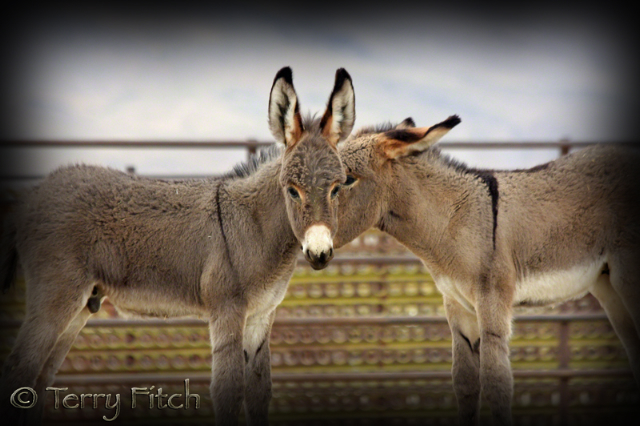
Baby Wild Burros Captured and Imprisoned by the BLM ~ photo by Terry Fitch
An Open Letter to the management of the Department of Interior and Bureau of Land Management
Dear Sirs:
As an outraged citizen I am writing you to beg for the mercy of week and
month old babies that will be the victims of the planned Round-ups starting
in July.
The BLM handbook states that round-ups should NOT be conducted during
foaling season. In July there are still mares that are heavily pregnant and
babies that are only weeks old. Even babies that are one or two months old
cannot withstand the miles and miles of running over treacherous terrain.
July is in the middle of foaling season.
These round-ups will undoubtedly result in many foals suffering and dying
and pregnant mares aborting their babies. Babies have died from sloughing
off their hooves before. (during the Calico Roundup)
It is easy to predict, young babies simply cannot withstand the miles and
miles of exerting exercise, their small under-developed feet cannot
withstand the pounding, they cannot go without their mothers milk
especially after this exertion, and the stress and anxiety of separation
from their mothers is extremely inhumane to both mothers and babies.
One would not run one’s own pregnant mare or mare and baby for miles and
miles and expect them to be ok. As a matter of fact one would be arrested
for cruelty to animals.
I do not agree with any BLM Round-ups as there is no independent count of
Wild Horses and the contractors are inhumane and have no knowledge of
natural horsemanship.
However, Round-ups during foaling season take this one more inhumane step
further and are even more callous and willfully cruel and heartless.
Thousands of horse advocates are outraged, Horse organizations are
outraged, my pony club is outraged, my neighborhood is outraged, and the
media is outraged.
Please have mercy and direct the contractors to conduct the Round-ups only
after the foaling season is over. And only when temperatures are not
extreme. I beg of you to order the round-ups to only ever take place during
the months of Sept and October and November, after the summer heat is over,
when the babies are at least 3 months old and before the bitter winter
cold.
Most urgently I ask you please, postpone the foaling season roundups!!
Sincerely,
Ann M. Marini, Ph.D., M.D.
Robert H. Lipsky, Ph.D.
Sarah M. Lipsky, Licensed M.S.W.

Obama’s BLM Confirms it Will Resume Wild Horse and Burro “Gathers”

Straight from the Horse's Heart

Story by Steven Long ~ Editor/Publisher of Horseback Magazine
Another Season of Injury, Death and Imprisonment to Commence in July

Obama's BLM torturing the last of our wild mustangs ~ photo by Terry Fitch
HOUSTON, (Horseback) – After spending most of the last two years under attack for its wild horse “gathers” in the west, the federal Bureau of Land Management will soon resume the capture and possible extinction of the North American Mustang. The confirmation came early Monday from BLM Chief Washington Spokesman Tom Gorey.
The agency had canceled all of its roundups for the remainder of the year citing a lack of funds to continue. Since Labor Day weekend 2009 when the BLM launched an accelerated schedule of capture on Montana’s Pryor Mountain, hundreds of wild horses have died during and in the aftermath of helicopter driven stampedes.
Gorey says the capture of horses will now resume for the remainder of the  year.
“The Federal government had been operating under several stopgap spending measures (so-called Continuing Resolutions) earlier this year until this month, when Congress passed a longer-term Continuing Resolution that will take us through the remainder of Fiscal Year 2011, which ends Sept. 30,” Gorey said.
“The current Continuing Resolution provides a $12 million increase to the BLM’s Wild Horse and Burro Program (putting the FY 2011 WH&B budget at $75.8 million), thus making it possible for the agency to conduct gathers this summer, starting in July. With the funding issue now resolved, the BLM will be able to carry out this facet of its management responsibilities.  The tentative schedule for this summer’s gathers will be issued soon,” he said.
The Pryor Mountain capture of an iconic Palomino named Cloud who had been the subject of three PBS “Nature” documentaries sparked outrage nationwide and even abroad.
Conservative wild horse advocate and author R.T. Fitch blasted the Congress for wasteful spending by funding the capture of wild horses.
“The U.S. Congress broke it’s promise to reduce unnecessary spending when they not only fully funded the BLM’s 2011 budget but granted them an additional $12 million so that they can now harass, maim, injure, capture and warehouse our last remaining wild horses,” he said.
Earlier BLM Director Bob Abbey said the agency was going in a new direction after appointment of a new interim director of the Wild Horse and Burro Program. Fitch says the director has gone back on his word.
“Bob Abbey, who has admitted that the system does not work, appears to consider a ‘new direction’ to be simply more of the same cruelty and waste.  Taxpaying Americans have lost control of their government,” the author said.
Chicago based Equine Welfare Alliance President John Holland echoed Fitch.
“The BLM faces an inevitable budget crisis over the cost of keeping the horses in long term holding, and yet they never miss an opportunity to make the situation worse,” he said. “Clearly, we are watching the engineering of a disaster. Within a year they will be wringing their hands about what they can possible do with all the horses.”