Showing posts with label HR 503/ S727. Show all posts

Thursday, November 11, 2010

Horse Slaughter “Summit” Organizer Caught in Web of Lies

Straight from the Horse's Heart

Story by Steven Long ~ Editor/Publisher of “Horseback Magazine

United Horsemen’s Dave Duquette Speaks with Foul, Forked Tongue
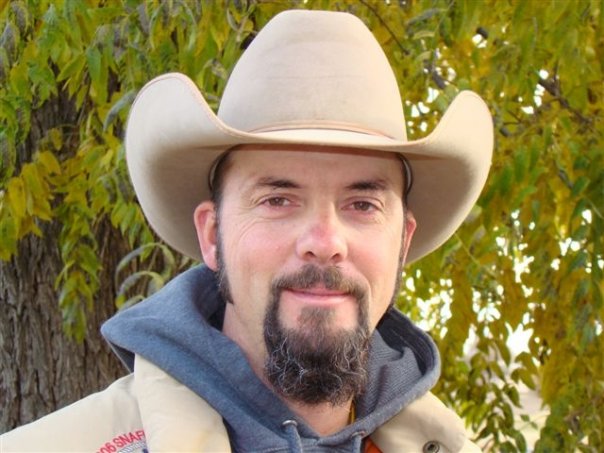

United Horsemen's David Duquette, stranger to the truth but a friend of foul language - photo courtesy of "Cussing" Dave Duquette's public Facebook Page
HOUSTON, (Horseback) – The federal Bureau of Land Management will not lose the services of its $140,259 Wild Horse and Burro Program director, Don Glenn, for even a minute to attend a planned slaughter “summit” in Las Vegas.
Glenn’s name was among those of several high government officials who were called to the nation’s gambling capital by an obscure pro-slaughter group, United Horsemen.
Besides Glenn, the event claims to have invited other Interior Department and BLM officials including Dr. Boyd Spratling, a member of the BLM Wild Horse and Burro Advisory Board, Ken Salazar, Secretary of the Interior, and Sylvia Baca, Under Secretary of the Interior.
BLM Chief Washington spokesman Tom Gorey earlier said none of the officials had confirmed they would be going.
However, United Horsemen founder Dave Duquette challenged Horseback’s story saying Glenn had indeed confirmed he was coming to the slaughter summit.
“Your journalistic integrity is in question after Don Glenn and I had a long conversation about Your Lies (sic). He did not say those things to you and I do know who did. Stop bullshitting. That person was out of line for telling you what was already CONFIRMED,” he said in a series of emails to the magazine yesterday that were laced with profanity.
The emails also attacked acclaimed equine author R.T. Fitch, and John Holland, president of the Chicago based Equine Welfare Alliance.
Gory re-confirmed his earlier statement regarding Glenn Wednesday morning.
“Don is not going to the conference,” he said.
The BLM is under fire from wild horse advocates for an accelerated capture program that has taken tens of thousands of protected animals from their native habitat in the American West. The agency is often accused of selling wild Mustangs to slaughter, a charge Gorey stoutly denies.
Duquette’s organization claims the abolition of legal horse slaughter in the United States has destroyed the low end of the horse market despite USDA reports to the contrary. While horses are no longer going to packers in the United States, thousands are still being shipped abroad to Mexico and Canada.
Duquette is a professional working cow horse trainer from Hermiston, Oregon.
Breakout sessions are billed as The Politics of Land and Horses, The U.S. Horse Industry – Protecting Our Horseback Cultures and Livelihoods, Efforts to Provide Humane and Economically Viable Options, and Canadian and United States Connections in the Equine Economy.
Also invited are newly elected Governor of Nevada, Brian Sandoval, David Martosko, Temple Grandin, rodeo stock contractor Ike Sankey, John Falen of the Public Lands Council, and Bill and Jann Parker of the Billings horse auction.
Duquette has made no further claims about the attendance of any of these officials. Gorey told Horseback Magazine Wednesday that his earlier statement that no BLM officials had accepted the invitation still stands.

Friday, July 16, 2010

15 days to go.....

A reminder from Terry in Havasu...Thanks, Terry!

The requirements posted on the CFIA website state, “Effective July 31, 2010, it will be mandatory for all CFIA inspected facilities in Canada engaged in the slaughter of equines for edible purposes to have complete records for all animals (domestic and imported) presented for slaughter.”

Saturday, July 3, 2010

An Interesting Email About the Arizona Horse Council

I will not name the sender, but let me just say that I AGREE WHOLE-HEARTEDLY!

A little history first.

I approached Chip Wilson, president of The Arizona State Horseman's Association (ASHA) several years ago, asking that the state group adopt an anti-slaughter stance. Chip and I went round and round until he finally agreed that the state group would defer the decision to the members, and that the state group would take a neutral stance. This was not my desired result, but I had to respect the decision to not impose an opinion on the whole group.

ASHA has recently been re-named Arizona Horse Council, http://arizonahorsecouncil.org/

In recent years, Chip Wilson has become associated with Sue Wallis' group The United Organizations of the Horse (UOH), a pro-slaughter group, and Chip and his wife have actually donated money to the pro-slaughter group. When I learned of the association and the donation, and that ASHA had been re-named, I discovered that the Arizona Horse Council is indeed associated with the pro-slaughter UOH.

Now, on to the email I received. A special thanks to this horse warrior who sent it! You know who you are!


Greetings  Horse Enthusiasts,
Wanted to warn you all to be very wary of an organization calling itself the Arizona Horse Council. http://arizonahorsecouncil.org/  It was formerly known as the Arizona Horseman Association, but they changed their named in 2009 to be associated with the national Horse Council.
The Horse Council and the state organizations like the Arizona Horse Council, are industry supported, pro horse slaughter, anti equine welfare organizations funded by agri-business and pharmaceutical companies. They masquerade as equine welfare organizations.
We have known that the millionaire lobbyists Rick Berman, http://www.humanesociety.org/news/news/2010/05/investigative_report_berman_1.html
  
who runs campaigns for the tobacco and polluters organization to persuade the public on the merits of the cancer causing products has been hired by agri-business to target the Humane Society of the United States (HSUS). HSUS has done a lot for animals. I personally collected more than 1600 signature on ballot initiatives to stop veal crates in Arizona which passed. Ari-business does not like the public to have impact on the treatment of animals and are targeting HSUS.
Today, to my horror, as I attended a meeting of well intentioned horse enthusiasts from around Arizona to strategized how to provide support to equines and their humane partners, as least 3 people from the Arizona Horse Council were angry and disruptive and attacked the speaker because she was employed by HSUS. They angrily objected to my comment that equines be provided shade in Arizona and admonished anyone from even trying. After listening to the rules of behavior from the meeting, the angry lady from the Arizona Horse Council, disseminated inflammatory documents against HSUS (Rick Berman inspired) and unbelievably, applications to their  own pitiful organization. It was a deceitful move and telling about the illegitimacy of the Arizona Horse Council. Shame on them!
The Arizona Horse Council, the National Horse Council and the phony Unwanted Horse Coalition needs to be exposed for the anti equine welfare, pro-industry, animal abusing industry they are.
If you are a member, quit! Do it now. Spread the word.  The Arizona Horse Counsel is bad for horses! Bad for  humans! And bad for rescues! 

Wednesday, June 30, 2010

US handling of slaughter 'an embarrassment' | Horsetalk - International horse news

US handling of slaughter 'an embarrassment' | Horsetalk - International horse news


July 1, 2010

The handling of the horse slaughter issue in the United States has been branded an embarrassment by the Equine Welfare Alliance.

The alliance said it was an embarrassment that the European Union (EU) will have to enforce drug policies because the US Congress won't stop the flow of untraceable horses, whose meat is potentially tainted with banned drugs.
Congress had been unable to pass legislation banning slaughter despite polls indicating that 70 per cent of Americans were against the trade, the umbrella group for anti-slaughter groups said.
"When it comes to stopping the slaughter of horses, clearly money talks," spokesman John Holland said.
Equine welfare advocates have been trying since 2001 to get Congress to pass legislation to ban the slaughter of American horses.
"Polls have consistently shown that the legislation has the support of 70 per cent of Americans, but without fail the bills have been stalled, blocked with secret holds, and left off the legislative calendars. Now it appears the EU and Canada may stop horse slaughter before Congress," Holland said.
Strict new traceability requirements will go into effect from July 31 for all horses slaughtered for consumption in the EU.
The EU is poised to require Country of Origin labeling of all meat and the alliance says the EU has also begun investigating inhumane slaughter practices in Mexico.
"The agricultural special interests have continually been allowed to prevent the legislation from moving forward," Holland said.
This was despite US President Barack Obama's promise to not allow lobbyists to run the country and his support of a horse slaughter ban when he was in the Senate, Holland noted.
Legislation was recently introduced to the Canadian Parliament to ban horse slaughter for human consumption, "threatening to accomplish what our Congress should have done years ago".
"It is an embarrassment the EU has to enforce drug policies because our Congress won't stop the flow of untraceable horses that put the health of European consumers of horse meat at risk," Holland said.
"Moreover, it is a further embarrassment that, despite an unending stream of gruesome undercover videos, our Congress continues to allow American Horses to be brutalised.
"The abuse and cruelty inherent with horse slaughter is well known to our Congressional members. The horrific findings of the recent investigations into Canadian and Mexican plants did not reveal anything that wasn't prevalent in US plants before their closure in 2007."
A Government Accountability Office report in 2004 revealed improper stunning of equines before slaughter. A follow-up to the report noted no improvement and a 900-page US Department of Agriculture report documented serious transport injuries.
"Yet," Holland noted, "the brutal practice was allowed to continue."

Tuesday, June 22, 2010

Sunday, April 11, 2010

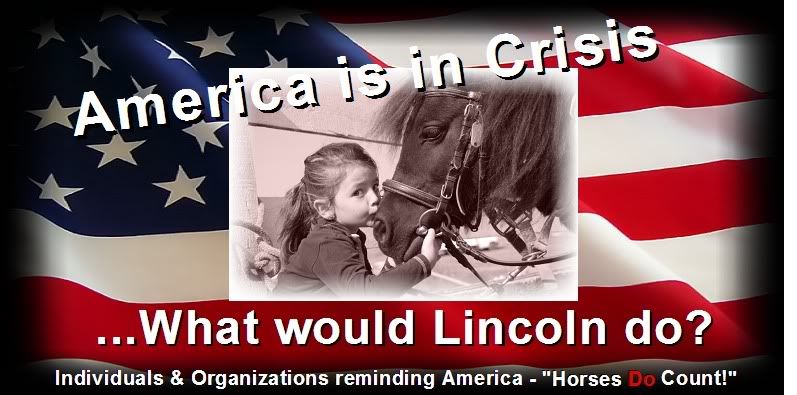
Ask President Obama What Would Lincoln Do?

Americans Against Horse Slaughter


Dear Friends,
Please take a moment to send this following letter to the President and then crosspost far and wide!
Thanks for all you do for the horses.


Dear President Obama,
 
What would Lincoln do?
 
No matter the politics of Horse Slaughter in America , there’s one thing that both sides cannot deny, our horses are suffering daily. 
 
Mr. President, if you admired President Lincoln, then you surely must have known about his deep compassion for animals.
 
Illinois politician William Pitt Kellogg recalled: “Next to his political sagacity, his broad humanitarianism was one of his most striking characteristics.
 
Historian Charles B. Strozier noted that “ Lincoln ’s lifelong sympathy for animals...was hardly the norm for the frontier.” [1]
 
Abe Lincoln loved children and animals and often preached against cruelty to animals.
 
Did you know that when the white House stables caught fire in 1863, President Lincoln had to be restrained from entering the burning structure to rescue six trapped horses?
 
Mr. President, even you wrote about Lincoln ’s self-awareness and his humility in one of your books.  Surely, Mr. President, you must have known about his compassion for animals.
 
If you admired President Lincoln, you must have known that pardoning the Turkey each Thanksgiving is part of Lincoln’s legacy?
 
Mr. President, even the theme of your Inauguration was taken from a line in Lincoln’s Gettysburg Address:
“A New Birth of Freedom”
 
Please Mr. President, please end the suffering of our American horses and give them their freedom and the respectable quality of life they deserve.  
 
President Lincoln once said, "I am not bound to win, but I'm bound to be true. I'm not bound to succeed, but I'm bound to live up to what light I have." 

Be true Mr. President…  What would Lincoln do?
 
http://www.myhero.com/myhero/go/specialevents/hero.asp?hero=LBC_PetsChildren&eid=1
 
Americans’ Against Horse Slaughter
 

EWA Alert! Press Release | CHDC Investigation 04.11.10

Equine Welfare Alliance

EWA Press Release
 
Hi, all. The following press release was just issued.
 
April 10, 2010

FOR IMMEDIATE RELEASE

Contacts:

John Holland
540.268.5693

Vicki Tobin                         
630.961.9292


Leading Horse Slaughter Proponent Calls Undercover Video a Fabrication

CHICAGO, (EWA) - The Canadian Horse Defence Coalition (CHDC) recently released hidden camera footage from an investigation that took place at the two largest horse slaughter plants in Canada, Bouvry Exports and Viande Richelieu.

So horrific are the conditions depicted at both plants that they have prompted Bill desBarres, Chairman of the Horse Welfare Alliance of Canada (HWAC) and a long time proponent of horse slaughter, to declare he believes the footage was fabricated by groups opposed to "any animal agriculture".

Bill desBarres and his organization have repeatedly praised the CFIA (Canadian Food Inspection Agency) and its inspectors for their diligence in assuring that horses are treated humanely at the slaughter plants and his organization lists the CFIA as a "resource partner" on their web site. The Horse Welfare Alliance appears to be nothing more than a front for the horse slaughter industry.

CHDC's Eastern Region Director, Shelley Grainger said of the footage, "The evidence provided compelling proof that puts into question the effectiveness of the assembly-line slaughter of horses. The evidence demonstrates that both the facilities in Alberta and Quebec fail to meet humane slaughter standards."

The footage is incontrovertible. In a court of law it would stand the test of cross examination as evidence.

Now, faced with such absolute evidence of the true nature of the slaughter process, desBarres has elected to use the Nixon Gambit and make the outrageous suggestion that the video is somehow fabricated. "One has to wonder," says EWA's John Holland, "does desBarres believe the CHDC tortured horses in staged mock-ups of the plants or does he think they hired Steven Spielberg to produce a digital fantasy?"

"The evidence obtained on the footage at both facilities was random - these instances we see of horses suffering terribly happened on those random days, and we can be certain they happen every day. As there are only two government-approved methods of stunning horses in Canada - captive bolt gun and rifle - and both methods have been shown to cause prolonged suffering in horses, it is evident that these animals cannot be slaughtered humanely in today's slaughterhouse assembly lines" says Grainger.

Grainger's conclusion is supported by similar under cover footage from a Mexican slaughter plant and appalling photos of horses at a US plant released by the USDA (US Department of Agriculture) under a response to a citizen request through the U.S. Freedom of Information Act.

The revelations are even more problematic for the CFIA who has yet to respond publicly to findings of a study published recently in the journal Food and Chemical Toxicology showing that horses given the banned carcinogen Phenylbutazone had routinely slipped through the inspection process and been slaughtered for human consumption.

The CFIA has been more circumspect than the HWAC, indicating only that such actions are unacceptable and that they will investigate the abuse issue.

Shelly Grainger commented, "As of July 31st, all slaughter bound horses in Canada must have an Equine Identification Document (EID) verifying they have not received Phenylbutazone, Clenbuterol, or various other drugs and steroids. As well, there is an extensive list of medications that require a 6-month withdrawal period."

The dual controversy comes as bills have been introduced into several state legislatures in support of horse slaughter. "They are just ignoring reality," says EWA's Vicki Tobin, "They can't keep ignoring the drug concerns, the horrific conditions at the slaughter plants and the cruelty inherent with the entire slaughter pipeline. The only states that want horse slaughter are those who have never experienced it."

It is time to take back our horses from the predatory slaughter industry. EWA urges all horse owners to contact their legislators and insist that the federal horse protection legislation be passed immediately.

The Equine Welfare Alliance is a dues free, umbrella organization with over 100 member organizations and hundreds of individuals worldwide. The organization focuses its efforts on the welfare of all equines and the preservation of wild equids.

www.equinewelfarealliance.org

Tuesday, April 6, 2010

Horse Slaughter Is Cruel, and 'Bute' in the Meat Kills Humans

USA Today

April 05, 2010 04:04 PM ET | Bonnie Erbe | Permanent Link | Print
By Bonnie Erbe, Thomas Jefferson Street blog
If you can't persuade them for the right reasons, then scare them with the facts.
A new paper in the journal Food & Chemical Toxicology shows how dangerous American horse meat is for human consumption.
Americans should stop selling horses for slaughter abroad because we love our horses and do not treat them as livestock. That's the right reason to stop this incredibly cruel practice. Still, millions of greedy horse owners and breeders send horses off to slaughter because it's more remunerative than not breeding at all or even having them euthanized.
But according to this new paper, humans who consume horse meat (most often overseas and especially in France, Italy, Japan and Belgium) are at risk for being poisoned by Phenylbutazone or "bute." It's a nonsteroidal anti-inflammatory drug originally developed for treating severe cases of arthritis, but it was later found to...
"cause serious and lethal idiosyncratic adverse effects in humans. Sixty-seven million pounds of horsemeat derived from American horses were sent abroad for human consumption last year. Horses are not raised as food animals in the United States and, mechanisms to ensure the removal of horses treated with banned substances from the food chain are inadequate at best."
Bute is still routinely used not just at the thoroughbred racetrack, which is what the authors of this paper studied, but also by horse owners nationwide to mitigate pain for all sorts of horse injuries. Horses do not have the same lethal reaction to bute that humans can display, although long-term use of bute for horses can create ulcers and other organ damage.
The paper's authors call it a "significant health hazard" for people to consume horse meat. I hope this information is highly promulgated throughout horse-consuming societies in Europe and Asia.

Monday, April 5, 2010

The ultimate betrayal of the horse

Horsetalk Guest Blog

The ultimate betrayal of the horse

April 5th, 2010 by George McDonald I felt nauseated as I read a story this morning on this site about the “equine house of horrors” at two Canadian horse slaughter plants.
The whole issue of horse slaughter nauseates me, full stop. I find it unfathomable that people who supposedly care for and about an animal would betray it by sending it to slaughter.
A butcher shop specializing in horse meat in Pezenas, Languedoc, 
France. (Wikipedia)
A butcher shop specializing in horse meat in Pezenas, Languedoc, France. (Wikipedia)
But then not all horse lovers care about horses.
As I read through the Canadian story, I felt saddened for the horses involved, and anger at the people who had sent them to their deaths.
I also felt anger at the idiots in the world (yes, there are plenty) who seem to think that horse slaughter is a convenient form of euthanasia – not only do they get the ‘problem’ out of sight and out of mind – but – bonus – they make a few bucks, too.
Now, the devil’s-advocate types out there jump up and say they see no difference between eating a cow, sheep, or deer, than eating a horse.
Well, there are two main differences that these people fail to consider.
One is that there are rigorously inspected facilities for cattle, sheep and deer where they are treated humanely when they are slaughtered.
As outlined in the Canadian story, the facilities that horses end up in are generally not like that:
“Problems include failure to restrain each animal’s head properly before shooting, shooting from too great a distance, shooting in the wrong part of the head or body, failure to follow up with an immediate second shot in animals that were not killed by the first, hoisting apparently conscious animals, and – in the case of [one] plant – cruel handling and treatment of the horses, including excessive whipping and overuse of an electric prod, as well as an apparent callous disregard for the animals’ suffering.
“An additional cause of very major concern is the presence of what appear to be either plant supervisors or inspectors who observe the employees’ actions and yet do nothing.”
Two, is that horses have been selectively bred for hundreds of years for many things, and slaughter isn’t one of them. They have been bred to carry a soldier to war, or to plough a field, to pull a cart as transport, or to be gentle enough for a child to ride, or to run fast for entertainment and as a money-earner, or to jump high or look pretty, and so on.
Most also have names.
In simple terms, there are (to me) two main types of people who send horses to slaughter.
1 – those who breed or buy them just for the purpose. [known as kill buyers or breeders]
2 – those who have used the horse until it has outlived its usefulness to them and they don’t care about providing another home or providing another option for the horse. It’s all about the money.
Type 2 can be split further:
a. those who have the horse disposed of by someone else – think of a racehorse owner whose trainer says the horse is no good, but they’ll find them another one. The owner doesn’t know where the old one went, and doesn’t care because he has another ‘prospect’.
b. those who sell a horse (usually cheap or at auction) for whatever reason yet fail to properly place the horse in a new suitable home, or check the buyer out.
c. those who knowingly send their horse to slaughter as a form of euthanasia.

Fast food shop selling horse Leberkäse (Pferdeleberkäse) in 
Vienna. (Wikipedia)
Fast food shop selling horse Leberkäse (Pferdeleberkäse) in Vienna. (Wikipedia)
How any of these people could have missed the unpalatable facts in the media about horse slaughter in the past few years is another question. Heads buried in the sand? Which leads me to type c – the worst kind of traitors to the equine. They say they are horse lovers and make their money from or get pleasure from the horse, yet betray them at the very end.
These “c” people keep telling themselves and anyone else misguided enough to listen that slaughter plants are necessary because it is so expensive to have a horse killed when they don’t want it any more. If they don’t exist, these people argue, horses will be mistreated and neglected. Sad to say that horses were being mistreated and neglected long before slaughter plants in the US closed. I’ve read a lot about this  on this website over the past few years.
The misinformation being spread knows no limits.
Don’t get me started on the silly people who think it is great that the meat of horses is used to feed the poor. It isn’t. Horse meat sells as a delicacy  so it takes a special kind of ignorance to consider sophisticated diners in Belgium, France and Japan as paupers.
Never mind the fact that many horses are pumped full of toxic (to humans) chemicals. This proves that people will eat anything they can shove down their throats, and believe what is shoved down their throats by those promoting it.


A horse at a livestock auction in Pennsylvania.
The biggie drug here is phenylbutzone, or Bute, which is a carcinogen (that means cancer causing) and causes bone marrow toxicity in humans. The US Food and Drug Administration (FDA) has set no safe levels of the drug and bans its use food-producing animals, including horses. Yet still horses are killed for their meat and people eat it. ‘It’s safe’, say the kill buyers, and the European Union believes them when they say the horses are free of key drugs.
Reading through the Canadian story I felt so bad for the horses who ended up being sold down the road, only to find a lonely, painful, and frightening end.
We have bred horses for many generations to be easy to handle and put their trust in us. They have been pampered and loved, groomed and shown, and handled with care.
Slaughter is the ultimate betrayal.

Humans Consume Bute-Laden Horse Meat: Research

Top News

Questions have arisen over human safety, after a paper published in United States has claimed that horses administered with phenylbutazone have also been slaughtered for human consumption.

More...

Saturday, April 3, 2010

Footage reveals "equine house of horrors"

Horsetalk
April 4, 2010


This mare and foal were among sick, young, and pregnant horses at an Ontario kill buyer feedlot.

A Canadian horse welfare group has released hidden camera footage from two slaughter plants it says shows that both facilities fail to meet humane slaughter standards. The Canadian Horse Defence Coalition says it is "compelling proof that puts into question the effectiveness of the assembly-line slaughter of horses".
Its release prompted a call from the Humane Society of the United States to ban the export of horses to Canada for slaughter.
One noted veterinarian who watched the footage labelled one plant an equine house of horrors.
Equine Canada said it had contacted the Canadian Food Inspection Agency over the material, which can be viewed at http://www.defendhorsescanada.org (warning: graphic content).
The organisation's release of the material was accompanied by a statement from the World Society for the Protection of Animals (WSPA), which said it was "appalled by evidence of grossly inhumane slaughter of horses taking place in Canada".
London-based farm animal programme manager, Dr Rasto Kolesar, and Toronto-based programmes manager for the WSPCA in Canada, Patrick Tohill, commented on the footage, saying: "It is clear that neither the facilities nor the behaviour of the personnel shown are suited to the humane slaughter of horses, and that extreme suffering results for many individual animals.
"Problems include failure to restrain each animal's head properly before shooting, shooting from too great a distance, shooting in the wrong part of the head or body, failure to follow up with an immediate second shot in animals that were not killed by the first, hoisting apparently conscious animals, and - in the case of [one] plant - cruel handling and treatment of the horses, including excessive whipping and overuse of an electric prod, as well as an apparent callous disregard for the animals' suffering.
"An additional cause of very major concern is the presence of what appear to be either plant supervisors or inspectors who observe the employees' actions and yet do nothing."
The WSPA called on the appropriate authorities "to take immediate action to close both these plants down and ensure that those responsible are disciplined".
Neither plant, the pair said, should be reopened until or unless they have been redesigned to meet humane slaughter standards, "and all staff in contact with these intelligent animals have been trained to treat them with the dignity they deserve".
It said the Canadian Food Inspection Agency (CFIA) needed to audit plants to ensure problems were not occurring at other plants.
"Measures must be taken to ensure that procedures at the slaughterhouse are carried out in accordance with legislation, including the Canadian Meat Inspection Act which requires that all animals should be slaughtered humanely," they said.
The CFIA should guarantee avoidance of practices that inflict extreme pain and suffering on slaughtered animals, they said.
"The WSPA would be happy to provide advice on appropriate facilities and training for humane slaughter, if required, to help protect animals from needless suffering."
Equine Canada, the country's governing body for equestrianism, said it was notified of the material on March 30.
"While recognising that no aspect of these allegations is confirmed, Equine Canada immediately contacted the CFIA.
"Equine Canada has been assured that the CFIA takes allegations of abuse very seriously and that their officials are investigating this case.
"The CFIA has further assured Equine Canada that their routine surveillance indicates that most producers, transporters and processers in this sector are committed to treating the horses in their care humanely.
"In those rare cases when abuse is determined, the CFIA has a range of enforcement options at their command."
Equine Canada said it will monitor the proceedings and provide an update when findings are available.
The Humane Society of the United States said the footage further demonstrates what it has documented for years about horse slaughter: "Foreign-owned horse slaughterhouses have set up shop just over the border, and US horses will continue to suffer both during long-distance shipping and then during a gruesome butchering process - all for the culinary whims of foreign gourmands."
The society noted that some horses in the footage bear tags from the US Department of Agriculture, indicating animals shown in the video originated in the US.
"Every day while Congress delays, 'killer buyers' are transporting American horses to Canada and Mexico, and there the animals are meeting an awful demise, often after a painful and harrowing journey," said Wayne Pacelle, the society's president and chief executive.
Pacelle said cruelty in the industry will end only when the Congress passes the Prevention of Equine Cruelty Act.
He said about 100,000 US horses are purchased by "kill buyers" at auctions across the US annually, to be transported to slaughter plants in Canada and Mexico.
"Despite Canada's regulations and inspection standards for plants that process horses, this investigation shows how ineffective they are at preventing suffering."
Nicholas Dodman, a noted veterinary behaviorist, a founding member of Veterinarians for Equine Welfare, and Tufts University School of Veterinary Medicine professor, reviewed the videos for the society, labelling one of the plants an equine house of horror.
"Horses kicking after they have been shot, sinking down and rising up; sometimes periods of struggling or paddling before a second or third shot has to be administered.
"This atrocity goes against all veterinary guidelines for humane euthanasia. Terror and suffering is the rule at this equine house of horrors ... and all in the name of the gourmet meat market."
The society urged federal lawmakers to pass legislation to prevent US horses being exported for laughter for human consumption.

Landmark Paper Links Bute to Chemical Contamination

Horseback Magazine


Story and Photo by Steven Long
HOUSTON, (Horseback) – Decades of USDA studies asserting U.S. and Canadian horse meat as chemically harmless have been branded as bogus by a new peer reviewed scientific study.
The paper, titled "Association of Phenylbutazone Usage With Horses Bought for slaughter: A Public Health Risk" appeared in the journal Food and Chemical Toxicology.
It questions USDA (US Department of Agriculture) and CFIA (Canadian Food Inspection Agency) testing programs. The programs have consistently given bute and scores of other dangerous chemicals a clean bill of health in U.S. horsemeat exported for human consumption in the dining rooms of Europe and other destinations abroad.
The paper begins by putting the dangers of bute into historical perspective citing 14 prior scientific studies..
“Phenylbutazone (PBZ) was marketed in the United States for the treatment of rheumatoid arthritis and gout in 1952. Serious and often fatal adverse effects such as aplastic anemia and agranulocytosis appeared in the literature within three years of its use ( Benjamin et al., 1981; Böttiger and Westerhom, 1973; Cameron et al., 1966; Chaplin, 1986; Deaths due to butazolidin, 1952; Dunn, 1972; Etess and Jacobson, 1953; Hale and DeGruchy, 1960; Leonard, 1953; Mauer, 1995; McCombs, 1958; Nelson et al., 1995; Ramsey and Golde, 1976; Risks of agranulocytosis and aplastic anemia, 1986; Steinberg et al., 1953 ). The serious adverse effects of PBZ culminated in its unavailability for human use in the United States.”
Agricultural interests have long touted the USDA studies as valid proof supporting the assertion that domestic horsemeat is harmless for human consumption.’
The European Union last year banned the import of U.S., and Canadian horsemeat citing the use of bute and scores of other dangerous and carcinogenic chemicals.
Agricultural interests in at least five states have mounted serious legislative efforts to again legalize the slaughter of horses for the export of their meat for human consumption abroad.
______________________
EWA Praises Bute Study
CHICAGO, (EWA) - A peer reviewed scientific study tracing race horses sent to slaughter for human consumption has found that 100% of the horses in the study group had been administered phenylbutazone, a banned carcinogen that can also fatally damage the bone marrow of humans. The findings appear to validate the European Union’s recent tightening of traceability requirements on horse meat from third countries.

The paper, titled Association of phenylbutazone usage with horses bought for slaughter: A public health risk, appeared in the journal Food and Chemical Toxicology and calls into question the reliability of the USDA (US Department of Agriculture) and CFIA (Canadian Food Inspection Agency) testing programs which have consistently failed to detect the substance.

The manuscript(1), which was authored by Drs. Nicholas Dodman(2), Nicolas Blondeau(3) and Ann M. Marini(4), followed eighteen Thoroughbred (TB) race horses that were identified by matching their registered name to their race track drug record over a five year period and were given phenylbutazone (PBZ, Bute) on race day and were subsequently sent to slaughter for human consumption.

The study also traced records on sixteen TB race horses that were given PBZ on race day and would have also entered the food chain had they not been rescued. The study was limited to race horses because of the availability of drug records, but phenylbutazone is one of the most common drugs used in the treatment of musculoskeletal injuries in horses.

Because of the bone marrow toxicity caused by PBZ in humans, the Food and Drug Administration (FDA) has set no safe levels of PBZ and bans its use food producing animals, including horses. While PBZ is but one of the numerous banned substances that are routinely given to US horses, it is one of the most dangerous.

Defenders of horse slaughter have long pointed to USDA testing records which consistently showed no positive results for PBZ. The new study shows that the USDA testing could not have been accurate. Indeed, the study uncovered a pilot test performed by the USDA in 2004 and 2005 that used a different testing technique and found 8.3% of the meat to be contaminated with PBZ. The pilot program had been subsequently discontinued.

The study estimates that sixty seven million pounds of horse meat derived from US horses were sent overseas for human consumption in 2008. If 8.3% of this meat contained phenylbutazone residues, it would translate to over 5 million pounds of contaminated meat.

Opponents of horse slaughter have long warned that US horses are not raised as food animals and mechanisms to ensure the removal of horses treated with banned substances from the food chain are inadequate at best.

Equine Welfare Alliance recently issued a discussion paper with their partners, Canadian Horse Defence Coalition on the serious drug issue concerning North American horses. The comprehensive paper covers concerns over the ability to meet compliance with European Commission regulations on food safety.

(1) Article is cited as, Dodman, N., Blondeau, N., Marini, A.M., Association of phenylbutazone usage with horses bought for slaughter: A public health risk, Food and Chemical Toxicology (2010), doi: 10.1016/j.fct. 2010.02.021
(2) Tufts University, Cummings School of Veterinary Medicine, North Grafton, MA
(3) Institut de Pharmacologie Moléculaire et Cellulaire - I.P.M.C, UMR 6097,
C.N.R.S/Université de Nice Sophia Antipolis, 660 route des Lucioles, Sophia Antipolis
06560 Valbonne, FRANCE
(4) Department of Neurology and Program in Neuroscience, Uniformed Services University of the Health Sciences, Bethesda, MD.

Friday, April 2, 2010

Horses given bute entering food chain, study shows

Horsetalk

Horses given bute entering food chain, study shows


April 3, 2010

A United States study has shown that horses given phenylbutazone have been sent for slaughter, raising questions around the safety of the meat for human consumption. The paper, entitled "Association of phenylbutazone usage with horses bought for slaughter: A public health risk", appeared in the journal Food and Chemical Toxicology.
The paper, by Drs Nicholas Dodman, Nicolas Blondeau and Ann Marini, followed 18 thoroughbreds whose drugs records showed they had been given phenylbutazone, also known as bute. The horses were subsequently sent for slaughter.
The study also traced records of 16 thoroughbreds that were given the drug on race day and would have also entered the food chain had they not been rescued.
The study was limited to racehorses because of the availability of drug records.
"The permissive allowance of such horsemeat used for human consumption poses a serious public health risk," the authors said, noting that 67 million pounds of horsemeat derived from American horses were sent abroad for human consumption last year.
"Horses are not raised as food animals in the United States and, mechanisms to ensure the removal of horses treated with banned substances from the food chain are inadequate at best," they said.
Phenylbutazone is one of the most common drugs used in the treatment of musculoskeletal injuries in horses.
Because of the bone marrow toxicity caused by phenylbutzone in humans, the US Food and Drug Administration (FDA) has set no safe levels of the drug and bans its use food-producing animals, including horses.
The Equine Welfare Alliance (EWA), which has long pointed out the likelihood that meat contaminated with the drug is entering the human food chain, said the study called into question the reliability of US Department of Agriculture (USDA) and Canadian Food Inspection Agency (CFIA) testing programmes, which have consistently failed to detect the substance.
"Defenders of horse slaughter have long pointed to USDA testing records which consistently showed no positive results for PBZ," said EWA representatives John Holland and Vicki Tobin.
"The new study shows that the USDA testing could not have been accurate.
"Opponents of horse slaughter have long warned that US horses are not raised as food animals and mechanisms to ensure the removal of horses treated with banned substances from the food chain are inadequate at best," they said.
The European Union is bringing in traceability requirements for horses entering the food chain in a bid to ensure drugs such as bute do not enter the food chain. The move is likely to impact heavily on the American slaughter industry, centred on Canada and Mexico.

Thursday, April 1, 2010

HSUS calls upon Congress to Ban the Export of US Horses to Slaughter


FOR IMMEDIATE RELEASE

The Humane Society of the United States Urges Congress to Ban the Export of U.S. Horses to Slaughter in Light of New Canadian Undercover Investigation

Video shows horses conscious as they are shot multiple times

(April 1, 2010)— New undercover video footage released Tuesday by the Canadian Horse Defence Coalition confirms the horrible abuses inherent in the slaughter of our horses for human consumption, and illustrates the need for the U.S. Congress to bar the export of tens of thousands of U.S. horses each year to slaughter plants across the border. At the Bouvry Exports plant in Canada, a chestnut horse is shot three times while a gray mare waits in the kill box. As the chestnut horse panics and struggles—as horses are biologically wired to do—the gray mare is shot. She remains alive and kicking even as two more .22-caliber shots are fired at her face. She languishes. The pattern repeats itself.

The CHDC’s video footage, titled “Chamber of Carnage,” further demonstrates what The Humane Society of the United States has documented for years about horse slaughter: Foreign-owned horse slaughterhouses have set up shop just over the border, and U.S. horses will continue to suffer both during long-distance shipping and then during a gruesome butchering process—all for the culinary whims of foreign gourmands.

To see the "Chamber of Carnage" video, click here. Some horses in the CHDC footage bear tags from the United States Department of Agriculture, indicating animals shown in the video originated in the United States.

“Every day while Congress delays, ‘killer buyers’ are transporting American horses to Canada and Mexico, and there the animals are meeting an awful demise, often after a painful and harrowing journey,” said Wayne Pacelle, The HSUS’ president and CEO. “This new investigation affirms again that there is unmistakable cruelty in this industry and it will only end when the Congress passes the Prevention of Equine Cruelty Act.”

The footage is consistent with similar footage obtained by The HSUS of horses cruelly butchered in foreign-owned plants on U.S. soil as well as that of horse slaughter in Mexico. One theme runs through every investigation – U.S. horses are generally not raised for food and where this trade occurs, there is inherent abuse.

Horse slaughter is not a form of humane euthanasia – something The Canadian Horse Defence Coalition’s video clearly shows. Horses are trusting, majestic creatures, and extreme flight animals. They fight or try to flee, and they suffer in these slaughter houses. Approximately 100,000 U.S. horses are purchased by “kill buyers” at auctions across the United States, who frequently outbid good horse owners to secure the fattest, healthiest horses, and are then transported cross-country often with no food, water or rest to slaughter plants in Canada and Mexico, where they are butchered. Despite Canada’s regulations and inspection standards for plants that process horses, this investigation shows how ineffective they are at preventing suffering. 
Nicholas H. Dodman, D.V.M., one of the world's most noted and celebrated veterinary behaviorists, a founding member of Veterinarians for Equine Welfare, and Tufts University School of Veterinary Medicine professor, reviewed the videos for The HSUS and echoed the same sentiment: “Noise, blood and suffering is what you get at the Bouvry equine slaughter plant: Horses kicking after they have been shot, sinking down and rising up; sometimes periods of struggling or paddling before a second or third shot has to be administered. This atrocity goes against all veterinary guidelines for humane euthanasia. Terror and suffering is the rule at this equine house of horrors ... and all in the name of the gourmet meat market.”
The HSUS joins CHDC and hundreds of other horse industry and animal welfare groups in calling for the immediate passage of H.R. 503/S. 727 to prevent our horses from the cruelty of horse slaughter for human consumption. This legislation, authored by Reps. John Conyers, D-Mich., and Dan Burton, R-Ind., and Sens. Mary Landrieu, D-La., and John Ensign, R-Nev., has 181 House cosponsors and 29 Senate cosponsors.
-30-
Media Contact: Pepper Ballard: 301-258-1417; pballard@humanesociety.org
Follow The HSUS on Twitter.  
The Humane Society of the United States is the nation’s largest animal protection organization – backed by 11 million Americans, or one of every 28. For more than a half-century, The HSUS has been fighting for the protection of all animals through advocacy, education and hands-on programs. Celebrating animals and confronting cruelty -- On the web at humanesociety.org.

Monday, March 29, 2010

PNGI Tracks Adopt Anti-Slaughter Policy

Bloodhorse

PNGI Tracks Adopt Anti-Slaughter Policy

Updated: Monday, March 29, 2010 3:10 PM
Posted: Monday, March 29, 2010 2:35 PM 
 
Penn National Gaming Inc. has adopted a policy that punishes horsemen that sell horses for slaughter.
The company, which currently owns five horse racing tracks and has an agreement to purchase a sixth, released the company-wide policy March 29. It is similar to those in place at other racetracks.
The policy states: “Any horsemen stabled at a Penn National Gaming Inc.-owned or -operated horse racing facility who knowingly, or without conducting proper due diligence, sells a horse for slaughter, directly or indirectly, will have his or her stalls revoked and may, in addition, be barred from all of our racing properties.”
PNGI said horsemen are required to conduct “proper due diligence on those buying horses.” The company said it encourages horsemen participating at PNGI facilities and industry-wide to support rescue and adoption efforts and to seek humane means of dealing with horses unable to continue racing.
The policy took effect immediately at Black Gold Casino at Zia Park in New Mexico; Charles Town Races & Slots in West Virginia; Hollywood Casino, Hotel and Raceway, a harness track in Bangor, Maine; Hollywood Casino at Penn National Race Course in Pennsylvania; and Raceway Park, an Ohio harness track.
“We need horsemen to become educated and use best efforts and practices in how they manage their equine charges and to act in a responsible way when those athletes no longer are able to race,” PNGI vice president of racing Chris McErlean said. “We plan to assist our respective horsemen’s organizations in promoting and advertising available options.”


Tuesday, March 16, 2010

Another "Front" for Horse Slaughter

Animal Law


Pro-slaughter interests have once again used a state legislature to advance their agenda to return horse slaughter to the U.S.


They have pushed through the Wyoming legislature a new law, H.B. 122, introduced by Wy. State Rep. Sue Wallis who is also the self-styled Executive Director of the United Organizations of the Horse, which is said to unite The United Horsemen's Front, The United Horsemen's Alliance, and The United Horsemen's Political & Legal Action Fund.  "Front" is probably the most appropo name for this collection of horse slaughter supporters. Front for pro-horse slaughter interests.

It's not clear that when Wyoming residents elected Wallis as a state representative, they understood she would act as a shill for pro-slaughter interests.

The new law allows the Wyoming Board of Livestock to "send for slaughter" any abandoned, estray, feral, or abused animals under their control. The Board can already sell these animals at auction so including the phrase "send for slaughter" in the law doesn't add to the Board's current authority.  It just sends the message that horse slaughter is acceptable, even desirable.  

The new law also states that the Board "may enter into agreements with licensed meat processing plants to process meat from livestock disposed of by slaughter.  The processed meat shall be sold to:
(i)  Wyoming state institutions or to nonprofit organizations for no more than the board's cost for disposal, processing and delivery; or
(ii)  For profit entities at market cost for the processed meat." 

Wallis says she would like horsemeat made available to the "poor" for the cost of "disposal", processing (aka slaughter) and "delivery".  Another front....Because the real benefit theoretically goes to "for profit entities" that would sell it.

Theoretically because, of course, commercial horse slaughter in the U.S. for human consumption is not legal. No state law can change that.  Also, there is no market in the U.S. for horse meat. Americans, poor or not, don't eat horses. The "for profit entities" Wallis is assisting will sell the horsemeat as a delicacy in some foreign countries at great profit.

American communities including those in Wyoming will see none of that profit. When the 3 U.S. based slaughter houses were in operation, profits were siphoned off by their foreign owners. In 2004 Dallas Crown, Inc., for example, which operated a horse slaughter facility in Kaufman, Texas until 2007, paid $5 in federal income tax on $12 million in sales.  In the previous 5 years foreign-owned Dallas Crown's federal income tax was .3% or 1/3 of 1% of gross revenues or sales.  Dallas Crown paid no sales tax because its products, horse meat, are sold and consumed in foreign countries. Former Kaufman mayor, Paula Bacon, explains, "My community did not benefit. We paid."   

Even the foreign markets are shrinking as the French and Italians consider bans on horsemeat, and the European Union has issued restrictions on imports of American horsemeat that contain substances that make the meat unfit for human consumption. Substances banned range from toxic wormers to phenylbutazone (PBZ), the "aspirin" of the horse world, and even include fertility drugs that can cause miscarriages in women. "PBZ is a known carcinogen and can cause aplastic anemia (bone marrow suppression) in humans", says Equine Welfare Alliance (EWA) member, Dr. Ann Marini, Ph.D., M.D. But the list of contaminants is not limited to conventional drugs. "Some of the garbage ‘treatments' that are given to performance horses included iodine-peanut oil injections along the spine, anabolic steroids, cocaine, amphetamines, opioids and even snake venom", explains Dr. Nicholas Dodman, DVM at Tufts University.


American horses are not raised for food and there is no system for tracking drugs or other substances given to them.  Horses may have several owners before they are sold for slaughter. The new EU rules will mean that horses coming from auctions and other sources in the US will have to be kept drug free on a feedlot for half a year. For more on how Canada will handle American horses under the new EU rules. .... 
  
The new Wyoming law is, in effect, another pointless law offered simply to try to make horse slaughter acceptable, even desirable, to Americans who have rejected it in poll after poll. Americans understand the profitability of this sordid practice depends on animal cruelty.

What is particularly disturbing about this new Wyoming law is its astonishing cruelty. As Vicki Tobin, founder and vice-president of Equine Welfare Alliance, points out, "They didn't even consider that these horses might be adopted out or placed with rescues."    It's true. The only option the pro-slaughter interests gave for these poor animals is "send to slaughter".
________________
For more on the so called "unwanted horse", read Selling the Unwanted Horse, by John Holland
Go here for more on the disinformation campaign pro-slaughter interests are waging using the "unwanted horse".

CHDC/EWA Discussion Paper on the European Union Regs

What the New European Union Requirements for Imported Equine Meat Will Mean to North America’s Horse Industry March 2010

Introduction This paper discusses Canada’s planned compliance with the new European Commission (EC) measures for countries that export equine meat to Europe, and the impact they will have on North America’s horses. While the new rules are a positive step towards a necessary identification system for our horses, there are several major deficiencies with the measures Canada plans to implement. Most notably, there are several medications not permitted for equines slaughtered for food, including Phenylbutazone or “Bute” – the horse industry’s most widely used analgesic and anti-inflammatory medication. So commonly used, this drug alone precludes virtually all race and professional sport horses, as well as most pleasure horses, from entering the human food chain.

10 pages. More ...