Suit seeks immediate injunction, cites BLM’s violations of four Congressional Acts
New York City, NY (October 7, 2010)— A case filed today against Secretary of Interior Ken Salazar in federal court aims to stop the elimination of wild horses from Colorado’s North Piceance herd area. Plaintiffs Habitat for Horses (HfH), the American Society for the Prevention of Cruelty to Animals (ASPCA), The Cloud Foundation (TCF), Toni Moore and Dr. Don Moore challenge the BLM’s ongoing illegal treatment of wild horses residing on public lands and it’s intention to completely remove all wild horses from this area beginning October 11, 2010.
The Plaintiffs’ attorneys, Bruce Wagman (Schiff Hardin) and Valerie Stanley, are asking the court for an injunction to stop BLM from removing any of these wild horses pending a complete judicial review of the BLM’s conduct. The complaint cites four counts and violations committed by the Bureau of Land Management (BLM): violation of the Wild Free-Roaming Horses and Burros Act, the National Environmental Policy Act, the Information Quality Act and the Federal Land Policy Management Act. The suit has been brought against BLM Director Robert Abbey and Field Manager of the Colorado White River Field Office Kent Walter, in addition to Secretary Salazar. “The BLM’s ‘shoot from the hip’ policy of indiscriminately destroying and removing long standing wild horse herds has to come to an end,” says R.T. Fitch, Volunteer Executive Director of co-supporting organization HfH Advisory Council, “Poor accounting, outdated data and disengagement from the reality of the range is the hallmark of the BLM’s business plan. They must be stopped.”
On September 10th, 2010 the White River Field office of the BLM issued its final decision to completely and permanently eliminate the herd of wild horses which has lived in partnership with the natural environment in the Herd Area for centuries.
“BLM and other public agencies have eliminated over a third of wild horse herds designated for protection by Congress in 1971,” explains Cloud Foundation Volunteer Executive Director, Ginger Kathrens. “Colorado has only a few hundred wild horses remaining and the destruction of yet another herd is unthinkable—cruel, costly and completely unnecessary. It is a managing to extinction policy that must stop.”
This action is co-funded by HfH Advisory Council and the ASPCA. A suit filed last week to protect the nearby West Douglas wild horse herd has so far resulted in a one-year postponement of that “zeroing out action.” The case remains in court. The Cloud Foundation, HfH Advisory Council, ASPCA and over 200 other organizations and tens of thousands of members of the public continue to call for an immediate moratorium on BLM wild horse and burro roundups. To date the BLM has not changed course and plans to roundup and remove a total of 3,295 wild horses and burros before the end of the year. Currently, nearly 40,000 wild horses and burros are held in pens and pastures at taxpayer expense. Links of interest:
Legal documents filed today: http://bit.ly/d7ePWk
Congress Sends Letter for Wild Herds to Secretary Salazar http://bit.ly/54sign
Roundup Schedule- http://bit.ly/roundupsched
American Herds – “What’s Left?” http://bit.ly/WhatsLeft
Unified Moratorium on Roundups Letter http://bit.ly/MoratoriumLtr
Mestengo. Mustang. Misfit. America’s Disappearing Wild Horses – A History http://bit.ly/8ZCk8e
Straight from the Horse’s Heart http://www.sfthh.com
Stampede to Oblivion: An Investigate Report from Las Vegas Now http://bit.ly/Stampede2Oblivion Shortlink to this release: http://bit.ly/COmustangSuit Photos, video and interviews available by request from the Cloud Foundation The Cloud Foundation is a non-profit dedicated to the preservation and protection of wild horses and burros on our Western public lands with a focus on protecting Cloud’s herd in the Pryor Mountains of Montana. 107 S. 7th St. – Colorado Springs, CO 80905, p. 719-633-3842 www.thecloudfoundation.org The Habitat for Horses Advisory Council is the “The Legal Voice of the American Equine” and is comprised of like-minded equine welfare oriented organizations and individual advocates. The Council works to progress relevant issues imperative to furthering the safety and well being of horses, both domestic and wild, in the United States. Habitat for Horses Advisory Council is a registered 501c4 non-profit corporation. P.O. Box 213, Hitchcock, TX 77563, p.1-800-974-FOTH www.hfhadvisorycouncil.org
American Society for the Prevention of Cruelty to Animals (ASPCA)was the first humane organization in the Western Hemisphere. Our mission, as stated by our founder, Henry Bergh, in 1866, is “to provide effective means for the prevention of cruelty to animals throughout the United States. 424 E. 92nd St New York, NY 10128-6804, p. 212-876-7700 www.aspca.org
Anyone who knows anything about Wild Horses and Burros has heard the recent news that Madeleine Pickens has reported to garner agreement from the Bureau of Land Management (BLM) to move 1,000 captive wild horses from long term holding to an “Eco-Sanctuary” environment with the remaining 38,000+ to follow. Ms. Pickens should be applauded for her efforts but while she moves 1,000 altered Wild Horses to private land the BLM will strip from public land several thousand more and put them behind bars. Doesn’t speak highly of the BLM’s level of commitment to a solution, does it?
Although we want to see all of the horses out of their BLM prisons a declared moratorium on the process of using bad numbers, junk science and political motives as excuses to steal America’s mustangs from their rightful land should be a component to these negotiations and an eventual solution. Without a moratorium on the roundups, to give time for a full accounting of actual Wild Horse and Burro numbers, we are just pumping more horses into a cruel situation while gutting the taxpayer’s pocketbooks.
In reality, we are giving a spoon full of medicine to treat a symptom while the cancer continues to ravage the body; outside of giving a little comfort it does not change the inevitable outcome of the sickness’s progression and the “Eco-Sanctuary” will not stop the BLM’s decimation of the wild horses from their native homes.
Personally, I do not trust the management of the BLM as for decades they have been attempting to destroy the wild horses and burros of this great nation. It was just two short years ago when this same agency wanted to kill all of the horses that they had in long term holding; a leopard does not change his spots that quickly.
This is not an act of benevolence on the part of the BLM but an excuse and a device to distract the public outrage as the BLM “Wild Horse Harvesting Machine” continues its consumption of all of the wild horses from their rightful homes. 12,000 horses this year added to the existing 38,000 and 11,000 more stampeded into oblivion next year. Do the math and being that we do not have an accurate accounting of what is really out there, the end of the American Wild Horse draws nearer with each passing day.
Madeleine’s news will be good news to the horses that are in BLM concentration camps but it will do nothing to stop the BLM from continuing its assault upon our national icon. The only way to slow this down and stop the deadly stampedes is to chant the mantra of “Moratorium”; repeat it loud and often, the madness has to stop so that true science, compassion and ethical management can be applied to the saving of our last few, true, wild horses.
What we need, today, is a moratorium; that would be something to truly celebrate about.
As the Prophet Mohammed's army marched towards Mecca in 630 to conquer it they passed a female dog with puppies. The Prophet gave orders that they should not be disturbed and posted a man to see that this was done. He said, "Verily, there is heavenly reward for every act of kindness done to a living animal."
Statement from The Cloud Foundation and Katie Fite with Western Watershed Project Responding to the End of the Tuscarora Roundup
Reno, NV (Aug 4, 2010) —"The Tuscarora roundup accurately characterizes a government agency who treads heavily on the First Amendment Rights of American citizens while they destroy a beloved icon of the West," explains Ginger Kathrens, Executive Director of The Cloud Foundation and Emmy Award-winning producer.
"Originally the BLM locked down the area—to dissuade press and observers from covering the roundup for the first two weeks. We can only imagine the dirty work the BLM did not want us to see," says Laura Leigh, Herd Watch Director for The Cloud Foundation. "Even as an accredited member of the press and member of the public I was not allowed to observe any horses during the deadly Owyhee roundup. It is absolutely unacceptable that our government can operate in such a cloak and dagger manner with a resource so important to the American people. This kind of secretive action cannot be allowed to happen again. It is a clear violation of the checks and balances afforded in our Constitution."
"It is horrific to see dead horses off rocky cliffs as a result of the Tuscarora roundup," says Anne Novak spokesperson for The Cloud Foundation. "When the press and public are barred from bearing witness, we can only wonder what the contractor and the BLM are trying to hide."
Despite the BLM's spin doctors at work on the Tuscarora death toll, Katie Fite Biodiversity Director for Western Watersheds Project states, "The desert doesn't lie," reminding us the truth will be revealed.
The Cloud Foundation is a non-profit dedicated to the preservation and protection of wild horses and burros on our Western public lands with a focus on protecting Cloud's herd in the Pryor Mountains of Montana.
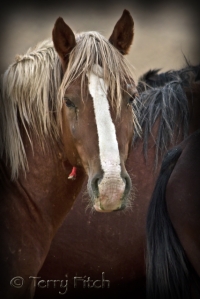
By Steven Long, Photo by Terry Fitch HOUSTON, (Horseback) – The federal Bureau of Land Management is hiding the identity of landowners who are providing wild horse trap sites.
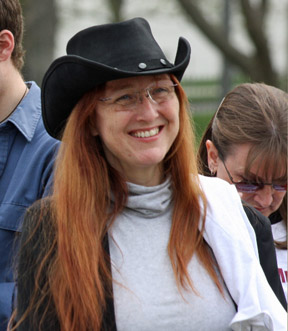
Journalist, author, and artist Laura Leigh won a major First Amendment victory in federal court when Reno’s Judge Larry Hicks ruled it unconstitutional for the BLM to bar observers and the press from observing wild horse “gathers.”
But she was barred by local deputies and threatened with if she pursued her recently won right to observe wild horse “gathers.” Why? Because the trap site used by the federal agency was located on privately owned land. Leigh was told the landowner would not allow press and public on his property.
BLM officials told her to get permission from the landowner if she wanted to see the horses.
“In the BLM response to my desire to observe Tuscarora (Owyhee specific) they claim that I should have independently contacted the landowner. How can I do that if they do not provide the trap site locations that are actually in use and the landowner’s information? Are we supposed to trespass and then ask the person listed on the summons?” she wrote to Horseback Magazine.
In a letter to BLM dated July 27th, the magazine asked for the names and contact information for the landowners. The agency response – a stone wall reminiscent of the classic Joseph Heller anti bureaucracy satire, Catch 22.
The bureau responded through Washington spokeswoman Melodie Lloyd saying “Because of FOIA rules, we are unable to supply the name and contact information of landowners for the Calico and Tuscarora gathers.”
FOIA is government shorthand for the federal Freedom of Information Act whose goal is government openness. BLM is using the law to shield its cozy relationship with local landowners and to prevent observation of its activities.
Leigh had run into a bureaucratic obstacle as stout as the Berlin Wall of bygone days. To outsiders, that wall appears to have been erected for the same purpose as the original – to shield a government agency habitually accused of ham handed treatment of those outside its tight knit circle of ranchers, oil companies, and hunting interests.
Leigh was caught in a classic example of Orwellian doublespeak.
If the government won’t reveal who to ask regarding obtaining permission to step on private property, it’s impossible to step on the property without risking arrest, even though the government told Leigh to ask permission – Catch 22.
Lloyd also responded to another question posed by Horseback Magazine. How much is the government paying to lease the private property it uses? The answer was surprising, and again demonstrated the cozy relationship wild horse activists charge is enjoyed by Nevada ranchers and the federal agency with whom they lease grazing land at the fire sale price of $1.35 per month per cow.
“The BLM, in all the years it has been conducting wild horse and burro gathers in Western states, has never leased private property for use as a trap site or for holding pens. Taxpayer dollars have not been used in the past, and are not used today,” Lloyd responded extolling the Nevada landowner’s generosity.
Despite Judge Hicks’ ruling, the BLM is continuing to make it difficult to observe its activities. It appears determined to continue to take a hard line preventing unfettered press and public access to its secretive roundups according to today’s response from its Washington spokeswoman even though a federal judge has ruled that doing so is unconstitutional.
“When the gather site is located on private property, it is the landowner’s decision whether to allow anyone, including the BLM or contract gather personnel, access to his/her property. The BLM lacks jurisdiction over privately-owned lands and does not have the authority to grant access to the public to enter private lands. When the roundup site is located on public lands, the BLM will make arrangements to provide access to the public, keeping the safety and well-being of the horses and those performing the work as the top priority.”
Leigh has continued to file motions in her case against the government, a case in which government lawyers mislead the judge regarding the availability of easy access to water.
The site is chosen by the helicopter chase contractor, she said.
“When beginning preparations for a roundup, the BLM enters into an agreement with a gather contractor who consults with the Wild Horse and Burro Specialist to look at maps of the HMA and review the locations of previously used roundup sites. The gather contractor then scouts the herd management area by helicopter. Important factors taken into consideration when selecting a site are proximity to where the herds are located at the present time as well as where they normally travel within the HMA, the availability of water, the accessibility of roads and the topography of the land,” she said.
“Oftentimes private land roads, over which heavy vehicles must travel during a roundup, are superior to the BLM roads which can be more primitive. Ultimately, the selected site must be conducive to protecting the health and welfare of the animals being gathered and the safety of those conducting the gather. When the gather contractor identifies a suitable site, he must obtain concurrence from the BLM and then coordinate with the private landowner to secure authorization before beginning any preparations. For the recent Calico and Tuscarora gathers in Nevada, the gather sites used were “historical” sites that the BLM has used for the past 10 – 20 years.”
Finally, Horseback questioned recent reports from local landowners of horses leaving BLM pens in the dead of night. We asked if the agency would request the Justice Department to investigate whether animals were being stolen by department employees.
The BLM animal counts are historically inaccurate and activists have repeatedly called for independent investigations.
Again, BLM threw up its impenetrable stone wall.
“Since the BLM has provided information in answer to the allegations raised, we do not plan to involve the Department of Justice,”
When 54 members of Congress are petitioning for BLM roundups to stop, perhaps agency officials won’t have to ask the FBI to look into matters.
HOUSTON, (Horseback) – A federal helicopter chase contractor has acknowledged there was plenty of water in an Elko County, Nevada wild horse area, contradicting what government lawyers told a U.S. District Judge last month.
More to this Story ~ Photo by Katie Fite
She said that many of the horses in a large herd management area just didn’t know it was there and were kept in pastures far away.
In an exclusive interview with Horseback Magazine, Sue Cattoor of Cattoor Livestock Roundups, Inc. said the Owyhee River, the border of their most recent wild horse stampede dubbed the “Tuscarora Gather,” has enough water for vacationers to camp and fish, plus multiple trails leading down to water’s edge giving access to thirsty animals including horses.
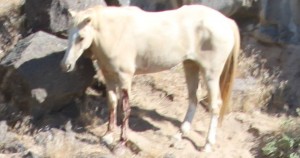
A disturbing photo of a dead Palomino Wild Horse surfaced on the Internet and in news reports last week. The picture, taken by Western Watershed Project Biodiversity Director Katie Fite shows the horse laying in rocks below a cliff. Wild horse activists say the photo demonstrates the cruelty of a government program wasting millions of dollars that is out of control. Many of them believe that a Cattoor helicopter drove the horse over a cliff.
That is not true.
But a firestorm of outrage has swept across the desert sands of Nevada and the nation at what many believe is a government agency that has turned rogue. U.S. Senator Mary Landrieu, (D) La has proposed that her colleagues consider removing the Wild Horse and Burro Program from federal Bureau of Land Management control.
And fifty-four members of Congress have petitioned Interior Secretary Ken Salazar to end the capture of wild horses on land controlled by the BLM. They have asked the National Academy of Science to investigate the agency’s Wild Horse and Burro Program. More than 150 horses and foals died in the wake of a mid-winter roundup in Nevada’s Calico Mountains. The congressmen say that 21 horses have died at BLM’s hand thus far during and after the Tuscarora stampedes.
Reno federal Judge Larry Hicks imposed a temporary injunction that had stopped the agency from capturing horses after one day in which 12 horses died after being run eight miles in more than 100 degree July Nevada desert heat. He lifted the temporary restraining order after being told by government lawyers an emergency existed because horses needed to be captured since they faced the prospect of dying of thirst because there was no water in the desert.
In fact, the BLM trucked water into the area rather than driving them, as they are clearly capable of doing, to a freely flowing river with abundant water. But she says the bulk of the horses involved in the roundup were in three pastures away from the river.
Cattoor acknowledged that the Owyhee River has running water, and during the roundup an Idaho group was camping on its banks – and even fishing.
“They were just a little ways up from where the horses trail down to the river. It‘s almost like a miniature Grand Canyon. This particular spot of where the trail goes down in the canyon is where the horses go to water,” Cattoor said.
Cattoor also said that there are other trails leading to the river that would have been available to the horses, but “the horses aren’t using those trails. They are only using this one. A lot of those horses didn’t know that trail was there because a lot of the horses we captured in this HMA were young horses.”
Typically, foals follow their mothers to water, so in all likelihood, the young horses whose habitat is near the river had been exposed to the abundant water in the waterway and the riparian area on either side, despite Cattoors comments to the contrary.
But some horses came to the river fir the first time, she acknowledges. How did these lost horses get there? Were they driven there by a Cattoor helicopter, activist are certain to ask.
“After they were down in there, they did not know how to come out,” Cattoor said.
A wide trail leads down a gently sloping river bank to the river shown in a photograph on the Cattoor website http://www.wildhorseroundups.com . Sue Cattoor says the photo is deceptive and the trail is very steep.
Cattoor says that there has been ample water in recent years to sustain horses in the area.
“I find it odd that with all the months of planning by the BLM that occurs before a round-up there was no mention of lack of water for the horses in any of their documentation and then after the lawsuit was filed, it suddenly became an emergency,” said Vicki Tobin, co-founder of the Chicago based Equine Welfare Alliance.
“The BLM has authority to round-up horses in an emergency situation so if the horses were in such dire straits, they should have dealt with the situation long before the lawsuit was filed.”
Like many in the West steeped in a ranching tradition, Sue Cattoor believes the wild horse are livestock, not wild animals. That tradition views livestock as a commodity, nothing more. Something to be bought and sold. Ranchers have a very pronounced vision of how animals should be viewed, and Cattoor is no different.
“If they are wildlife, then why don’t they issue a license for them to be hunted?” she asks.
Cattoor said campers along the river mentioned that the wild horses were in the area when they first got there, however, there were no campers around during recent visits by others to confirm what the federal contractor says.
Visitors say they found evidence that there were traps set up along the river bottom. Cattoors counters that what they believe were the remnants of BLM pens were actually the abandoned campsites of the Idaho campers who had traveled to fish the river.
There are no witnesses to refute the allegation that horses could have been driven by a roaring helicopter into the area whose rugged features include jagged rocks and towering river banks. The horses also could have injured themselves on the sharp outcrops trying to escape something they feared and had never seen before.
“They climbed up on that ledge looking for a way out and didn‘t know how to get back out of it,” Cattoor said.
In a lengthy note on the company website Sue Cattoor explains her firm’s position in minute detail. The note is also accompanied by a photo of a broad well traveled trail leading to a flowing river filled with plenty of water. Another photo of the river shows steep cliffs. Cattoor denied Horseback Magazine permission to use the photos.
Sue Cattoor acknowledges the horses were injured trying to negotiate the rough terrain.
“They were moving around in those rocks, trying to go up and down to survive and would have gotten the injury in the rocks. Those horses were trying to find a way down”
She said the pocket of possible stragglers from the helicopter chase were discovered after the helicopter pilot and her husband flew over to speak with the campers they had seen along the river.
“When they flew over to talk to these campers, they discovered these horses on the opposite side of the river from where the trail was. They herded those horses that were up there back down to the river because those horses had ledged up there and they did not know how to get back down.”
But after the herd was driven down river, the two severely injured horses remained, Cattoor said. One was the Palomino horse later photographed dead by Fite.
Wild Horse on ledge before shot by David Cattoor from Chopper
The photo of the still living but injured Palomino horse was taken from the Cattoor helicopter and the wound appears to be to the bone. The photo was supplied to Horseback Magazine by Sue Cattoor.
Cattoor says the horse had vision problems and was old.
“There were two horses. One, the horses that she (Fite) took the picture of, and a foal that was caught in the crevasse of the rocks with broken legs that they had to go back and euthanize,” Cattoor said.
Former Horseback Magazine veterinary columnist Dr. Angela Chenault viewed the blown up photo and said the injury was possibly survivable, but “its not likely to have a good outcome on a feral horse. Aftercare is critical and even stalling this horse will be a problem mentally.”
The horse found by Fite was not driven over the cliff to its death by Dave Cattoor, it was shot by him from the helicopter with a high powered rifle.
Injury was NOT fresh but Cattoor still shot and killed Wild Horse from Chopper
“It happens on occasion because when we are out gathering horses, if we see something that has a pre-existing injury or if something is extremely old and needs to be put down, they will euthanize it in the field,” Cattoor said.
Dr. Chenault said the injury was not fresh.
“It’s difficult to say how old by the picture but I would say it is over 24 hours by the way the muscles look,” she said.
Activists will likely continue to believe the worst of the Cattoors and their company. And Sue Cattoor will continue to attempt to spin the image of a company that is compassionately capturing horses, even if some die in the process.
The helicopter contractor said that despite the judge’s ruling that observers be allowed to view the roundups, her company will not allow observers on horseback despite a long standing Horseback Magazine request to the BLM to do so.
“If they are on horseback they are going to interfere with the operation,” she said. “We never allow our wranglers to be on horseback when the helicopter is driving horses to the trap. We can’t have somebody there that might turn the horses back and cause problems.”
Cattoor said she would have no objection to observers who hiked in to the roundup area if they were accompanied by a BLM public relations person. In past “gathers” armed guards have prevented observers and the press from freely walking into the roundup area.
Despite encouragement from Cattoor for Horseback to observe a roundup, BLM has barred press and public in the trap area because recent ones have been located on private property. The agency claims landowners object to media and other observers on their land. However, when the BLM leases property for a site, it falls under federal control much like a post office building does when it is leased by the federal General Services Administration for public use. The landowner relinquishes control of his property to the control of the federal government.
Cattoor Livestock Roundups will not allow the media to fly as passengers in their helicopter citing prohibitions from their insurance company.
“I have no problem with the press coming out and watching if they want to, as long as they are absolutely not interfering with the gather and causing stress for the horses,” she said.
Cattoor also was critical during the interview of media reports of the numbers of horses which died “because of helicopter gathers.”
On the Calico roundup seven horses died in the field out of a total of more than 150 horses and unborn foals who met their deaths in captivity, including two foals who shed their hooves after being stampeded over rocky terrain in the dead of winter by a roaring helicopter.
“In this roundup we didn’t lose any on the actual HMA (herd management area). Others died for lack of water or too much water, or were destroyed for humane reasons,” Cattoor said.
“They are trying to stop roundups saying the helicopter gathers are cruel and inhumane and that’s not a fact,” she said. “The losses from Calico was because those horses were in very bad shape when they were captured because there wasn’t enough food out there.”
Photographs of the captured Calico horses by naturalist Craig Downer and wild horse litigant Laura Leigh show fat healthy horses even in the BLM hospital area.
And 54 members of Congress clearly want to knock Sue Cattoor and her company out of a job, temporarily at least.
And litigation continues in the courts to stop what the BLM benignly calls “gathers.”
_______________________________
_______________________________
Take THAT Debbie Collins -wildhorse@blm.gov ~ R.T.
Press Release from The Animal Welfare Institute Washington, D.C. - The Animal Welfare Institute (AWI), along with leading Members of Congress, numerous wild horse advocacy organizations and the majority of Americans, is exceedingly frustrated with the Bureau of Land Management’s (BLM) gross mismanagement of America’s wild horses and burros. In a recent ad in the Washington, D.C., newspaper, The Hill, AWI called on Congress to take swift and decisive action to prevent the BLM from “managing” our nation’s wild horses into extinction.
“AWI has long been critical of the BLM’s inability to responsibly manage wild horses on the range, and the agency’s recent actions have amplified concern for the future of America’s wild horses,” said Chris Heyde, deputy director of government and legal affairs for AWI. “BLM’s more aggressive campaign of rounding up and warehousing wild horses began under the Obama administration and Secretary of the Interior Ken Salazar. Recent reports of horses dying during roundups due to broken necks and legs, sloughed hooves, and most recently water intoxication (allowing the horses to drink a toxic amount of water following a strenuous run), are unconscionable.”
Thankfully, several members of Congress are stepping up to defend these national treasures. House Natural Resources Committee Chairman Nick Rahall (D-WV) and Subcommittee on National Parks, Forests and Public Lands Chairman Raul Grijalva (D-AZ) have led the way in holding the BLM accountable for its actions. They sponsored the Restore our American Mustangs Act (ROAM Act), which passed the House of Representatives by an overwhelming margin last year and have just sent a bipartisan letter signed by 52 of their colleagues to Secretary Salazar. The letter raises serious questions about the recent tragic deaths of several wild horses and addresses the dire need for an independent analysis of the wild horse and burro program by the National Academy of Sciences. As stated in the bipartisan letter, “We are concerned by the inability of your agency to acknowledge these disturbing outcomes, change what seems to be deeply flawed policy, and better manage the gathers so as to prevent the unnecessary suffering and death of these federally protected animals.” AWI shares these concerns.
Yet despite all of this public and Congressional attention, the BLM continues to recklessly round up and remove thousands of wild horses from their legally mandated rangeland. In fact, Secretary Salazar has proposed spending millions of taxpayer dollars to build additional long term holding facilities in the Midwest and East to facilitate even more wild horse removals, which will add to the staggering 38,000 animals already in confinement.
Ever defiant, just last week, BLM Director Bob Abby sent a letter to all Members of Congress decrying increased public scrutiny of the wild horse and burro program. In this letter Director Abby wrote, “Some wild horse activists are waging a campaign in the court of public opinion, aimed at stopping the Bureau of Land Management (BLM) from gathering wild horses and burros from overpopulated herds on Western public rangelands.”
“The Obama administration came into office promising greater transparency and accountability, which is entirely contrary to the BLM’s preference to keep its abuse of wild horses and burros behind closed doors,” contends D.J. Schubert, AWI’s wildlife biologist. “If the BLM is convinced that its wild horse management program is essential for the good of the horses and the land, it should provide the public with reasonable opportunities to observe its roundups – the good, bad, and ugly – instead of complaining when advocates expose the program’s inherent cruelties and deficiencies,” adds Schubert.
AWI asserts that, like its sister Department of Interior agency, the former Minerals Management Service (MMS), the integrity of the BLM’s wild horse and burro program has been compromised by its relationships with special interests that occupy or use wild horse and burro range. A few thousand wild horses are being blamed for every natural and unnatural problem facing the Western ranges, while ranchers, oil and gas companies, and other commercial entities abuse the public’s lands with inadequate oversight. The BLM’s obvious favoritism toward these more politically connected and financially lucrative industries continues to jeopardize the survival of America’s last wild horses and burros.
“Based upon its record, it is no wonder the BLM balks whenever the demand for genuine accountability is discussed,” states Heyde. “While the BLM has repeatedly ignored the public’s demands, we hope that the requests of Members of Congress will not be so easily dismissed.”
Dear Friends of the wild horses of the WEST;
Deadline is Tuesday to comment on Sec. Salazar’s proposal to move wild horses to the East and MidWest you can email this address and comment:
Email address/instructions:
1) send to wildhorse@blm.gov with “WHB Public Comments” in the subject line
2) categorize written comments according to the section of the document they are commenting on.
Here’s a link to the document: https://www.blm.gov/epl-front-office/projects/lup/4900/13613/13852/default.jsp?projectName=Wild+Horse+and+Burro+Strategy+Development+Document
Here are the comment categories:
a) Sustainable Herds
b) Preserves
c) Treasured Herds
d) Place Excess Animals into Private Care
e) Communications
f) Animal Welfare
g) Science and Research
We’ll be posting this information on our site as soon as possible, but thought I’d let you know (in case you haven’t heard yet).
Thanks,
Ginger
Ginger Kathrens
Volunteer Executive Director
ginger@thecloudfoundation.org
www.thecloudfoundation.org
_____________________________
For Immediate Release
Nevada Judge Refuses to Hear Contempt Charges Against BLM
Advocates want transparency, full public access and their First Amendment rights upheld
Reno NV (July 29, 2010)—Tuesday Judge Hicks refused to hear Laura Leigh’s motion for contempt against the BLM who denied her access to view the Owyhee/Tuscarora roundup that ended July 20th. Earlier, on July 16, 2010, the court ruled to honor Leigh’s First Amendment rights, emphasizing her right to view the roundup in Elko Country, northeastern Nevada.
“If the court refuses to listen to new arguments, then Secretary Salazar’s rogue agency—the BLM—is literally accountable to no one,” states Leigh, Director of Herd Watch, a Cloud Foundation program.
When Leigh sought access to the roundup the day after the ruling (July 17th), BLM officials told her she did not have permission to enter private land where they had placed the capture corrals, citing the landowner had written a letter refusing to allow the public onto his property. What Leigh saw was a letter allowing other public citizens (veterinarians) into the trap site. When she asked to be allowed to follow the same process as these other members of the public, she was told, because of the lawsuit she brought to the courtroom, she would most likely be denied. Further testimony revealed that the private landowner did indeed allow Leigh to witness the gather on the 19th, however BLM failed to allow access for Leigh and simply concluded their operations on the 20th.
“We want to have full access to see America’s wild horse roundups. This is the public’s right. We want to know how our American icons are treated especially during roundups in the hottest time of year when foals are still tiny,” explains Leigh. “The BLM is playing games and denying us access. At this point our only option is to go to court to hold the BLM accountable for the public’s wild horses.”
While attempting to observe the Owyhee roundup Leigh was followed by an Elko County Sheriff. She was on a county road miles from any town or even any ranch. The Sheriff indicated he could not tell her if she was on a county or a private road. But, if the road was private, he could arrest her. He indicated he could not radio the BLM for information, for lack of a radio, even though he had mentioned just speaking with the BLM. He could not call them, because there was no cell service, but would not agree to drive to a place where he might have cell service.
“Basically each time I asked for assistance in dealing with the BLM or the Sheriff’ the ‘I can’t help you,’ roadblocks went up and more hurdles were presented to jump over,” says Leigh. “Why did they go through so much trouble to keep me from observing the roundup?”
“The Nevada judge may have refused to hear the contempt charges brought against the BLM in a court of law, but the BLM’s actions are contemptuous and the public knows it,” states Ginger Kathrens, Executive Director of The Cloud Foundation. “Why does the BLM continue to drive our wild horses into private slivers of land in a sea of public land to round them up? Is it to hide from any scrutiny by the press or public observers?”
The BLM has already completed the Little Humboldt roundup. The Rock Creek roundup will be complete by weeks end. The entire Tuscarora roundup will have no more public observation scheduled than they had prior to the original Order of the Court recognizing Leigh’s First Amendment rights.
Kathrens points out that “Leigh was allowed to view fewer than 100 of the 1,200 wild American mustangs rounded up. The BLM’s blatant dismissal of First Amendment rights is alarming.”
The Tuscarora death toll is 22 horses and growing. Several foals less than three months of age have been killed in this roundup. Advocates for the horses warned that summer roundups would be extremely dangerous for small foals in the desert heat. The BLM contends that this is an appropriate time of year.
Statements made about the alleged emergency in the first of the three Tuscarora roundups (defined as an emergency only after the original lawsuit was filed) were expanded on in the defendants written affidavits. Photographs and affidavits from the plaintiff documented that the “emergency” was contained to only a small portion of the Owyhee area. The BLM launched misleading statements during the first ruling. The Court’s original ruling to allow the Owyhee gather to continue was based on a lack of information given to the Court. Expanded documentation was never allowed due to the current denial in the Reno district Federal Court.
“BLM needs to be accountable for their negligence”, states Leigh. “Creating apparent emergencies in order to clear away American mustangs is un-American. These animals deserve to roam freely on their land. They are a symbol of the American spirit.”
# # #
Case filings regarding the Tuscarora round ups can be read at
The Cloud Foundation is a non-profit dedicated to the preservation and protection of wild horses and burros on our Western public lands with a focus on protecting Cloud's herd in the Pryor Mountains of Montana.
107 S. 7th St. - Colorado Springs, CO 80905 - 719-633-3842
With the deadly Tuscarora roundup underway, and BLM plans to capture and remove 6,000 wild horses and burros between now and October, America’s iconic mustangs need your help now more than ever. Please take these two quick actions today. 1. CALL YOUR CONGRESSPERSON: Ask him/her to sign on to a letter calling for a halt to the roundups. Take Action by Friday.
Wild horse and burro champions Rep. Raul Grijalva (D-AZ) and Rep. Nick Rahall (D-WV) are currently circulating a letter that will be sent to Secretary Salazar with a cc to Bureau of Land Management (BLM) Director Bob Abbey. The letter expresses concern about the BLM’s deadly Tuscarora, Nevada roundup, which has cost the lives of 25 wild horses to date, and asks the BLM to halt the capture and removal of wild horses while the entire program is reviewed.
Please take time today to ask your Congressperson to sign on to this letter and show their support for protecting wild horses and burros on our public lands. Simply call your and say, “Hello, I’m _____ from _____ and I am a constituent of Representative _____. I’m calling to request that he/she contact Representatives Grijalva and Rahall to sign on to their letter to Interior Secretary Ken Salazar expressing concern about wild horse roundups.”
Find your Congress person’s contact information here. View text of sign on letter here. 2. LET YOUR VOICE BE HEARD. Submit comments on BLM Strategy Development Document by Monday, August 3, 2010.
The BLM is soliciting public comments on its draft strategy document for reform of its cruel and costly wild horse and burro program. You can submit comments only in one of two ways:
** Print out the sample letter and mail it to:
Wild Horse & Burro Strategy Document
BLM Washington Office
1849 C Street NW, Rm. 5665
Washington DC 20240
OR:
** Submit online: The BLM is only accepting online comments via a form on its website. It will take a few steps to submit your comments, but it is essential that your voice be heard. Follow these steps:
1. Personalize and copy the sample letter.
2. Go to the planning document.
3. Click on this text (in blue) near the top center of the page: “Click Here to Submit Comments.”
4. A new page will open.
o Paste your personalized letter into the text box (you can ignore the Selected Content and Comment Title sections).
o When you’re finished, click “Add Comment”
4. The page will appear again.
o The text box will be blank, but the “Comments” section at the bottom will show the number “1″ under “Comment id.”
o Click the “Next” button on the bottom right.
5. Fill in your personal information and click “Next.”6. Review your submission, and click “Submit” at the bottom right. A “Submission Successful” page will appear.
We know the public strongly supports the protection and preservation of America’s wild horses and burros in their rightful place on the Western range. Thank you for sticking with the difficult process that BLM has created to allow citizens to have a voice for our wild horses and burros. Remember to take action by August 3.
On behalf of the horses, thank you for your support,
The AWHPC Team
by Wayne Pacelle ~ President of the Humane Society (HSUS)
Yesterday I asked you to contact Agriculture Secretary Tom Vilsack in response to the reported plans to kill more than 150,000 geese in New York state (please do call 202-720-3631 if you haven’t done so already). Today, I need your action on another urgent concern—urging the Bureau of Land Management to stop the cruel and senseless roundups of wild horses and instead to develop humane, sustainable programs for managing the herds, such as fertility control through immunocontraception.
Over the past 10 years, the BLM has removed some 74,000 wild horses and burros from the range, and it intends to remove a total of 12,000 horses this year. The current program is costly, illogical, and has also had tragic consequences—you may have heard about the rising death toll associated with the BLM’s current Tuscarora wild horse gather in Elko County, Nev., where at least a dozen mustangs have died from dehydration, water intoxication and related complications.
The federal government has submitted a new policy proposal for wild horse management and is now accepting public comments. Please take a few minutes to make your voice heard—the deadline for comments is next Tuesday, Aug. 3, and we’ve provided instructions and guidance on our website.
I’ve asked Stephanie Boyles, a wildlife scientist with The HSUS, to elaborate on why the BLM must seriously reconsider its current policies and procedures given the program’s track record and the recent tragedy in Elko County.
So far this year, 18 wild horses rounded up by the BLM in Nevada have died. The BLM claims on its website that 16 of these horses died due to preexisting dehydration-related complications, congenital deformities or physical injuries, and that only two died as a result of “gather-related operations” (one horse was euthanized after sustaining a leg fracture in a temporary holding corral and another died from a neck injury).
Based on several factors, however, we can’t help but question the BLM’s assertion that all but two deaths were unavoidable, and that the agency was blameless and practiced due diligence prior to the gather.
First, the BLM has failed to answer the most basic, pertinent question posted in a Questions and Answers section on its informational site: “Why is the BLM using a helicopter to chase and capture wild horses in the summer’s extreme heat?”
Instead of answering the question, the agency simply describes the procedures used to conduct gathers during summer months—with no explanation for why they’re held in the hottest month of the year as opposed to the fall or winter, when the mares are not foaling and the new foals of the year are older and stronger.
For years, The HSUS has urged the BLM to use passive gather techniques, such as nutrient baits and/or water trapping (placing nutrients or water in an area where they are scarce to gradually lure horses, then building a large corral around the animals), to alleviate, to the greatest extent possible, the suffering, stress and trauma inherently associated with roundups.
In its Environmental Assessment for the Elko County gather, the BLM acknowledges that “water trapping can be very effective when water resources are scarce…”, but dismissed water trapping from detailed study for this gather because it claimed, among other factors, that the area has an abundance of public and private water sources.
Of course, we know now that at the time of the gather, water sources on the range were, in fact, scarce. So not only was water trapping a feasible option, it would have been preferable and should have been used once the BLM realized the targeted horses were suffering from dehydration due to inadequate water. The agency also knew that animals already suffering from dehydration are susceptible to toxic hydration if they drink too much water too quickly once it is made available.
Having contingency plans in place in the event of a crisis of this nature is one of the many critical changes that must be made to the BLM’s broken wild horse and burro management program. Instead of constantly defending its policies and procedures when things go wrong (and they clearly did in Tuscarora), the BLM needs to conduct a fair and objective evaluation of its procedures and make changes that will alleviate unnecessary suffering and save lives in the future.
You can help the BLM better serve the treasure it has been mandated to protect—our wild horses—by submitting comments on the agency’s recently released proposal.
HOUSTON, (SFTHH) – The Bureau of Land Management (BLM) tasked with protecting our public lands and wildlife has been doing exactly the opposite; they have been killing wild horses, deer and other species by selling off public water rights to private interests and allowing fences to be erected for private purposes so that the natural wildlife dies of thirst.
As reported by Steven Long, editor of Horseback Magazine in his most recent article, “Water on BLM Land Privately Owned Since 1916”, wild horse advocate Laura Leigh witnessed the Desert Ranch Reservoir located in the middle of a wild horse herd management area was fenced off. Earlier in the week the BLM killed in excess of 20 wild horses during an ill conceived, mid-summer helicopter stampede in the Owyhee area. Laura Leigh managed to obtain a TRO from a Federal Judge to delay the roundup in accordance with the rules of the BLM’s own handbook and to wait until the weather had cooled. Federal BLM attorneys argued that it was an emergency that all of the horses were in danger of dying of thirst so the roundup must take place; the judge lifted his order but issued a statement that Leigh would be allowed to witness the BLM and their stampede contractor’s operations. Both the contractor and BLM violated the judge’s order by moving the trap and staging area to a small private location within tens of thousands of public acres so that Leigh was not allowed access.
Tom Gorey, BLM Washington spokesperson, reported to Steven Long, regarding the fenced off water,
“Desert Ranch Reservoir, and I can categorically state that the Bureau of Land Management has never owned the water rights to that reservoir, nor has any entity of the United States government. I used the water rights ownership database of the Nevada state government’s Division of Water Resources, which shows that the water right was filed in September 1905 and was certificated in December 1916. It was originally owned by John G. Taylor and has been passed from different “grantors” to different “grantees” down to the present day.”
This week, Investigative Reporter for Las Vegas’ Channel 8, George Knapp reported.
“While we’ve been working on our latest stories, my photographer Matt Adams discovered an interesting feature on Google Earth. There’s an “I” for information feature and if you use it, it will allow you to identify some valuable info including: a) all water sources in the Tuscarora HMA’s b) all the cattle allotments c) the division of public and private land. I don’t know if the same breakdown is available for all HMA’s but it is for these three. I think it will make you sick when you study it. All of the water sources, or nearly all of them, have been made private. A rancher might have a tiny sliver of private land, surrounded by vast public acreage, but the small piece owned by the rancher is invariably the one with the water. Nice job by the BLM protecting the public’s interests.”
The BLM continually twists and bends the facts in an effort to convince the general public that they are acting in the best interests of the wild horses but as the facts mount up and the law suits gain in numbers it is obvious to the general populace that the BLM does not act in favor of anyone or anything other than the BLM and their private interest cronies.
Cleverly tucked away on private land the BLM conducts secret operations that kill our Wild Mustangs
The "good ole days" of "MANAGING" wild horses to extinction
The death toll rises, as per the BLM’s own stats: Total for the Calico Massacre = 158 Total for the Tuscarora Farce = 22
Again, “that we know of” as the BLM shamelessly hides in the shadows and conducts its shady business from behind closed private gates away from the watchful eyes of the U.S. public and press. “When you know you are wrong you hide. When you are afraid of being caught you rush. When you get stuck in a lie you stomp your foot, point your finger and cuss.”
So reads the current mission statement of Bob Abbey, Ken Salazar and President Obama’s BLM.
No accountability; the only deliverables required are to the special interest groups that are, obviously, greasing the palms of individuals very high up the food chain. Corruption runs freely and always has within the Department of Interior and its Bureau of Land Management.
BLM's current preferred weapon for destroying wild horses - the Helicopter
The new President promised change and we got it; we changed from being in a bad situation into something severely worse. We went from a corrupt federal bureaucracy to a form of government that in the recent past we have sent young men and women out to fight and die against. Thanks to the new administration we have now become our own worst enemy and still all we get is a deaf ear.
There is far worse going on in our country than the BLM’s massacre of our national icon, the wild horses (not to the horses of course). But the horses put it into perspective, they provide the focus and offer a micro version of all that is wrong within our government and they are doing this at the expense of their lives.
The leadership and management staff of the BLM have become the enemies of the union, the violators of the law and the agents of chaos to the American public. They operate outside legal parameters and flaunt their crimes while lawsuits continue to mount in an effort to stop their illegal crusade.
It’s a sad day when the citizens of the United States are required to use their hard earned dollars through the court system in an effort to stop a rogue government agency which is funded through taxation of the very same group of people.
It’s time for Congress to get off its dead ass and call these crooks to task.
It’s time for the new President to listen to the people, for a change, and call for a moratorium on these roundups.
It is time for the American public to make a serious paradigm shift under a new rallying call…”Vote the Bums Out!”
If they won’t listen, they’ve got to blinking go…every last one of them!
“For the Horses!”
Call Secretary Salazar, your Representative and Senators and demand that they stop the tax-payer funded disaster in Tuscarora before more mustangs are killed.
Phone: 202-208-3100
The Cloud Foundation Expands Lawsuit to Protect “Cloud's” Wild Horse Herd
Foundation includes Forest Service in lawsuit
Washington, D.C. (July 23, 2010)—On July 21 the Cloud Foundation, Front Range Equine Rescue and author/advocate Carol Walker filed an amended complaint in Federal District Court to add the U.S. Forest Service (USFS) to their current suit against the Bureau of Land Management (BLM). The suit challenges both agencies’ rejection of a Natural Management Approach for the herd and the planned construction of a two-mile long fence which would cut off the Pryor Mountain Wild Horse Herd from crucial summer and fall grazing lands they’ve used for centuries. This small herd is the world’s most famous and the last remaining in Montana, sometimes called “Cloud’s herd” for the now-15-year old band stallion who TCF Director and plaintiff Ginger Kathrens has documented for the popular PBS Nature series. The herd traces its history back to the horses of the Spanish Conquistadors, the Lewis and Clark expedition horses, and Crow Indian War ponies. Plaintiffs contend that the USFS and BLM are engaging in illegal treatment of these federally-protected mustangs and that the Pryor Wild Horses are entitled to use lands in the Custer National Forest, currently not included in the designated range.
Plaintiffs in the litigation include Front Range Equine Rescue based in Larkspur, CO; Carol Walker, equine photographer and author of “Wild Hoofbeats: America’s Vanishing Wild Horses”; and Ginger Kathrens, Director of the Cloud Foundation and Emmy-Award winning producer with 16 years experience documenting and observing the Pryor Mountain herd.
“People value the whole spectacular Pryor ecosystem including this unique Spanish wild horse herd. Seeing the area fragmented by new fencing across pristine, wide-open meadows degrades the experience of visiting this area with true wilderness values,” states Kathrens. “Beyond the visual and environmental damage, it will compromise the future of Cloud’s globally-beloved herd. Forest Service should be working to set this area aside as a designated wilderness rather than working on how to build a bigger, stronger barrier to keep the Pryor horses from their rightful and essential high mountain meadows.”
Building the fence, cattle guard and gates would illegally confine horses to jurisdictional boundaries, restricting their natural and long-held seasonal pattern of use on East Pryor Mountain. Centuries old horse trails go straight through the line now flagged for construction of the fence, estimated to cost taxpayers between $25,000 and $100,000, not including USFS planning costs which, according to USFS, greatly exceed the cost of building the fence.
“The Forest Service has fought efforts to expand the Pryor Mountain Wild Horse Range to allow the herd to engage in their historical and seasonal migrations. Confining wild horse herds to smaller and smaller areas of the public lands lays the groundwork for more intrusive management and manipulation as the Forest Service and BLM contend that these animals will need to be removed from the wild for their own good,” states lead attorney, Valerie Stanley.
For a four-year period in the early 2000s the Pryor Herd was at zero population growth due to mountain lion predation on the foals, as well as the ever-present harsh winter weather and deadly lightning storms. The population of the herd increased only after BLM encouraged the killing of mountain lions. “The public has overwhelmingly supported allowing the herd the opportunity to manage itself. Apparently, BLM and the Forest Service think Mother Nature can’t get along without them,” Stanley concludes.
Over 100 wild horses have been using the Custer National Forest this month, which constitutes the majority of the Pryor Mountain wild horses, of which less than 150 adults remain in the wild following a massive roundup in September 2009. The Custer National Forest has not explained how the wild horses would be driven them back into the designated horse range. At least two new foals were born last week on the mountaintop and more births are anticipated. Running these young mustangs is dangerous and inhumane and can be fatal as has been proven during recent BLM roundups in Nevada and Oregon.
The area immediately adjacent to the designated range is not currently allocated for livestock grazing, but the Cloud Foundation questions USFS motives in blocking horses from this public land. Actions by the USFS are based, not on damage by the horses to the ecosystem, but seemingly on complaints from livestock permittees. Plaintiffs wonder if USFS is arranging for the building of this fence to facilitate cattle grazing on what would be a new livestock allotment on scenic subalpine meadows used annually by wild horses, mule deer, black bears and an array of small animals in the summer and fall.
“Wild horses have used these Forest Service lands for centuries. BLM and Forest Service have so far failed to work together to expand the range, using natural boundaries which encompass the mustangs’ use area, for the good of the herd and the public that loves them,” explains Front Range Equine Rescue President/Founder, Hilary Wood.
Historically, BLM directed livestock permittees on public grazing land to round up wild horses by aircraft. Once captured, the wild horses were either killed and butchered on the range or were shipped live to meat packing plants. In 1968, a public outcry was launched, spurred by local residents and ABC reporter, author and TCF Honorary Board Member, Hope Ryden. Ryden’s discovery of plans to trap and remove the Pryor Horses despite BLM assertions to the contrary caused a national outcry. In response, then Secretary of the Interior Stuart Udall issued an Executive Order creating the first public range ever dedicated in the United States for the protection of wild horses. The 39,000-acre range was intended to protect the horses, other wildlife, and the natural state of the area. At the time, none of the Custer National Forest Service lands were included, as that was outside of Interior Secretary Udall’s jurisdiction.
“Treating the wild horses as if they are livestock by fencing them into one small section of their traditional use area will not just harm the mustangs, but also the public who can more easily access the Forest Service lands to experience a wildlife display unlike any in North America,” states plaintiff Carol Walker. “I don’t understand why the Forest Service would want to deprive the public from experiencing this kind of natural wild horse wilderness.”
“Wild horses need to be treated like wild horses—not livestock. Right now the public can easily access the Forest Service lands and experience a wildlife display unlike any other,” states plaintiff Carol Walker. “We want the Forest Service to immediately abandon plans to build the fence.”
The Cloud Foundation is a 501(c)3 non-profit dedicated to the preservation and protection of wild horses and burros on our Western public lands with a focus on protecting Cloud's herd in the Pryor Mountains of Montana.
IN THE HANDS OF KILL BUYERS! When horses are purchased at auction by buyers intending to kill them, they're hauled away in double- decker tractor trailers where they are beaten and often blinded with baseball bats to mollify them. After crossing the border into Mexico, the animals are stabbed on each side-an act to tenderize their meat-and immobilized. Workers, then saw the horses legs off, at the knee and hang them to bleed out-all while the horses are ALIVE! (This is an excerpt, from an article written by Missy Diaz, crediting Victoria Mc Cullough and Sen. Joe Abruzzo for bringing awareness of horse slaughter, to Florida. In 2010 Florida Legislation unanimously passed the Horse Protection Bill, making it a felony to slaughter horses for personal or commercial use.)
 New York City, NY (October 7, 2010)— A case filed today against Secretary of Interior Ken Salazar in federal court aims to stop the elimination of wild horses from Colorado’s North Piceance herd area. Plaintiffs Habitat for Horses (HfH), the American Society for the Prevention of Cruelty to Animals (ASPCA), The Cloud Foundation (TCF), Toni Moore and Dr. Don Moore challenge the BLM’s ongoing illegal treatment of wild horses residing on public lands and it’s intention to completely remove all wild horses from this area beginning October 11, 2010.